
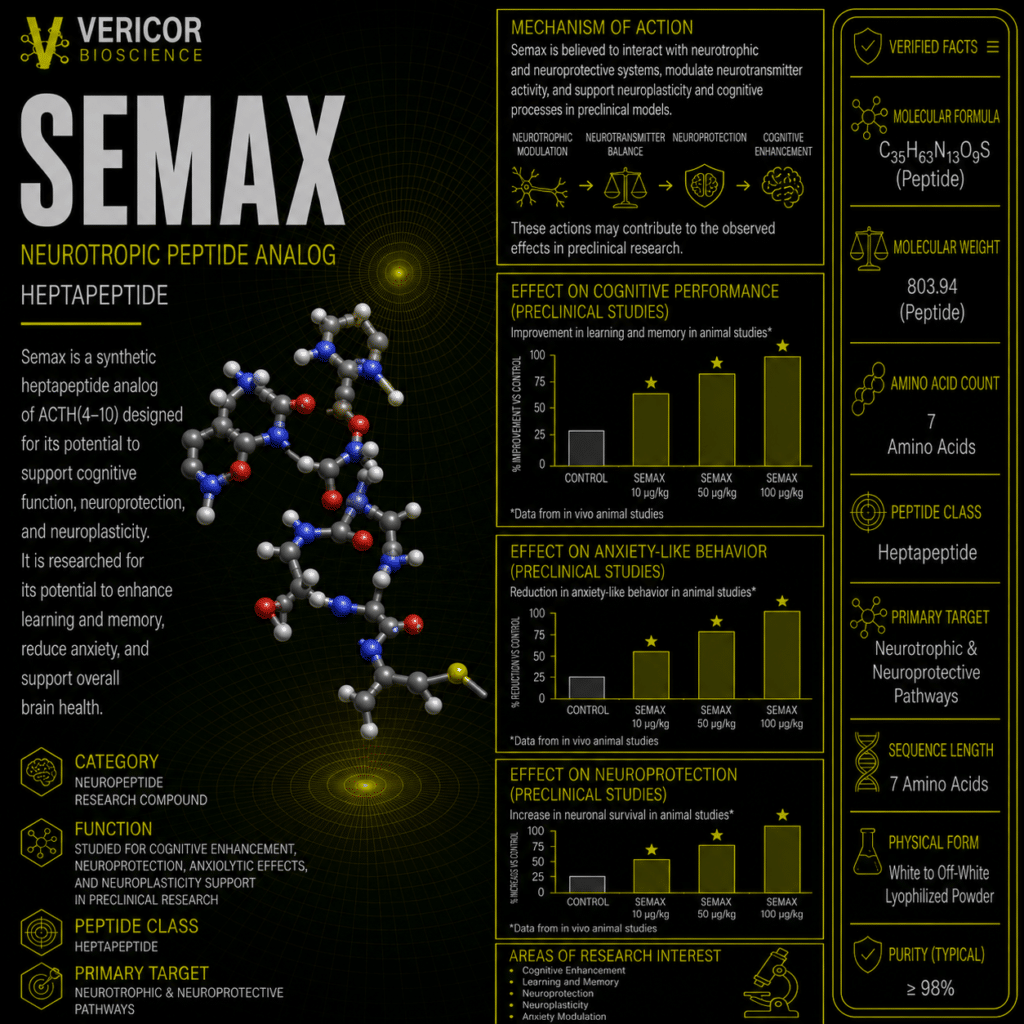
Semax is an experimental peptide that has attracted growing interest in the United States for its proposed effects on cognition, attention, memory, neurological recovery, and resistance to stress. However, many online descriptions present early laboratory findings as established human benefits. The available evidence does not support that level of certainty.
From an evidence-review perspective, Semax should be treated as an investigational research compound rather than a proven nootropic or neurological treatment. Published research includes animal experiments, molecular studies, small human investigations, and clinical work conducted mainly outside the United States. Moreover, Semax is not a component of an FDA-approved drug, and the FDA has identified significant gaps in its characterization, effectiveness data, safety evidence, and proposed compounded formulations.
This guide explains what Semax is, how scientists believe it may work, what research has actually shown, what remains uncertain, and how U.S. researchers can evaluate Semax without repeating exaggerated marketing claims.
Featured Definition: What Is Semax?
Semax is a synthetic seven-amino-acid peptide derived from a fragment of adrenocorticotropic hormone, or ACTH. Researchers have studied its possible effects on brain signaling, neurological stress, cognition, inflammation, and ischemic injury. However, its clinical effectiveness, standardized dosage, long-term safety, and therapeutic value remain unproven in the United States.
Table of Contents
- What Semax Is
- How Semax Was Developed
- How Semax May Work
- Semax and Cognitive Research
- Semax and Stroke Research
- Semax, BDNF, and Brain Signaling
- Human Evidence and Its Limitations
- Semax Versus Approved Neurological Treatments
- Semax Safety and Unknown Risks
- Intranasal Semax Research
- Semax Regulatory Status in the United States
- Research Quality and Product Evaluation
- People Also Ask About Semax
- Expert Semax Q&A
- Conclusion
What Is Semax?
Semax is a synthetic heptapeptide, which means it contains seven amino acids. Its reported sequence is:
Methionine–glutamic acid–histidine–phenylalanine–proline–glycine–proline
The sequence is often shortened to Met-Glu-His-Phe-Pro-Gly-Pro.
The first four amino acids correspond to part of adrenocorticotropic hormone, commonly called ACTH. The final proline-glycine-proline sequence was added to create a more stable peptide with different biological properties.
ACTH is best known as a pituitary hormone that stimulates the adrenal glands to produce cortisol. However, Semax is based only on a short ACTH fragment. It is not the same as full-length ACTH, and it should not automatically be assumed to produce the same hormonal effects.
According to the FDA’s 2026 scientific review, Semax free base has a molecular formula of C37H51N9O10S and a molecular weight of approximately 813.93 grams per mole. The FDA evaluated both Semax free base and Semax acetate because these are chemically distinct bulk drug substances and should not be treated as interchangeable ingredients.
That distinction matters because different chemical forms may have different:
- Stability
- Solubility
- Manufacturing requirements
- Impurity profiles
- Absorption characteristics
- Pharmacological behavior
- Safety profiles
Therefore, a product labeled only as “Semax” may not provide enough information to confirm its exact chemical identity.
How Was Semax Developed?
Semax was developed by researchers in the former Soviet Union and Russia as an analogue of an ACTH fragment. It has been investigated primarily for possible neurological and cognitive effects.
The peptide has been discussed in relation to:
- Ischemic stroke
- Cognitive impairment
- Memory
- Attention
- Neurological stress
- Brain injury
- Migraine
- Trigeminal neuralgia
- Neuroinflammation
However, the extent of evidence differs greatly between these proposed uses.
For example, some stroke-related studies involved animal models. Other publications examined molecular changes in brain tissue or short-term imaging measurements in healthy participants. These forms of evidence can help researchers understand possible mechanisms, but they do not establish broad clinical effectiveness.
In its July 2026 briefing, the FDA noted that Semax-related substances had been nominated for compounded uses involving cerebral ischemia, migraine, and trigeminal neuralgia. The agency also noted that it did not find supporting literature for the nominated attention-deficit/hyperactivity disorder use. In addition, “nootropic” was not evaluated as a separate recognized medical indication.
How May Semax Work?
Semax does not have one fully confirmed mechanism of action.
Instead, researchers have proposed several possible pathways involving:
- Brain-derived neurotrophic factor
- Nerve growth factor
- Dopamine-related signaling
- Serotonin-related signaling
- Melanocortin receptors
- Inflammation
- Oxidative stress
- Gene expression
- Protein synthesis
- Neuroplasticity
- Blood flow in nervous tissue
These mechanisms are still being investigated.
A biological effect observed in an animal or cell experiment does not necessarily produce a useful outcome in people. Furthermore, the same pathway may produce different effects depending on dose, tissue, timing, illness, age, and route of administration.
Semax and ACTH-related signaling
Semax contains the ACTH 4–7 fragment, but it does not include the full sequence responsible for the classic adrenal effects of ACTH.
Researchers have nevertheless examined whether Semax interacts with signaling systems related to melanocortin peptides. Melanocortins are a family of signaling molecules involved in pigmentation, appetite, inflammation, stress responses, and nervous-system function.
However, describing Semax simply as an “ACTH peptide” can be misleading. It may suggest that Semax has a clearly established hormonal mechanism when its reported research effects are more complex and less certain.
Effects on gene expression
Recent preclinical research has examined how Semax changes gene activity in animal brain cells.
A 2024 rat study reported changes in hundreds of genes after exposure to Semax. Many of the affected pathways were linked to immune activity, metabolism, ion channels, and neurological signaling. However, the authors also emphasized that peptide effects under normal physiological conditions must be considered when interpreting effects during disease.
This is important because a change in gene expression is not automatically beneficial.
A compound may activate or suppress many pathways at once. Researchers must determine:
- Whether the change is temporary
- Whether it occurs in humans
- Whether it improves function
- Whether it creates unintended effects
- Whether repeated exposure changes the response
- Whether different brain regions respond differently
Gene-expression findings are therefore useful for generating hypotheses, not proving treatment outcomes.
Semax and Cognitive Research
Semax is commonly promoted online as a nootropic. In general use, “nootropic” refers to a substance marketed or investigated for possible effects on learning, memory, attention, or mental performance.
However, nootropic is not an FDA approval category. It also does not establish that a product is safe or effective.
Research involving Semax has examined:
- Memory formation
- Learning behavior
- Attention-related processes
- Stress-related cognitive changes
- Neurological recovery
- Brain connectivity
- Neurotrophic signaling
Much of this evidence comes from animals.
For example, researchers may expose rats to neurological stress or experimentally induced brain injury and then measure maze performance, avoidance behavior, or memory retention. These experiments can identify biological signals worth investigating.
Yet they do not prove that Semax improves concentration in a healthy person, prevents dementia, treats ADHD, or increases productivity.
Why animal memory studies have limits
Animal behavior is used because researchers cannot directly ask an animal how it feels or thinks. Instead, they measure actions that may reflect learning, fear, memory, pain, or motivation.
However, performance can be influenced by many factors:
- Movement ability
- Stress
- Sensory changes
- Motivation
- Sedation
- Appetite
- Pain
- Familiarity with the task
Therefore, improved performance on an animal test may not represent improved human cognition.
In addition, researchers often use doses, administration routes, or disease models that differ from real-world human exposure.
Semax and Stroke Research
One of the main areas of Semax research is cerebral ischemia.
Cerebral ischemia occurs when blood flow to part of the brain is reduced or blocked. If the disruption is severe or prolonged, brain cells may become injured or die.
In the United States, an ischemic stroke is a medical emergency. Established acute treatments may include clot-dissolving medication and mechanical removal of a clot in eligible patients. The choice depends on the type of stroke, time since symptoms began, brain imaging, medical history, and other clinical factors.
Semax has not been approved by the FDA as an alternative to emergency stroke care.
Preclinical ischemia evidence
A frequently cited Semax publication examined rats with experimentally induced ischemic injury in the prefrontal cortex. The researchers reported that intranasal Semax reduced the volume of cortical injury and improved performance on a conditioned avoidance task.
The study is available through the National Library of Medicine Semax ischemia record. However, it was an animal experiment rather than a controlled human treatment trial.
Therefore, the study cannot establish that Semax:
- Prevents human strokes
- Reverses brain injury
- Replaces thrombolytic therapy
- Replaces thrombectomy
- Improves long-term disability
- Is safe during an acute stroke
- Works within a clinically useful treatment window
Animal stroke models are useful for identifying possible neuroprotective mechanisms. Nevertheless, many compounds that appear promising in animals do not later show meaningful human benefits.
Why stroke translation is difficult
Human strokes differ widely in:
- Location
- Size
- Cause
- Duration
- Collateral blood flow
- Patient age
- Existing medical conditions
- Time to treatment
- Rehabilitation access
A controlled laboratory injury in a healthy animal cannot fully reproduce these variables.
Moreover, reducing the size of an experimental lesion does not automatically improve a patient’s speech, mobility, independence, or quality of life. Human trials must measure outcomes that matter to patients.
Semax, BDNF, and Neuroplasticity
Many Semax discussions focus on brain-derived neurotrophic factor, or BDNF.
BDNF is a protein involved in:
- Neuron survival
- Synaptic plasticity
- Learning
- Memory
- Adaptation to stress
- Formation and maintenance of neural connections
Because BDNF plays an important role in the nervous system, substances that affect BDNF are often described as neuroprotective or cognition-enhancing.
However, this reasoning can become oversimplified.
A temporary increase in BDNF does not prove that a compound improves memory or protects against neurological disease. BDNF activity varies by brain region, timing, age, physical activity, sleep, illness, and laboratory method.
In addition, more biological activity is not always better. Healthy signaling depends on location, timing, receptor availability, and balance with other pathways.
Therefore, phrases such as “Semax increases BDNF and repairs the brain” are too strong for the current evidence.
A more accurate statement is that preclinical studies have examined whether Semax influences neurotrophic signaling, including pathways related to BDNF. The clinical importance of those effects remains uncertain.
Semax and Brain Connectivity
A small human investigation used resting-state functional magnetic resonance imaging to examine short-term brain-connectivity changes after Semax, Selank, or placebo.
The study involved 52 healthy participants. Researchers examined connectivity involving the amygdala and dorsolateral prefrontal cortex before administration and shortly afterward.
The amygdala plays a role in emotional processing and threat detection. Meanwhile, the dorsolateral prefrontal cortex contributes to attention, working memory, planning, and cognitive control.
The researchers reported differences in connectivity involving the right amygdala and areas of the right temporal cortex. The publication can be reviewed through the PubMed Semax functional-connectivity study.
Still, several limits are important:
- The study included healthy participants.
- The sample was small.
- Measurements were taken over a short period.
- Brain connectivity was the main outcome.
- The study did not establish improved daily cognition.
- It did not establish long-term safety.
- It did not show that Semax treats a medical condition.
Functional MRI detects changes in blood-oxygen-related signals that are associated with brain activity. It does not directly measure intelligence, memory, emotional health, or treatment success.
Therefore, an imaging change should not be marketed as proof of a cognitive benefit.
Human Semax Evidence and Its Limitations
Human evidence is the most important requirement for evaluating whether a potential treatment works in people.
However, not all human studies provide the same level of confidence.
Evidence is stronger when research includes:
- Adequate sample sizes
- Random assignment
- Placebo controls
- Blinding
- Clearly defined participants
- Validated outcome measurements
- Predefined analysis plans
- Long-term follow-up
- Transparent adverse-event reporting
- Independent replication
Much of the publicly discussed Semax literature does not meet all these standards.
The FDA’s 2026 review found that the available evidence did not adequately establish effectiveness for the evaluated compounded uses. It also identified problems such as limited study information, uncertain formulations, insufficient control details, small samples, unclear statistical methods, and weak applicability to proposed U.S. compounded products.
This does not mean every reported result is false. Instead, it means the evidence is not strong enough to support confident clinical claims.
Semax Evidence by Research Level
| Research level | Typical Semax findings | What they may suggest | What they cannot prove |
|---|---|---|---|
| Cell studies | Changes in genes, proteins or inflammatory signals | Possible molecular mechanisms | Human safety or clinical effectiveness |
| Animal studies | Changes in memory tasks, ischemic damage or behavior | Whether further research is justified | That people will experience the same benefit |
| Small human imaging studies | Short-term changes in functional connectivity | Possible activity in human brain networks | Better cognition or treatment of disease |
| Uncontrolled clinical observations | Symptoms measured without strong controls | Preliminary signals | Cause-and-effect relationships |
| Combination-treatment studies | Semax used with other interventions | Possible contribution to a treatment program | Whether Semax works independently |
| Large randomized trials | Placebo-controlled clinical outcomes | More reliable benefit and risk estimates | Final certainty without replication |
| FDA approval review | Quality, safety, effectiveness and labeling | Whether evidence supports a specific medical use | Approval cannot be assumed from availability |
The table shows why evidence should be described by level rather than grouped together as “research proves Semax works.”
Semax Versus Established Neurological Care
| Feature | Semax | FDA-approved medication | Standard stroke treatment |
| FDA approval | Not approved | Approved for defined indications | Established through clinical guidelines |
| Evidence quality | Mostly preclinical and limited human data | Controlled clinical studies and regulatory review | Large trials and outcome-based evidence |
| Standardized dosage | No FDA-approved dosage | Defined in prescribing information | Selected by emergency specialists |
| Product consistency | May vary between sources | Controlled manufacturing standards | Hospital-controlled products and procedures |
| Long-term safety data | Insufficient | Formally assessed, although risks remain | Risks and benefits are clinically characterized |
| Appropriate role in the U.S. | Experimental research subject | Medical treatment when prescribed | Emergency and specialist care |
| Main concern | Uncertain benefit, quality and safety | Known contraindications and adverse effects | Time-sensitive eligibility and treatment risk |
This comparison does not imply that approved drugs are risk-free. Rather, it shows that approved care has undergone a far more structured evaluation.
Is Semax Proven to Improve Focus?
No high-quality body of evidence currently proves that Semax reliably improves focus in healthy adults.
Attention is not a single process. It includes:
- Sustained attention
- Selective attention
- Working memory
- Cognitive flexibility
- Processing speed
- Resistance to distraction
A compound could affect one area without improving another.
Focus is also influenced by sleep, stress, mental health, medications, caffeine, nutrition, pain, vision, hearing, and underlying medical conditions.
Therefore, subjective reports of increased focus cannot establish pharmacological effectiveness. Expectations and placebo effects may also change how people rate their performance.
Reliable evidence would require objective cognitive testing, placebo controls, adequate sample sizes, dose comparisons, and repeated assessment over time.
Is Semax an ADHD Treatment?
Semax is not an FDA-approved treatment for ADHD.
The FDA’s 2026 evaluation noted that supporting literature was not found for the nominated ADHD use.
ADHD is a recognized neurodevelopmental condition. Diagnosis involves a structured assessment of symptoms, developmental history, functional impairment, and alternative explanations.
Evidence-based treatment may include:
- Behavioral interventions
- Educational support
- Workplace accommodations
- Stimulant medications
- Non-stimulant medications
- Treatment for coexisting conditions
Semax should not be presented as a proven substitute for these approaches.
Moreover, untreated attention problems may arise from anxiety, depression, sleep apnea, thyroid conditions, medication effects, substance use, or other health issues. Professional assessment can help identify the cause.
Semax Safety and Side Effects
The complete safety profile of Semax has not been established.
Small studies may report few adverse events because they include too few participants, last for too little time, or use incomplete monitoring. Rare but serious effects often require much larger studies to detect.
Potential areas of uncertainty include:
- Headache
- Dizziness
- Nasal irritation
- Changes in sleep
- Changes in mood
- Allergic reactions
- Immune responses
- Blood pressure changes
- Neurological effects
- Hormonal effects
- Interactions with medications
- Effects during pregnancy
- Effects during breastfeeding
- Effects in children
- Effects in older adults
- Effects in people with liver or kidney disease
These are not confirmed effects that every person will experience. Instead, they represent areas that have not been adequately characterized.
Immunogenicity concerns
Peptides may trigger immune responses, especially when they contain impurities, aggregates, altered sequences, or degradation products.
The FDA stated that the available information did not allow it to rule out potential immunogenicity associated with Semax impurities and peptide-related aggregates.
An immune response could involve:
- Antibody formation
- Allergic symptoms
- Reduced activity of the compound
- Cross-reactivity with related molecules
- Inflammation
- Delayed reactions
The actual risk depends on product quality, formulation, route, dose, frequency, and individual biology.
Intranasal Semax Research
Semax is frequently discussed as an intranasal compound.
The nasal route is attractive because the nasal lining has a rich blood supply. Researchers are also interested in whether some compounds can reach nervous-system pathways through regions associated with the olfactory and trigeminal nerves.
However, “intranasal” does not mean that delivery to the brain is guaranteed.
Absorption can vary because of:
- Nasal congestion
- Mucus
- Allergies
- Spray technique
- Droplet size
- Formulation pH
- Device design
- Nasal anatomy
- Enzyme activity
- Contact time
- Product concentration
The FDA identified several unresolved quality issues for proposed Semax nasal sprays. These included pump delivery, content uniformity, spray pattern, plume geometry, droplet-size distribution, microbial quality, foreign particles, leachables, and compatibility between the formulation and device.
These factors matter because an inconsistent nasal spray may deliver a different amount with each use.
Why nasal formulation quality matters
A peptide powder cannot simply be dissolved in an arbitrary liquid and assumed to become a safe, reliable nasal product.
A scientifically controlled formulation may need assessment of:
- Solubility
- pH
- Osmolality
- Preservatives
- Microbial stability
- Peptide degradation
- Device compatibility
- Dose uniformity
- Local tissue irritation
- Container leachables
Without these controls, a stated concentration may not reflect the actual delivered exposure.
Semax Free Base Versus Semax Acetate
Semax free base and Semax acetate are related, but they are not the same bulk drug substance.
| Characteristic | Semax free base | Semax acetate |
| Peptide sequence | Met-Glu-His-Phe-Pro-Gly-Pro | Same peptide associated with acetate |
| Chemical identity | Free-base form | Acetate salt form |
| Molecular weight | Approximately 813.93 g/mol | Approximately 874.0 g/mol |
| Regulatory treatment | Separate bulk substance | Separate bulk substance |
| Interchangeability | Should not be assumed | Should not be assumed |
| Required documentation | Identity, purity and impurity data | Identity, salt content, purity and impurity data |
The FDA found inconsistencies in nomination documents that mixed names, formulas, molecular weights, and certificate information for the two forms. The agency warned that inconsistent naming can create safety risks because a patient or researcher may receive a different ingredient from the one intended.
For research purposes, the exact form should therefore be clearly documented.
Semax Regulatory Status in the United States
Semax is not a component of an FDA-approved drug.
In 2026, the FDA evaluated Semax free base and Semax acetate for possible inclusion on the Section 503A Bulk Drug Substances List. This list concerns certain bulk ingredients that may be used in pharmacy compounding when specific federal conditions are met.
The original nominations had been withdrawn. Nevertheless, the FDA continued evaluating the substances on its own initiative. Its briefing concluded that the evaluation criteria weighed against adding either form to the 503A list.
The FDA cited concerns involving:
- Inconsistent substance identification
- Lack of a United States Pharmacopeia monograph
- Absence from FDA-approved drugs
- Insufficient characterization
- Unclear impurity profiles
- Peptide aggregation
- Potential immunogenicity
- Weak effectiveness evidence
- Inadequate safety information
- Uncertain nasal-spray controls
- Uncertain injectable-product controls
The complete FDA Semax scientific briefing document provides the agency’s detailed assessment.
A committee review is not the same as final drug approval or a final determination about every legal use. Still, the FDA document provides an important current assessment of the available evidence and product-quality concerns.
Administrative and regulatory decisions should be reviewed by qualified legal counsel, licensed pharmacists, compliance specialists, or regulatory professionals. This article provides general educational information, not legal advice.
Research Use Versus Medical Use
A product intended for laboratory research should not be marketed as a proven treatment.
Claims can affect how a product is regulated. Examples of medical claims include statements that a product:
- Treats stroke
- Improves ADHD
- Prevents cognitive decline
- Repairs brain injury
- Relieves migraine
- Enhances human memory
- Treats depression
- Improves neurological recovery
A “research use only” disclaimer does not automatically cancel conflicting treatment claims.
Responsible research-focused content should clearly distinguish between:
- Experimental laboratory findings
- Observational evidence
- Clinical research
- Approved medical treatment
It should also avoid consumer dosage instructions or guarantees about human outcomes.
Semax Product Quality: More Than Purity
A high-performance liquid chromatography result may report a high purity percentage. However, that percentage does not establish complete product quality or suitability for human administration.
Chromatography may show the relative size of detected peaks under a specific testing method. It may not fully establish:
- Correct amino-acid sequence
- Molecular identity
- Total peptide content
- Salt form
- Residual solvents
- Water content
- Synthesis by-products
- Microbial contamination
- Endotoxin levels
- Stability
- Sterility
- Dose consistency
The FDA noted that synthetic peptide manufacturing can create impurities through incomplete coupling, sequence truncation, side reactions, starting-material impurities, solvents, reagents, catalysts, and scavengers. It also noted that sophisticated analytical methods may be needed to identify and measure related impurities.
Ten-Point Semax Research Evaluation Checklist
Researchers can use the following checklist when evaluating Semax for controlled laboratory investigation.
- Define the exact hypothesisState whether the project examines chemical stability, receptor activity, gene expression, inflammation, cell survival, or another measurable endpoint.
- Confirm the peptide sequenceVerify that the documented sequence is Met-Glu-His-Phe-Pro-Gly-Pro.
- Identify the chemical formDetermine whether the material is Semax free base, Semax acetate, or another form. Do not assume interchangeability.
- Review lot-specific documentationThe certificate of analysis should match the actual batch and include test dates, methods, specifications, and results.
- Confirm molecular identitySuitable mass-spectrometry or sequence-related testing can help verify that the material is the intended peptide.
- Evaluate impurity testingReview peptide-related impurities, synthesis residues, solvents, water content, counterions, and degradation products where relevant.
- Match quality requirements to the studyAnalytical, cell-culture, animal, and clinical research require different controls and quality standards.
- Create a storage protocolPeptides may be sensitive to heat, moisture, pH, oxidation, light, and repeated temperature changes.
- Use appropriate experimental controlsInclude untreated, vehicle, positive, or reference controls based on the study design.
- Report limitations clearly
Do not convert a laboratory signal into a human treatment claim. State whether findings are exploratory, preclinical, observational, or clinically validated.
How to Read a Semax Study Critically
Identify the study model
A rat, cell culture, healthy adult, and stroke patient represent very different research settings.
Check the comparison group
A placebo or suitable control group helps separate the compound’s effects from natural recovery, expectations, or unrelated changes.
Examine sample size
Small studies may produce unstable estimates and miss uncommon adverse effects.
Review the formulation
Researchers should report the exact chemical form, concentration, excipients, route, and dosing method.
Look at the outcome
A molecular change is different from a functional benefit.
For example:
- Higher BDNF is a biomarker result.
- Improved memory-test performance is a functional result.
- Greater independence after stroke is a clinical outcome.
Consider follow-up duration
A short-term effect does not prove sustained benefit or long-term safety.
Look for replication
A result becomes more credible when independent teams reproduce it.
Examine conflicts of interest
Funding or intellectual-property interests do not automatically invalidate a study. Nevertheless, readers should consider them when evaluating conclusions.
Common Semax Claims Versus Current Evidence
| Common claim | Evidence-based interpretation |
| “Semax repairs the brain” | Preclinical studies suggest neurological effects, but brain repair in humans has not been established. |
| “Semax improves memory” | Animal and limited human research generate interest, but reliable cognitive enhancement is unproven. |
| “Semax treats ADHD” | It is not FDA-approved for ADHD, and the FDA reported that supporting literature was not found for that nominated use. |
| “Semax prevents stroke damage” | Animal ischemia findings do not establish effective emergency stroke treatment in humans. |
| “Semax increases BDNF” | Some research examines neurotrophic signaling, but biomarker changes do not guarantee clinical benefit. |
| “Semax has no side effects” | Available studies are insufficient to define the complete safety profile. |
| “Intranasal Semax goes directly to the brain” | Intranasal delivery is complex, and reliable brain exposure cannot be assumed. |
| “99% purity means pharmaceutical quality” | Purity alone does not establish identity, stability, sterility or dosing consistency. |
People Also Ask About Semax
No. Semax is not a component of an FDA-approved drug. In 2026, the FDA concluded that the available evaluation criteria weighed against adding Semax free base and Semax acetate to the Section 503A Bulk Drug Substances List.
Researchers have studied Semax for possible effects on neurological stress, cognition, neurotrophic signaling, inflammation, and ischemic brain injury. However, its proposed benefits have not been confirmed through a strong body of large U.S. clinical trials.
Semax is often described as an experimental nootropic because researchers have studied cognition-related outcomes. However, “nootropic” is not proof of effectiveness and does not indicate FDA approval.
Animal studies and limited human investigations have generated interest in possible cognitive effects. Nevertheless, there is not enough rigorous human evidence to state that Semax reliably improves memory in healthy adults or treats memory disorders.
Its full safety profile has not been established. In addition, nasal delivery requires controls involving microbial quality, device performance, dose uniformity, droplet size, formulation stability, and local tissue effects.
Expert Semax Q&A
1. Does Semax cross the blood-brain barrier?
Researchers have reported nervous-system effects after intranasal administration, but the exact human absorption and brain-distribution profile is not fully characterized. Central effects do not automatically prove that a predictable percentage of each dose reaches a specific brain region.
2. Does Semax increase dopamine?
Preclinical research has examined Semax in relation to dopamine and other neurotransmitter systems. However, a simple statement that it “raises dopamine” does not explain which brain region is affected, how long the effect lasts, or whether it produces a safe clinical benefit.
3. Can Semax be used with stimulants or antidepressants?
Reliable interaction data are insufficient. Combining experimental peptides with stimulants, antidepressants, sedatives, blood-pressure medications, or neurological drugs may create unpredictable effects and should not be treated as an evidence-based practice.
4. What studies would be needed to prove Semax works?
Researchers would need well-characterized formulations, pharmacokinetic studies, dose-ranging studies, randomized placebo-controlled trials, validated clinical outcomes, long-term monitoring, and independent replication. Trials would also need to establish which condition and patient population, if any, receives a meaningful benefit.
5. Why do user reports about Semax vary?
Experiences may differ because of expectations, placebo effects, chemical form, concentration, formulation, device accuracy, storage, product quality, other substances, and individual health factors. Without controlled testing, the cause of a reported effect cannot be confirmed.
Semax vs. Selank: Comparing Two Russian-Developed Research Peptides
Semax and Selank are both synthetic peptides originally developed in Russia, and both are frequently compared by researchers exploring the ACTH- and tuftsin-derived peptide families. Semax is a heptapeptide derived from a fragment of adrenocorticotropic hormone (ACTH) and has been studied primarily for its proposed effects on brain-derived neurotrophic factor (BDNF) signaling and cognitive-function research models. Selank, by contrast, is a synthetic analog of the immunomodulatory peptide tuftsin, and preclinical research has focused more on anxiolytic-type behavioral outcomes and GABAergic pathways.
In short, Semax research skews toward cognitive and neurotrophic outcomes, while Selank research skews toward anxiolytic and immunomodulatory outcomes: different peptides with different hypothesized mechanisms, not interchangeable versions of the same compound. Both remain unapproved by the FDA for any human use, and all available data comes from animal or in vitro studies. For the full picture of Selank’s preclinical evidence, see our Selank research guide.
Conclusion
Semax is a scientifically interesting synthetic peptide derived from a short ACTH-related sequence. Researchers have studied it in connection with cognition, neurological stress, neurotrophic signaling, gene expression, inflammation, ischemic brain injury, and functional brain connectivity.
However, scientific interest is not the same as established medical value.
Animal experiments have reported changes in ischemic injury, memory-related behavior, and molecular pathways. A small human imaging study also identified short-term changes in functional brain connectivity. These findings justify further research, but they do not prove that Semax improves memory, treats ADHD, prevents stroke damage, or enhances mental performance.
The current U.S. regulatory picture is also important. Semax is not a component of an FDA-approved drug. In its 2026 review, the FDA identified significant concerns involving inconsistent chemical identification, limited effectiveness evidence, insufficient safety data, impurities, aggregation, possible immunogenicity, and weak controls for proposed nasal and injectable formulations.
Therefore, responsible content should avoid claims that Semax repairs the brain, guarantees cognitive enhancement, or provides a proven alternative to established neurological care.
Researchers should evaluate the exact chemical form, peptide identity, analytical documentation, impurity profile, stability, storage conditions, and experimental controls. They should also describe findings according to their actual evidence level.
Qualified investigators conducting controlled laboratory work can review Semax research product specifications from Vericor Bioscience. Any material should be assessed according to the study’s analytical requirements, institutional procedures, and applicable United States research standards. It should not be represented as an FDA-approved medicine or a substitute for emergency, neurological, or mental health care.