
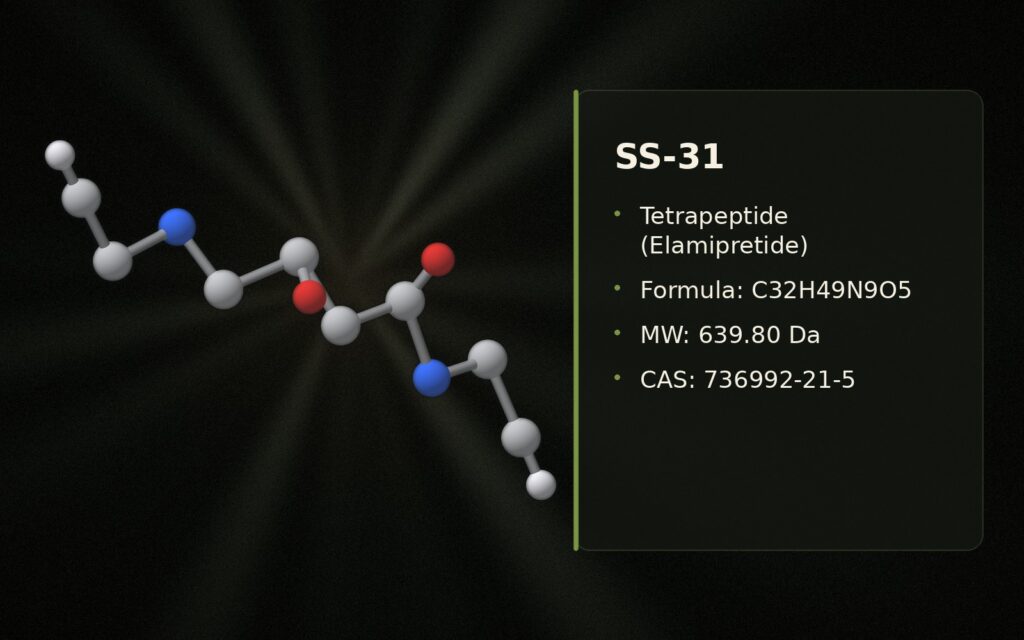
SS-31 — known in the pharmaceutical literature as elamipretide — is a mitochondria-targeting tetrapeptide with an unusually deep clinical-trial record for a compound in the research-peptide space, including a genuine 2025 FDA approval of a related prescription drug product for one narrow rare-disease indication. This guide is written for laboratory researchers, institutional buyers, and scientific staff evaluating SS-31 as a research-use-only (RUO) compound, and it draws a hard line throughout between (1) the clinical drug-development program run by Stealth BioTherapeutics under the name elamipretide and (2) Vericor Bioscience’s RUO laboratory material. Vericor’s SS-31 is sold strictly for laboratory research use — not for human use, not for compounding, and not as, or in place of, any FDA-approved drug product.
Featured definition: SS-31 (elamipretide) is a synthetic, mitochondria-targeting aromatic-cationic tetrapeptide (D-Arg-Dmt-Lys-Phe-NH₂) that concentrates in the inner mitochondrial membrane and binds cardiolipin; a related prescription formulation (elamipretide hydrochloride, brand name Forzinity) received FDA accelerated approval in September 2025 for a single rare-disease indication, Barth syndrome, while research in several other conditions remains at the clinical-trial or preclinical stage.
What Is SS-31 (Elamipretide)?
SS-31 is the laboratory designation for a small synthetic peptide originally developed by Dr. Hazel Szeto and colleagues (the “SS” prefix refers to the Szeto-Schiller series of aromatic-cationic peptides) and later advanced through clinical drug development by Stealth BioTherapeutics under the International Nonproprietary Name elamipretide. Early clinical-trial literature also refers to it by the code name MTP-131 and the developmental brand name Bendavia.
Structurally, SS-31 belongs to a class of peptides called aromatic-cationic peptides: short sequences that alternate a positively charged (cationic) residue with an aromatic residue. This alternating pattern is what allows the molecule to selectively accumulate in the inner mitochondrial membrane (IMM) at concentrations reported in preclinical work to be orders of magnitude higher than in the surrounding cytosol, without depending on the mitochondrial membrane potential the way many other mitochondria-targeted delivery strategies do. Once localized to the IMM, SS-31 is proposed to bind selectively to cardiolipin, a phospholipid that is highly enriched in the inner mitochondrial membrane and is essential to the structural organization of the electron transport chain.
Because of this mechanism, SS-31/elamipretide has been studied — first preclinically and later in a substantial human clinical-trial program — as a candidate for conditions in which mitochondrial dysfunction, oxidative stress, and impaired cardiolipin integrity are thought to play a central role: primary mitochondrial diseases, ischemia-reperfusion injury, heart failure, kidney disease, and age-related retinal degeneration, among others. That clinical-trial history is one reason SS-31 is a compound of particular scientific interest relative to many other items in a typical research-peptide catalog — but it is important for researchers to understand precisely what has and has not been established, and to keep Stealth BioTherapeutics’ prescription drug-development program entirely separate, in both fact and framing, from any RUO laboratory material sold under the SS-31 name.
Chemical Identity & Structure
The chemical identity below reflects information published by chemical reference sources (PubChem, chemical supplier databases such as ChemicalBook and MedKoo) and the peer-reviewed peptide-chemistry literature. Researchers should independently confirm identity data against a primary database and a current Certificate of Analysis before relying on it for study design.
| Property | Value |
|---|---|
| Common research names | SS-31; elamipretide (INN) |
| Developmental code names | MTP-131; Bendavia (early clinical brand); RX-31 |
| Approved-drug brand name | Forzinity (elamipretide hydrochloride) — Stealth BioTherapeutics, U.S. prescription product |
| Amino acid sequence | D-Arg–Dmt–Lys–Phe-NH₂ (Dmt = 2′,6′-dimethyltyrosine), C-terminally amidated tetrapeptide |
| Peptide class | Aromatic-cationic peptide; mitochondria-targeting |
| Molecular formula (free base) | C₃₂H₄₉N₉O₅ |
| Molecular weight (free base) | ≈ 639.8 g/mol |
| CAS number (free base) | 736992-21-5 |
| CAS number (salt forms) | Supplier chemical databases list separate registry numbers for the acetate and hydrochloride salt forms used in different research and clinical formulations; researchers should confirm the specific salt form and its CAS number against their own Certificate of Analysis rather than assuming free-base values apply |
| Sponsor of clinical development | Stealth BioTherapeutics Inc. |
The sequence is short — only four residues — which is part of what distinguishes SS-31 mechanistically from larger, more conventional signaling peptides in the research-compound space. The D-amino acid at the N-terminus (D-Arg) and the amidated C-terminus both increase resistance to proteolytic degradation relative to an all-L, free-acid tetrapeptide, a design feature commonly cited in the medicinal-chemistry literature discussing this peptide class.
Proposed Mechanism of Action
The mechanism described below reflects the working model presented in the peer-reviewed pharmacology and mitochondrial-biology literature. It should be read as a proposed, actively studied mechanism — not as a fully closed causal chain established in humans across every proposed indication.
- Selective mitochondrial accumulation. The alternating cationic/aromatic residue pattern of SS-31 is reported to drive selective partitioning into the inner mitochondrial membrane, independent of the membrane potential gradient that many other mitochondria-targeted cations (e.g., TPP+-conjugated compounds) rely on for uptake. This is proposed as an advantage in disease states where mitochondrial membrane potential is already impaired, since uptake is not expected to fail specifically where it may be needed most.
- Cardiolipin binding. Once localized to the IMM, SS-31 is proposed to bind cardiolipin through a combination of electrostatic interaction (with cardiolipin’s negatively charged phosphate headgroups) and hydrophobic interaction (via the Dmt and Phe aromatic residues). Cardiolipin is required for the proper folding, clustering, and function of electron transport chain complexes (particularly Complex I, Complex III, Complex IV, and the ATP synthase), and for maintaining the folded cristae architecture of the inner membrane.
- Prevention of cardiolipin peroxidation. Cardiolipin is unusually susceptible to oxidative damage because of its high content of polyunsaturated fatty acid side chains, and peroxidized cardiolipin is implicated in triggering mitochondrial permeability transition and apoptotic signaling (including cytochrome c release). By binding and stabilizing cardiolipin, SS-31 is proposed in preclinical studies to reduce reactive oxygen species (ROS) generation at the electron transport chain and to preserve cristae structure under oxidative or metabolic stress.
- Downstream bioenergetic effects. Preclinical models report that this cardiolipin-stabilizing activity translates into improved mitochondrial respiratory efficiency, better-preserved ATP production capacity, and reduced markers of oxidative damage in stressed tissue (e.g., ischemia-reperfusion models, models of heart failure, and models of skeletal-muscle mitochondrial dysfunction).
Researchers should treat this cardiolipin-centered model as the leading, most-cited mechanistic hypothesis in the literature for SS-31/elamipretide, while recognizing that mechanism-of-action work in intact human tissue, at clinically relevant exposures, remains more limited than the preclinical dataset.
Research & Clinical Trial Findings
SS-31/elamipretide has one of the most extensive human clinical-trial records of any compound sold in the research-peptide market — a genuinely unusual profile compared to most items in Vericor’s catalog. All clinical findings below were generated by Stealth BioTherapeutics (or academic collaborators) using the sponsor’s clinical drug product, under Investigational New Drug (IND) applications and, eventually, an approved New Drug Application for one indication — not by Vericor Bioscience, and not using RUO laboratory material.
Preclinical mechanistic research. A substantial body of published in vitro and animal work — spanning cardiac ischemia-reperfusion models, models of chronic kidney disease, skeletal-muscle aging models, and neurodegeneration models — reports that SS-31 reduces mitochondrial ROS production, preserves cristae architecture, and improves markers of bioenergetic function under stress conditions. This preclinical literature underlies the mechanistic rationale described above and preceded the compound’s advancement into human trials.
Barth syndrome — TAZPOWER (NCT03098797). This Phase 2, randomized, double-blind, placebo-controlled crossover trial, followed by an open-label extension running approximately 168–192 weeks, evaluated elamipretide in patients with Barth syndrome, an ultra-rare, X-linked mitochondrial cardioskeletal disease estimated to affect roughly 150 individuals in the United States. Published and FDA-reviewed results reported improvements in skeletal muscle strength (using knee extensor strength as the key measure) and, in extension follow-up, sustained improvements in exercise capacity and reduced fatigue. This trial became the pivotal evidence supporting FDA accelerated approval, discussed in the next section.
Primary mitochondrial myopathy — MMPOWER-3. This Phase 3, randomized, double-blind, placebo-controlled trial evaluated elamipretide in adults with genetically confirmed primary mitochondrial myopathy, using the six-minute walk test (6MWT) as its primary endpoint. The trial did not meet its primary 6MWT endpoint, though secondary analyses reported reduced total fatigue scores and suggested a possible benefit within a subgroup of patients with nuclear DNA-related mitochondrial defects. Following this result, Stealth BioTherapeutics and academic collaborators have pursued further study of nuclear DNA-related primary mitochondrial disease specifically, including a subsequent Phase 3 program (publicly referenced as “NuPower”) reported to be ongoing as of the most recent available information.
Dry age-related macular degeneration — ReCLAIM / ReCLAIM-2. These Phase 2, randomized, placebo-controlled trials evaluated elamipretide (delivered via subcutaneous or other investigational routes studied in the ophthalmology program) in patients with dry AMD and geographic atrophy. The trials did not meet their primary endpoints (visual acuity and geographic atrophy area), but reported a secondary finding of slowed ellipsoid-zone degradation on optical coherence tomography, interpreted by investigators as a signal of reduced photoreceptor degeneration. Based on this signal, Stealth BioTherapeutics has continued into a Phase 3 trial in this indication (publicly referenced as “ReNEW”), which was reported in company communications to have reached roughly 50% of its target enrollment as of 2025 and to remain an active, ongoing study.
Other studied indications. Elamipretide has also been investigated at earlier stages — primarily preclinical or early-phase clinical — in heart failure, diabetic foot ulcers, hypertension/vascular stiffness, and various kidney-disease models, reflecting the broad hypothesis that cardiolipin stabilization and mitochondrial protection could be relevant across many tissues affected by oxidative and bioenergetic stress. These programs are earlier-stage and should not be characterized as established indications.
Evidence by Research Level
| Research Level | What Has Been Studied | Sponsor / Setting | Status / Strength of Evidence |
|---|---|---|---|
| In vitro / cell-based mechanism | Cardiolipin binding, ROS reduction, mitochondrial membrane stabilization | Academic and Stealth BioTherapeutics-affiliated laboratories | Foundational; consistent across multiple published studies |
| Animal models | Ischemia-reperfusion, kidney disease, skeletal-muscle aging, cardiac stress models | Multiple independent academic groups | Preclinical evidence supporting the mechanistic hypothesis; not directly predictive of human efficacy |
| Human Phase 2 — Barth syndrome (TAZPOWER) | Muscle strength, exercise capacity, cardiac measures | Stealth BioTherapeutics, sponsor-run trial | Positive; basis for FDA accelerated approval (surrogate/intermediate endpoint) |
| Human Phase 3 — Primary mitochondrial myopathy (MMPOWER-3) | Six-minute walk test, fatigue scores | Stealth BioTherapeutics, sponsor-run trial | Primary endpoint not met; secondary/subgroup signal only; follow-on trial (“NuPower”) reported ongoing |
| Human Phase 2 — Dry AMD (ReCLAIM / ReCLAIM-2) | Visual acuity, geographic atrophy area, ellipsoid-zone integrity | Stealth BioTherapeutics, sponsor-run trials | Primary endpoints not met; secondary imaging signal supported advancement to Phase 3 (“ReNEW,” reported ongoing) |
| FDA-approved use | Barth syndrome, muscle strength (Forzinity, elamipretide HCl) | Stealth BioTherapeutics — approved prescription drug | Accelerated approval only, for this one indication; not evidence of approval for any other use or of general safety/efficacy for other purposes |
Researchers should note that even where trial outcomes were positive, they concern a specific sponsor-manufactured clinical drug product administered under a controlled clinical protocol — not any RUO material available on the general research-chemical market.
U.S. Regulatory Status
The following reflects publicly available FDA information as of this writing (September 2026). Regulatory status can change, and researchers should independently verify current status through primary FDA sources before making compliance decisions.
- FDA accelerated approval — Barth syndrome only. On September 19, 2025, the FDA granted accelerated approval to elamipretide hydrochloride, marketed under the brand name Forzinity, for the treatment of adult and pediatric patients with Barth syndrome weighing at least 30 kg, to improve muscle strength. This is the first FDA-approved treatment for Barth syndrome and is described by the sponsor and by patient-advocacy organizations as the first approved therapy for a primary mitochondrial disease. The approval is an accelerated approval, meaning it was granted based on an intermediate/surrogate clinical measure (knee extensor muscle strength) from the TAZPOWER trial, rather than on a traditional, fully validated clinical outcome measure; accelerated approvals typically carry post-marketing confirmatory-trial obligations.
- This approval is narrow and indication-specific. Forzinity’s approval applies only to Barth syndrome patients meeting the specified weight threshold. It is not an approval for primary mitochondrial myopathy, dry AMD, heart failure, or any other condition in which elamipretide has been studied — those programs remain at Phase 3 (dry AMD) or earlier stages, as described above.
- Supporting FDA designations. Prior to approval, elamipretide received FDA Rare Pediatric Disease Designation and Fast Track Designation for the Barth syndrome program, along with Priority Review of the marketing application — the standard set of expedited-pathway designations FDA uses for serious, rare pediatric conditions with unmet medical need.
- Forzinity is a distinct, separately regulated prescription product. Forzinity is manufactured, tested, and distributed by Stealth BioTherapeutics under an approved New Drug Application, subject to FDA current Good Manufacturing Practice (cGMP) requirements, prescription-only dispensing, and post-marketing safety surveillance. Vericor Bioscience does not sell Forzinity and does not claim any equivalence between its RUO SS-31 research compound and the approved drug product. RUO material has not been reviewed, tested, or approved by FDA for any use and should never be treated as interchangeable with, or a substitute for, Forzinity.
- Not on the FDA 503A Bulks List. SS-31/elamipretide does not appear among the peptides FDA’s Pharmacy Compounding Advisory Committee has evaluated or recommended for the Section 503A Bulks List (the list governing which bulk drug substances may lawfully be used in compounded prescription products). Because an FDA-approved drug product (Forzinity) already exists for elamipretide, using bulk elamipretide to compound a copy of an approved drug would in any case face additional restrictions under FDA’s compounding framework, independent of bulks-list status.
- Research-use-only status of Vericor’s product. In the United States, Vericor Bioscience’s SS-31 is offered only as a research-use-only laboratory chemical for qualified personnel and institutions — not for human consumption, self-administration, compounding, or clinical use of any kind.
Safety Profile & Unknown Risks
The safety information below comes from Stealth BioTherapeutics’ published clinical-trial and FDA-review documentation for the elamipretide clinical drug program (including the TAZPOWER, MMPOWER-3, and ReCLAIM trials, and FDA’s review supporting the Forzinity approval). These findings describe the sponsor’s clinical drug product administered under controlled trial or prescribing conditions — they do not describe, and should not be assumed to apply to, any RUO laboratory material.
- Injection-site reactions. Across the clinical program, injection-site reactions (erythema, pain, pruritus) have been among the most commonly reported adverse events associated with subcutaneous elamipretide administration.
- Gastrointestinal and general adverse events. Trial documentation reports gastrointestinal symptoms (nausea, diarrhea) and general symptoms such as headache and fatigue at rates elevated over placebo in some studies.
- No signal of the specific safety concern that halted an unrelated peptide’s trial history. Available FDA review documentation for the Barth syndrome program does not describe a trial-halting safety event comparable to what has occurred in the development histories of some other research peptides; however, the overall human safety database remains limited to the specific populations and durations studied (Barth syndrome patients, primary mitochondrial myopathy patients, and dry AMD patients, generally over trial periods extending up to several years in open-label extensions).
- Safety in broader or healthy populations is not established. Clinical safety data concerns specific patient populations with defined diseases; it does not establish a safety profile for use in healthy individuals, in populations outside those studied, or at exposures outside the studied dose range.
- No safety data exists for Vericor’s RUO material specifically. Because Vericor’s product is not the clinical drug substance manufactured, tested, and monitored under Stealth BioTherapeutics’ approved or investigational protocols, none of the clinical safety findings above can be assumed to transfer to RUO SS-31 obtained through the general research-chemical market. Identity, purity, and degradation state should be independently verified (e.g., by HPLC and mass spectrometry) for any RUO lot before it is used in a research protocol.
- No pediatric, pregnancy, or long-term general-population data outside the approved indication. Even within the approved Barth syndrome indication, use is defined by a specific weight threshold and disease population; no data exists establishing safety in pregnancy, in the general pediatric population outside Barth syndrome, or over multi-decade timeframes.
SS-31 sold by Vericor Bioscience is intended exclusively for laboratory research use by qualified personnel, handled under appropriate institutional biosafety and chemical-handling protocols, and is not intended for human use of any kind.
Research Evaluation Checklist
Researchers evaluating SS-31 (elamipretide) as an RUO laboratory compound should work through the following before designing a study or relying on third-party claims:
- Separate the approved drug from the research compound. Confirm whether a given claim, dataset, or marketing statement is describing Stealth BioTherapeutics’ approved Forzinity product, an investigational clinical formulation, or an RUO laboratory compound — these are not interchangeable, and vendor materials sometimes blur the distinction.
- Verify chemical identity independently. Confirm sequence, molecular formula, molecular weight, salt form, and CAS number against a primary chemical database and a current, lot-specific Certificate of Analysis rather than a product page alone.
- Trace efficacy claims to the specific trial. Identify whether a claim originates from the positive Barth syndrome (TAZPOWER) results, the missed primary endpoint in MMPOWER-3, the missed primary endpoints with a positive secondary signal in ReCLAIM/ReCLAIM-2, or unsourced marketing copy — these have materially different evidentiary weight.
- Confirm current FDA and trial status directly. Check FDA.gov and ClinicalTrials.gov rather than a supplier’s characterization, since the regulatory picture for this compound has changed materially in recent years and may change again (e.g., outcomes of the ongoing NuPower and ReNEW Phase 3 programs).
- Demand analytical documentation for the specific lot. Request a current Certificate of Analysis confirming identity and purity for the RUO material actually being purchased.
- Match study design to the mechanistic hypothesis being tested. Because the proposed mechanism centers on cardiolipin binding and mitochondrial membrane effects, ensure assay design (e.g., mitochondrial isolation methods, ROS assays, membrane-potential measurements) is appropriate to detect the specific proposed activity.
- Maintain RUO labeling and framing throughout the research chain. Ensure any internal or published use of the compound is documented and labeled strictly as laboratory research, with no suggestion of human dosing, therapeutic use, or equivalence to the approved drug product.
People Also Ask About SS-31
Yes. SS-31 is the original research designation for the peptide now known by the International Nonproprietary Name elamipretide, which was also called MTP-131 and Bendavia in earlier clinical-trial literature. Vericor Bioscience’s product is an RUO laboratory compound sold under the SS-31 name; it is not the same product as Stealth BioTherapeutics’ approved drug.
As of the most recent available information (accelerated approval granted September 19, 2025), a prescription formulation of elamipretide hydrochloride, brand name Forzinity, is FDA-approved for one specific indication: improving muscle strength in adult and pediatric Barth syndrome patients weighing at least 30 kg. It is not approved for any other condition, including primary mitochondrial myopathy or dry AMD, both of which remain in active clinical trials.
Forzinity is Stealth BioTherapeutics’ FDA-approved prescription drug product (elamipretide hydrochloride). It is not the same product as, and is not equivalent or interchangeable with, Vericor Bioscience’s RUO SS-31 research compound, which has not been reviewed or approved by FDA and is not manufactured under the same pharmaceutical controls.
In laboratory research settings, SS-31/elamipretide is studied for its proposed mitochondria-targeting and cardiolipin-binding activity, typically in models of oxidative stress, mitochondrial bioenergetics, ischemia-reperfusion injury, and cellular aging. These are research applications in cell and animal models — not statements about approved or appropriate human use.
Results have been mixed. The Barth syndrome program (TAZPOWER) reported positive results that supported FDA accelerated approval. The primary mitochondrial myopathy Phase 3 trial (MMPOWER-3) did not meet its primary endpoint, though a subgroup signal prompted further study. The dry AMD Phase 2 trials (ReCLAIM/ReCLAIM-2) did not meet their primary endpoints but showed a secondary imaging signal that supported advancing to a Phase 3 trial reported to be ongoing.
SS-31/elamipretide does not appear on FDA’s Section 503A Bulks List, and with an FDA-approved drug product (Forzinity) now on the market for one indication, compounding a copy of that approved product faces additional restrictions under FDA’s compounding rules. Vericor Bioscience’s SS-31 is sold only as a research-use-only laboratory chemical, not for compounding, prescribing, or any human use.
Expert SS-31 Q&A
Why is SS-31’s cardiolipin-binding mechanism considered mechanistically distinct from other mitochondria-targeted antioxidants?
Most other approaches to targeting compounds to mitochondria rely on a lipophilic cationic group (such as triphenylphosphonium, used in MitoQ) that is driven into the matrix by the mitochondrial membrane potential — a mechanism that can be self-limiting in diseased tissue where that potential is already reduced. SS-31’s alternating cationic/aromatic tetrapeptide structure is instead reported to localize to the inner membrane through a combination of electrostatic and aromatic interactions with cardiolipin itself, which is proposed to preserve targeting even under conditions of partial mitochondrial depolarization. This is a specific, testable structural hypothesis, not a universally validated mechanism across all tissue and disease contexts.
What should researchers make of the split outcomes across elamipretide’s clinical program — positive in Barth syndrome, missed primary endpoints in MMPOWER-3 and ReCLAIM?
Divergent outcomes across indications are common in mitochondrial-medicine drug development, where the degree and type of mitochondrial dysfunction, the disease’s genetic basis, and the sensitivity of the chosen clinical endpoint all vary substantially. The Barth syndrome result benefited from a well-characterized, homogeneous, ultra-rare genetic population and a targeted functional endpoint (muscle strength); the missed 6MWT endpoint in the more heterogeneous primary mitochondrial myopathy population, and the missed primary visual endpoints in dry AMD, are consistent with the general difficulty of demonstrating benefit on broad functional or anatomic endpoints in more heterogeneous or slower-progressing conditions, even when a secondary or biomarker-level signal is present.
Does the Forzinity accelerated approval tell researchers anything about the safety or efficacy of RUO SS-31 material sold for laboratory use?
No. Accelerated approval was granted for a specific, sponsor-manufactured drug substance and formulation, tested under cGMP conditions and administered under a controlled clinical protocol to a defined patient population. It says nothing about the identity, purity, or behavior of RUO material obtained from the general research-chemical market, which has not been subject to the same manufacturing controls or clinical evaluation and should be independently characterized before use in any study.
What is the significance of accelerated approval being based on knee extensor muscle strength rather than a “hard” clinical outcome?
Accelerated approval is an FDA pathway intended for serious conditions with unmet medical need, allowing approval based on a surrogate or intermediate clinical endpoint reasonably likely to predict clinical benefit, with confirmatory trials expected post-approval. Muscle strength is a functionally meaningful measure in a muscle-wasting disease like Barth syndrome, but it is not the same evidentiary standard as, for example, a mortality or major-morbidity endpoint. Researchers citing this approval should describe it accurately as an accelerated approval based on an intermediate endpoint, not as evidence of a fully established, broad clinical benefit.
Given the ongoing NuPower and ReNEW Phase 3 programs, should researchers expect elamipretide’s approved-use profile to expand?
It’s possible, but not established. Both programs are active, sponsor-run Phase 3 trials in indications (nuclear DNA-related primary mitochondrial disease, and dry AMD) where earlier trials produced secondary signals but missed primary endpoints. Researchers should track these programs through primary sources (ClinicalTrials.gov, FDA announcements, peer-reviewed publication of results) rather than assuming expanded approval, and should not extrapolate this pipeline activity to any change in the regulatory status of RUO SS-31 material.
SS-31 and MOTS-C: Two Approaches to Mitochondrial Research
MOTS-C and SS-31 are both mitochondria-focused research peptides, but they represent genuinely different approaches to mitochondrial biology. SS-31 (elamipretide) is a cell-permeable tetrapeptide studied for its proposed interaction with cardiolipin on the inner mitochondrial membrane, where it is thought to help stabilize electron transport chain structure and reduce oxidative byproduct formation. MOTS-C, by contrast, is a mitochondrial-DNA-encoded microprotein studied primarily for its proposed role in AMPK activation and metabolic/exercise-adaptation signaling — thought to act as a retrograde signal from mitochondria to the nucleus during metabolic stress.
Because these two proposed mechanisms sit at different points in mitochondrial function — one structural at the membrane level, one upstream in nuclear signaling — researchers sometimes discuss them together when reviewing the broader mitochondrial-research-peptide landscape, rather than as interchangeable or competing compounds. As with all research materials in Vericor’s RUO catalog, neither is FDA-approved for human use, and any comparison here is intended strictly for laboratory research context, not treatment guidance.
Conclusion
SS-31 (elamipretide) stands out among research peptides for a genuinely deep and clinically consequential development history: a well-defined mitochondria-targeting, cardiolipin-binding mechanism; a substantial preclinical literature; and a human clinical-trial program that, as of September 2025, produced FDA accelerated approval of a prescription formulation (Forzinity, elamipretide hydrochloride) for one specific rare-disease indication — Barth syndrome muscle strength — while related programs in primary mitochondrial myopathy and dry age-related macular degeneration remain in active Phase 3 trials rather than approved use. That approval belongs to Stealth BioTherapeutics’ clinical drug product, developed and manufactured under FDA-regulated conditions; it is not an approval of, and does not extend to, any research-use-only laboratory compound sold under the SS-31 name, including Vericor Bioscience’s product.
Vericor Bioscience’s SS-31 is intended strictly for laboratory research use by qualified personnel — it is not an approved drug, not a substitute for Forzinity or any other approved therapy, and not intended for human use, self-administration, or clinical application of any kind. Researchers who want to review current specifications and analytical documentation for SS-31 as a laboratory research compound can visit Vericor Bioscience’s research product page for SS-31.