
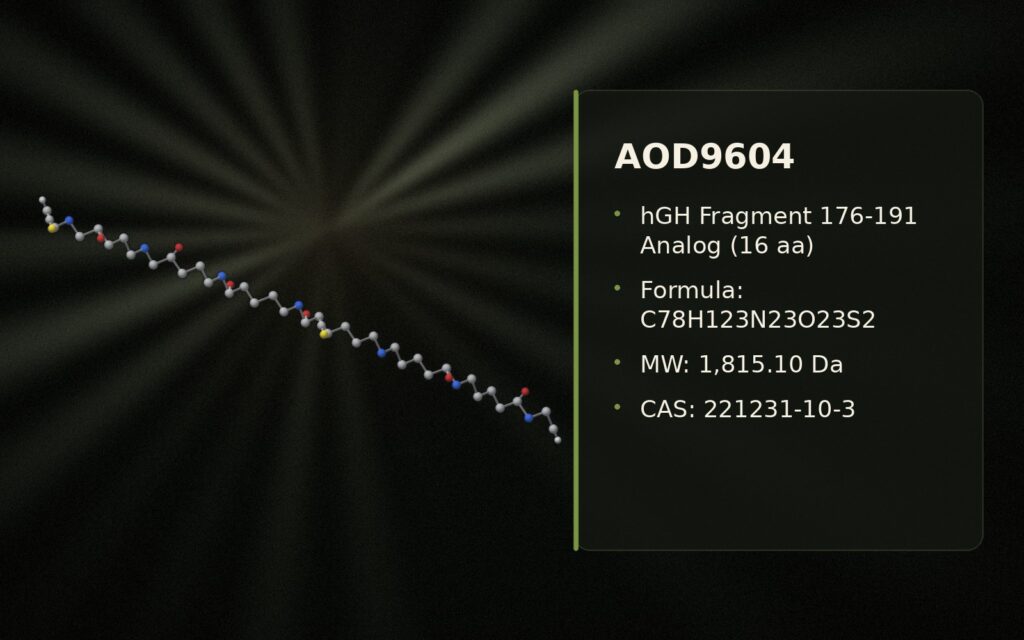
AOD9604 is a synthetic fragment of human growth hormone that has circulated in laboratory research for over two decades, most often in the context of lipolysis (fat-metabolism) and adipocyte biology studies. It is sold for research use only (RUO), is not approved by the FDA for any human use, and is not intended for human consumption, self-administration, or diagnostic or therapeutic use of any kind.
Before going further, it is worth stating plainly what much of the online marketing around this compound leaves out: AOD9604 was carried through a multi-year, multi-trial human clinical development program aimed specifically at obesity, sponsored by an Australian biotechnology company, and that program was discontinued after later-stage trials failed to demonstrate the efficacy needed to support a drug approval. That history does not mean the underlying science is worthless — it is one of the more extensively studied growth-hormone-fragment peptides in the published literature — but it does mean that any claim describing AOD9604 as a proven “fat loss peptide” is not consistent with the compound’s own clinical record. This article is written for laboratory researchers and is organized around what has actually been published, not around consumer marketing claims.
Because AOD9604 is frequently marketed online using weight-loss and body-composition language aimed at consumers, we want to be explicit up front: nothing in this article should be read as a claim that AOD9604 causes fat loss, weight loss, or any change in body composition in a person. The findings summarized below come from in vitro, animal, and controlled human clinical-trial research conducted by outside investigators and sponsors — not from Vericor Bioscience, and not from anecdotal or consumer use.
Featured definition: What is AOD9604?
AOD9604 is a synthetically produced 16-amino-acid peptide corresponding to the C-terminal fragment (amino acids 176–191) of the human growth hormone (hGH) molecule, with a tyrosine residue added at the N-terminus to aid stability and synthesis. It was developed by Australian biotechnology company Metabolic Pharmaceuticals as a candidate that isolates the lipolytic (fat-metabolizing) region of the hGH molecule while avoiding the growth-promoting and blood-sugar-affecting activity associated with intact growth hormone. It progressed through Phase I and Phase II human clinical trials for obesity before development was discontinued after the compound did not meet its efficacy endpoints in later-stage trials. AOD9604 is not FDA-approved for any indication and is available in the United States only as a research chemical for laboratory and preclinical use.
What Is AOD9604? Chemical Identity and Derivation from HGH
AOD9604 (also written AOD-9604; CAS 221231-10-3) is a modified fragment peptide derived from the human growth hormone sequence. Its defining chemical characteristics, as listed by chemical reference databases, are:
- Molecular formula: C₇₈H₁₂₃N₂₃O₂₃S₂
- Molecular weight: approximately 1,815.1 g/mol
- Sequence: a 16-amino-acid chain (Tyr-Leu-Arg-Ile-Val-Gln-Cys-Arg-Ser-Val-Glu-Gly-Ser-Cys-Gly-Phe), corresponding to residues 176–191 of the human growth hormone molecule, with the naturally occurring phenylalanine at position 176 substituted with a tyrosine
- Structural class: a linear peptide fragment containing a single intramolecular disulfide bond (a hallmark of the native hGH C-terminal loop it replicates)
The rationale behind AOD9604’s design traces to research from the 1990s indicating that different regions of the growth hormone molecule are responsible for different downstream effects. The central portion of hGH is associated with the hormone’s growth-promoting, IGF-1-stimulating activity, while the C-terminal fragment — amino acids 176–191 — was identified in early studies as retaining lipolytic (fat-metabolizing) activity in isolated systems without the growth-promoting activity of the intact hormone. AOD9604 was synthesized to reproduce this C-terminal fragment as a standalone molecule, with the added N-terminal tyrosine intended to improve manufacturing stability and analytical characterization during drug development.
Researchers comparing peptides should note that AOD9604 is closely related to, but not identical to, “HGH Fragment 176-191,” a name sometimes used interchangeably in less careful marketing materials; the tyrosine substitution is the distinguishing feature between the two naming conventions.
Proposed Mechanism of Action
The mechanism proposed for AOD9604 in the pharmacological literature centers on the lipolytic signaling pathways engaged by growth hormone, without engaging the receptor activity responsible for hGH’s classic growth-promoting and glucose-regulatory effects. In cell-based and animal research, the proposed pathway involves:
- Beta-adrenergic receptor engagement. Preclinical work has proposed that the fragment’s activity on adipocytes (fat cells) is mediated in part through beta-3 adrenergic receptor pathways, which are involved in stimulating lipolysis (the breakdown of stored triglycerides into free fatty acids) and, in some model systems, inhibiting lipogenesis (new fat storage).
- Dissociation from IGF-1 stimulation. A central premise of the original drug-development program was that the intact hGH molecule’s growth-promoting effects are mediated by a different structural region than its lipolytic effects. Published pharmacology studies report that AOD9604 does not raise serum IGF-1 levels the way full-length growth hormone does — this was, in fact, the entire scientific rationale for isolating the fragment.
- Apparent lack of effect on glucose handling. Several published human pharmacokinetic and safety studies report that oral glucose tolerance testing in study participants did not show the impairment in glucose handling associated with growth hormone excess, which was another design goal of the fragment approach.
Researchers should treat “mechanism of action” language for AOD9604 as a working model derived largely from receptor-binding assays, isolated adipocyte and explant studies, and rodent models — not as a fully elucidated human pharmacological pathway. Peptide fragments of larger hormones do not always retain the full activity profile suggested by in vitro assays, and receptor-level findings do not automatically translate into predictable physiological or clinical effects.
Preclinical Research: Cell and Animal Studies
Preclinical characterization of AOD9604 spans several study types commonly cited in the peptide research literature:
- Isolated adipocyte and tissue studies. Early work identifying the C-terminal hGH fragment’s lipolytic activity used isolated fat cell preparations to compare its effects on lipid metabolism against intact growth hormone and control conditions.
- Rodent models of obesity. Published pharmacology research describes obese and lean rodent models examining body-weight and adiposity endpoints following peptide administration, alongside markers of lipid metabolism.
- Receptor and binding characterization. Follow-on molecular studies examined how the fragment interacts with growth-hormone-receptor-associated signaling relative to full-length hGH, informing the “lipolysis without growth effect” hypothesis.
Researchers should be cautious about extrapolating rodent or in vitro findings to human physiology. Species differences in adipose tissue biology, receptor density, and metabolic regulation are well documented, and, as described below, the preclinical signal for AOD9604 did not fully replicate in later human trials.
Human Clinical Trial History: The Phase II Obesity Program
Unlike many peptides discussed in the research-chemical space, AOD9604 has an unusually well-documented human clinical trial history, because it was formally developed as an obesity drug candidate by Metabolic Pharmaceuticals Ltd., an Australian biotechnology company, through the 2000s.
What was studied. Published accounts and sponsor disclosures describe a series of randomized, double-blind, placebo-controlled trials — reportedly six trials in total — enrolling several hundred adult participants, most with obesity (BMI in the obese range). Trials examined both intravenous and oral formulations across a range of doses and treatment durations, including at least one trial extending to roughly 24 weeks. Endpoints generally centered on body weight and body-composition change compared with placebo, alongside standard clinical safety and tolerability measures.
What was reported. According to published summaries, an earlier 12-week trial reported a modest average weight difference (on the order of less than two kilograms) favoring the AOD9604 group over placebo. However, subsequent larger and longer trials — including a later-stage, longer-duration trial — reportedly did not reproduce a clinically meaningful or statistically robust efficacy signal sufficient to support continued drug development. Development of AOD9604 as an obesity pharmaceutical was ultimately discontinued in the late 2000s.
Why this matters for researchers. This is the single most important fact for anyone evaluating “fat loss peptide” marketing claims about AOD9604: a well-funded, purpose-built human clinical program specifically testing AOD9604 for weight and fat-related outcomes was run to completion and did not produce results supporting an obesity-drug approval. That is a materially different evidentiary position than an untested compound — it is a compound that was tested in exactly the way marketing claims imply, and the program did not succeed on efficacy. Some of the same trials did report a favorable safety and tolerability profile relative to placebo (see the Safety section below), which is a separate and distinct finding from efficacy.
Researchers should also note that, because this compound has not advanced to approval in any jurisdiction, there is no ongoing sponsor-run clinical program, no FDA-reviewed prescribing information, and no post-market surveillance data of the kind that exists for approved drugs.
Evidence by Research Level
| Research Level | What Has Been Studied | Strength of Evidence |
|---|---|---|
| In vitro / cell-based | Adipocyte lipolysis assays, growth-hormone-receptor binding characterization | Foundational; establishes proposed mechanism, not human relevance |
| Animal models | Rodent obesity models examining adiposity and metabolic markers | Preliminary; mixed translation to later human findings |
| Human Phase I | Single- and multiple-dose safety, tolerability, and pharmacokinetics in healthy/obese adults | Reasonably well documented; favorable safety/tolerability reported |
| Human Phase II/IIb | Randomized, placebo-controlled efficacy trials for obesity (weight/body composition endpoints) | Conducted and completed; did not meet efficacy endpoints in later-stage trials |
| Approved clinical use | Any FDA-approved indication | None — development discontinued; not approved for any human use |
Common Claims vs. Evidence
Marketing content outside legitimate research channels frequently describes AOD9604 as a “fat-burning peptide” or “safe alternative” for weight management. Because these claims can mislead readers about what the clinical record actually shows, we address them directly below.
| Common Marketing Claim | What the Evidence Actually Shows |
|---|---|
| “AOD9604 is a proven fat-loss peptide.” | AOD9604 underwent a dedicated human clinical program for obesity, and later-stage trials did not meet the efficacy endpoints needed to support that use. It is not an evidence-backed fat-loss agent. |
| “AOD9604 targets fat without any side effects.” | Published human trials reported a favorable tolerability profile relative to placebo in the specific populations and doses studied, but “no side effects” is not an accurate characterization of any bioactive compound, and long-term or unsupervised-use safety data do not exist. |
| “AOD9604 is a safer, natural alternative to prescription weight-loss drugs.” | AOD9604 is not FDA-approved for any use, has no established human dosing for a therapeutic indication, and cannot be meaningfully compared to approved pharmaceuticals evaluated through FDA review. Framing it as an “alternative” to an approved drug is not supported by its regulatory status. |
| “Research shows AOD9604 works for weight loss.” | Some early-phase and preclinical findings reported lipolytic activity in laboratory systems, but the compound’s own dedicated human efficacy trials for obesity did not succeed. Citing preclinical or early-phase data alone omits the program’s actual clinical outcome. |
| “AOD9604 is legal and approved for use.” | AOD9604 is not FDA-approved for any indication and is not included on the FDA’s interim 503A bulks list for compounding, per FDA’s own proposed determination. It is available only as a research-use-only laboratory compound. |
U.S. Regulatory Status
The following points reflect verifiable, publicly available FDA regulatory information as of this writing:
- No FDA approval. AOD9604 is not approved by the FDA for any human therapeutic, diagnostic, or preventive use. Its original obesity-drug development program was discontinued before reaching approval.
- Not included on the FDA’s 503A Bulks List. In FDA briefing materials prepared for a 2024 Pharmacy Compounding Advisory Committee (PCAC) meeting evaluating candidate substances for the interim 503A bulks list, the agency’s proposed position was that AOD9604 (both free base and acetate forms) should not be included on that list — meaning FDA has proposed against its use as a bulk substance in compounded human drug products.
- Research-use-only status. AOD9604 is lawfully offered in the United States only for laboratory and research purposes, not for human consumption, compounding into prescriptions, or any clinical use.
- General enforcement climate. The FDA has issued warning letters to a number of companies marketing peptide products — as a category — for unapproved human use, unsubstantiated therapeutic claims, or misbranding. Researchers should treat this as an active area of regulatory attention and never present RUO compounds as suitable for human use in any context.
Regulatory status can change, and this section reflects publicly documented information at the time of writing rather than a permanent or exhaustive legal determination; researchers and institutions should independently verify current status through primary FDA sources before making compliance decisions.
Safety Considerations and Unknown Risks
Published human trials of AOD9604 — conducted under IND-type clinical trial protocols, with medical monitoring, defined dosing, and controlled conditions — reported adverse events that were generally mild-to-moderate and, according to sponsor and investigator summaries, comparable in frequency to placebo, with headache and gastrointestinal symptoms (such as diarrhea and flatulence) most commonly noted, particularly at higher oral doses. Long-term studies reportedly included a small number of serious adverse events that investigators assessed as unrelated to treatment. Reported laboratory findings included the absence of an IGF-1 increase and no evidence of anti-AOD9604 antibody formation in study populations.
These findings come from a specific, terminated clinical development program with defined dosing regimens, monitoring protocols, and study populations — they do not constitute a general safety profile applicable outside those controlled conditions, and they say nothing about outcomes with unregulated sourcing, non-sterile handling, unsupervised administration, or use outside a laboratory research setting. Important unknowns and risk considerations for the research community include:
- No long-term human surveillance data. Because AOD9604 was never approved and does not have an ongoing marketed use, there is no post-market surveillance dataset comparable to what exists for approved drugs.
- Product quality and purity risk. As with any peptide obtained outside a validated pharmaceutical supply chain, purity, identity, endotoxin levels, and degradation state can vary substantially between sources. Research use should always involve independent analytical verification (e.g., HPLC, mass spectrometry, endotoxin testing) rather than reliance on vendor claims alone.
- Species and model limitations. As noted above, much of the mechanistic and efficacy picture comes from in vitro and animal work; extrapolation to intact human physiology carries the same limitations inherent to any preclinical dataset.
- Not evaluated for interactions or contraindications. Because AOD9604 has no approved human indication, there is no FDA-reviewed labeling describing drug interactions, contraindications, or use in specific populations (e.g., pregnancy, renal or hepatic impairment, pediatric populations).
AOD9604 is not intended for human use of any kind. It should be handled only by qualified personnel in appropriate laboratory settings, following institutional biosafety and chemical-handling protocols and all applicable research-use regulations.
Research Evaluation Checklist
Researchers evaluating AOD9604 — or any RUO peptide marketed with strong efficacy claims — should consider working through the following steps before drawing conclusions from vendor or third-party materials:
- Verify chemical identity independently. Confirm molecular formula, molecular weight, sequence, and CAS number against a primary chemical database (e.g., PubChem) rather than relying solely on a vendor product page.
- Trace claims back to primary literature. Identify whether a given claim originates from a peer-reviewed publication, a conference abstract, a sponsor press release, or unsourced marketing copy — these carry very different evidentiary weight.
- Distinguish preclinical from clinical evidence. Note explicitly whether a cited finding comes from in vitro assays, animal models, or controlled human trials, and weight conclusions accordingly.
- Check for a completed clinical development record. For AOD9604 specifically, review the Phase I/II trial history and its documented outcome before accepting efficacy claims at face value.
- Confirm current regulatory status. Check FDA sources directly (warning letters, bulks list determinations, any relevant guidance) rather than relying on a supplier’s characterization of legality or approval status.
- Demand analytical documentation. Request a current Certificate of Analysis (COA) confirming identity and purity for any specific lot, and verify it against independent testing where feasible.
- Confirm RUO labeling and handling practices. Ensure the product is labeled and distributed strictly for laboratory research use, with no suggestion of human dosing, administration schedules, or therapeutic outcomes.
- Document study design limitations. When incorporating AOD9604 into a research protocol, explicitly record species, model system, dose range, and duration limitations in any resulting write-up or internal report.
People Also Ask About AOD9604
No. AOD9604 has never received FDA approval for any indication. Its original developer discontinued the compound’s obesity-drug program after later-stage human trials did not meet efficacy endpoints, and FDA briefing materials have proposed against including it on the 503A compounding bulks list.
Human trials produced mixed results. An earlier, shorter trial reported a modest weight difference versus placebo, but subsequent larger or longer trials reportedly did not reproduce a clinically meaningful efficacy signal, and the obesity-drug development program was discontinued as a result.
The two names are often used interchangeably in the marketplace, but they are not identical. AOD9604 corresponds to hGH residues 176–191 with an added N-terminal tyrosine substituted for the native phenylalanine; researchers should confirm the exact sequence and CAS number of any specific product rather than assuming equivalence based on naming alone.
Published Phase I/II trials reported a tolerability profile broadly comparable to placebo within the specific dosing regimens and monitored clinical settings studied. That data does not extend to unsupervised use, unverified sourcing, or use outside a research context, and no long-term surveillance data exist because the compound was never approved for ongoing human use.
Much of the online marketing language around AOD9604 predates or omits the compound’s later-stage clinical trial outcomes and instead draws on earlier preclinical and early-phase findings, or on the compound’s original design rationale, without noting that the dedicated efficacy trials did not succeed. Researchers should treat such claims skeptically and consult primary trial data rather than promotional summaries.
AOD9604 can be lawfully purchased in the United States only as a research-use-only chemical intended strictly for laboratory research by qualified personnel or institutions — not for human consumption, compounding, or clinical administration.
Expert AOD9604 Q&A
From a pharmacology standpoint, why was the C-terminal fragment of hGH selected for isolation in the first place?
Structure-activity research on growth hormone in the 1990s suggested that different regions of the intact hGH molecule contribute differently to its various biological activities. Investigators hypothesized that the C-terminal region (residues 176–191) retained lipolytic activity in isolated systems while being separable from the region responsible for IGF-1-mediated growth signaling. AOD9604 was synthesized to test that hypothesis directly as a standalone peptide.
What is the practical significance of AOD9604’s Phase II trial outcome for researchers today?
It means AOD9604 should be categorized, evidentially, as “tested and not confirmed for efficacy” in the obesity indication it was purpose-built for — not as an untested novel compound, and not as a validated one. That distinction matters for anyone designing new studies or evaluating existing claims.
Does the reported absence of IGF-1 elevation mean AOD9604 has no growth-hormone-axis activity at all?
Not necessarily. The absence of IGF-1 elevation in the cited trials is a specific, measured endpoint that supported the compound’s designed dissociation from classic hGH growth signaling. It does not by itself establish a complete absence of any interaction with growth-hormone-axis biology; researchers examining this question should design assays specific to their own endpoints of interest.
What kind of study would be needed to responsibly re-evaluate AOD9604 for a metabolic research question today?
A rigorous approach would replicate the double-blind, placebo-controlled design used in the original trials, predefine primary and secondary endpoints, use adequately powered sample sizes based on effect sizes reported previously, and report results regardless of outcome. Given the existing negative later-stage efficacy data, any new protocol should also pre-specify a clear rationale for why a different result might be expected.
How should a lab distinguish a credible AOD9604 supplier from an unreliable one?
Look for a current, lot-specific Certificate of Analysis showing identity confirmation and purity by HPLC, clear RUO-only labeling with no human-use claims, transparent sourcing documentation, and no marketing language describing dosing schedules, expected outcomes, or comparisons to approved pharmaceuticals.
Conclusion
AOD9604 occupies an unusual place in the peptide research landscape: it is not an obscure, untested compound, but one that was carried through a genuine, multi-trial human clinical development program aimed squarely at the obesity indication it is still marketed for today — and that program was discontinued after later-stage trials did not meet their efficacy endpoints. For researchers, that history is a feature, not a footnote: it provides a relatively rich, if ultimately negative-on-efficacy, human dataset alongside preclinical work on hGH-fragment lipolytic signaling, growth-hormone-receptor interactions, and adipocyte biology. It also means that current “fat loss peptide” marketing built around this compound should be read with real skepticism, since it typically does not reflect the compound’s own clinical trial outcomes.
AOD9604 remains available only as a research-use-only compound. It is not FDA-approved for any use, is not intended for human consumption or administration, and should be handled exclusively by qualified researchers in appropriate laboratory settings under applicable institutional and regulatory protocols. Researchers who want to review current specifications, analytical documentation, and available quantities for AOD9604 as a research compound can visit Vericor Bioscience’s product page for this peptide.