
Hexarelin is one of the more extensively studied compounds in the growth-hormone-releasing peptide (GHRP) class, with a research record that is unusual among peptides sold today as research-use-only (RUO) laboratory chemicals: it includes a meaningful body of controlled human pharmacology work, primarily conducted by European academic investigators in the 1990s and early 2000s, alongside animal and in vitro data. It is worth stating plainly up front: that evidence base, while more developed than for many peptides in this category, is still overwhelmingly short-term, mechanistic, and diagnostic in nature — not a record of established long-term safety or efficacy for any human outcome.
This article is written for laboratory researchers and institutional buyers evaluating Hexarelin for legitimate in vitro, ex vivo, or animal research. Hexarelin is sold by Vericor Bioscience strictly as a research-use-only (RUO) laboratory chemical. Hexarelin is not approved by the FDA for any human use, is not intended for human consumption or self-administration, and nothing in this article should be read as instruction, encouragement, or guidance for using it in or on a person. Where this article describes effects on growth hormone (GH), the ghrelin receptor system, cardiac tissue, or other physiological endpoints, those findings come from published preclinical and clinical-trial literature conducted by outside investigators and sponsors — not from Vericor Bioscience, and not from anecdotal consumer use.
Featured definition: What is Hexarelin?
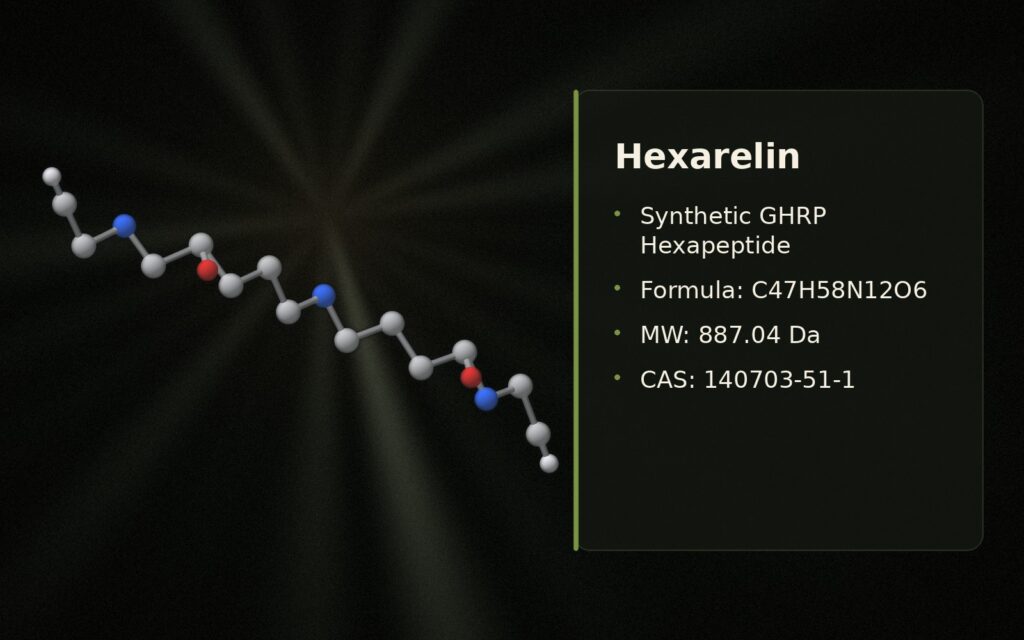
Hexarelin is a synthetic hexapeptide (six-amino-acid) growth-hormone-releasing peptide (GHRP) with the sequence His-D-2-methyl-Trp-Ala-Trp-D-Phe-Lys-NH2, molecular formula C₄₇H₅₈N₁₂O₆, and a molecular weight of approximately 887.0 g/mol (CAS 140703-51-1). It acts primarily as an agonist at the growth hormone secretagogue receptor (GHS-R1a) — the same receptor targeted by the endogenous hormone ghrelin — and has also been shown in the pharmacology literature to bind the scavenger receptor CD36 on cardiac and vascular tissue, a second, GH-independent pathway implicated in reported cardioprotective effects in animal models. Hexarelin has not been approved by the FDA for any indication and is not intended for human use.
What Is Hexarelin? Chemical Identity and GHRP Class Background
Hexarelin belongs to the growth hormone-releasing peptide (GHRP) family — a class of synthetic peptides discovered starting in the 1980s that stimulate GH secretion through a mechanism distinct from growth-hormone-releasing hormone (GHRH). Where GHRH analogs (such as sermorelin or CJC-1295) act on the GHRH receptor, GHRPs act on a separate G-protein-coupled receptor, the growth hormone secretagogue receptor (GHS-R1a), which was later identified as the natural receptor for the gut-derived hormone ghrelin. Hexarelin is one of several GHRPs developed and studied in this family, alongside earlier compounds such as GHRP-6 and GHRP-2.
Verified chemical identity, drawn from chemical reference sources (PubChem, ChemicalBook):
| Property | Hexarelin |
|---|---|
| CAS number | 140703-51-1 |
| Molecular formula | C₄₇H₅₈N₁₂O₆ |
| Molecular weight | ≈ 887.0 g/mol |
| Amino acid count | 6 residues (hexapeptide) |
| Sequence | His-D-2-methyl-Trp-Ala-Trp-D-Phe-Lys-NH2 |
| Structural notes | Contains two D-amino acids (D-2-methyl-Trp, D-Phe) conferring resistance to enzymatic degradation, and a C-terminal amide |
| Receptor class | Growth hormone secretagogue receptor (GHS-R1a) agonist; also reported to bind CD36 |
Hexarelin was first characterized in the research literature in the early 1990s by European endocrinology research groups investigating synthetic GHRPs as tools for probing the GH axis and, separately, as candidate diagnostic agents for GH deficiency testing. Unlike many peptides now marketed for RUO research, Hexarelin’s early development included a substantial run of investigator-led human pharmacology studies conducted primarily in Italy, which is why its published evidence base looks different from — and in some respects more extensive than — many other compounds discussed on this site. That history does not change its current U.S. regulatory status, discussed later in this article, but it is relevant context for interpreting the literature.
Proposed Mechanism of Action: Ghrelin Receptor and the GH Axis
Hexarelin’s proposed mechanism, as described in the pharmacology literature, operates through two at least partially distinct pathways:
- GHS-R1a (ghrelin receptor) agonism. Hexarelin binds and activates the growth hormone secretagogue receptor on somatotroph cells in the anterior pituitary, triggering downstream signaling (largely through phospholipase C and intracellular calcium mobilization) that stimulates pulsatile GH release. Because GHS-R1a is the same receptor bound by endogenous ghrelin, Hexarelin is frequently described in the literature as a “ghrelin receptor agonist” or synthetic ghrelin mimetic, and its GH-releasing potency in published dose-comparison work is generally reported as substantially greater, on a molar basis, than that of GHRH alone.
- Synergy with GHRH signaling. Published human studies frequently combine Hexarelin with GHRH in a single test (sometimes called a GHRH+GHRP or “hexarelin test”) because the two act on separate receptors and separate intracellular pathways, and the combination produces a GH response reported to be greater than either agent alone — a synergy used diagnostically to probe pituitary somatotroph reserve in suspected GH deficiency.
- CD36-mediated, GH-independent signaling. A distinct line of pharmacology research has identified the scavenger receptor CD36 as a second binding site for Hexarelin and related GHRPs, expressed on cardiac myocytes, vascular endothelium, and other tissues. Because CD36 is unrelated to the GHS-R1a/pituitary axis, activity at this receptor is proposed to explain reported cardiac and vascular effects of Hexarelin that occur independently of any change in circulating GH — a mechanistic point examined further below.
- Downstream GH/IGF-1 axis activity. As with other GH secretagogues, GH released in response to Hexarelin acts primarily on the liver to stimulate insulin-like growth factor 1 (IGF-1) production, and published human studies generally use both GH and IGF-1 measurements as pharmacodynamic markers of receptor engagement.
- Effects on other pituitary hormones. Unlike GHRH analogs, GHRPs as a class — Hexarelin included — are consistently reported in the literature to also raise circulating cortisol and prolactin, reflecting cross-talk with corticotroph and lactotroph signaling rather than a GH-axis-selective effect. This is discussed further in the safety section below.
Researchers should treat this as a receptor-and-axis-level working model derived from a genuine but still limited body of human and animal pharmacology — not as a fully characterized pathway with established dose-response relationships across all tissues or populations.
Preclinical and Human Research Findings
Preclinical (animal) pharmacology. Hexarelin has been studied in rodent models for both GH-axis and cardiac endpoints. A study published in Endocrinology (Bisi et al., 1999) reported growth hormone-independent cardioprotective effects of Hexarelin in rats subjected to experimental cardiac injury, proposing that the effect was mediated by specific myocardial GHS-type receptors rather than by systemic GH elevation. Separate rodent work examining repeated-dose and continuous-infusion administration (published in the Journal of Endocrinology) compared GH responsiveness under different dosing patterns and is one of the key preclinical sources underlying the desensitization discussion below.
Human pharmacodynamic studies. Hexarelin has been examined in a number of small, investigator-led human studies — in healthy adults, in older adults as part of aging-related GH-axis research, and in children or adults evaluated for suspected GH deficiency. These studies generally measured acute GH (and often IGF-1, cortisol, and prolactin) responses to intravenous, subcutaneous, intranasal, or oral Hexarelin administration, frequently benchmarked against GHRH alone or a combined GHRH+Hexarelin test. Findings across this body of work consistently describe a robust, dose-related acute GH-release response, generally exceeding that produced by GHRH alone at comparable doses — a pattern that helped establish Hexarelin’s use as a diagnostic probe of pituitary somatotroph function rather than as a therapeutic agent in its own right.
Cardiovascular research in humans. A notable human study (Bisi et al., 1999) compared acute intravenous recombinant human GH against intravenous Hexarelin in a small group of male volunteers, measuring left ventricular ejection fraction (LVEF) and hemodynamic parameters. Recombinant GH produced no measurable acute change in LVEF, blood pressure, or heart rate, while Hexarelin was associated with a transient rise in LVEF beginning around 15 minutes post-administration, peaking near 30 minutes, and persisting up to roughly 60 minutes — despite both agents producing comparable acute GH elevation. The authors concluded the cardiac effect was likely GH-independent and consistent with direct activity at myocardial GHS-type (and, per later CD36 research, CD36) receptors. This is a genuinely published finding and a reasonable basis for continued cardioprotection-focused research, but it comes from a single small acute study, not a program establishing any clinical cardiac benefit.
European clinical and diagnostic research history. Through the 1990s, Hexarelin was studied clinically in several European centers, most extensively in Italy, largely as (1) a diagnostic tool for adult and pediatric GH deficiency, often combined with GHRH, and (2) a probe of GH-axis physiology in aging and other endocrine research contexts. This represents real, published human clinical research — worth noting explicitly, since many peptides in this space have little or no controlled human data at all. But it is equally important to be precise about what it does and does not establish: it demonstrates that Hexarelin reliably and acutely stimulates GH release in humans and supports its historical use as an investigational diagnostic reagent. It does not constitute a clinical trial program establishing Hexarelin as a safe or effective therapeutic agent for any indication, and no such program has led to regulatory approval anywhere.
What has not been established. There is no published, adequately powered, placebo-controlled efficacy trial demonstrating a specific clinical outcome (body composition, athletic performance, cardiac disease outcomes, or reversal of any aging-related process) for Hexarelin in humans. The available human data is overwhelmingly acute pharmacodynamic and diagnostic-test data collected over short observation windows — not long-term efficacy or safety data.
The Receptor Desensitization Question
One of the more genuinely documented limitations of Hexarelin in the research literature concerns desensitization — a reduction in GH response with repeated or prolonged receptor stimulation — and the picture in the published data is mixed rather than uniform, which is itself an important finding for researchers to understand.
- Short-term repeated dosing. At least one published study examining short-term intranasal or oral Hexarelin administration in human aging research reported that GH responsiveness was preserved across repeated doses over a short observation period — no clear desensitization under those specific conditions.
- Continuous infusion versus repeated bolus dosing. Rodent research comparing repeated-bolus administration against continuous infusion of Hexarelin found a different picture: continuous infusion was associated with a reduced GH response over time relative to intermittent bolus dosing, consistent with classic receptor desensitization (down-regulation or uncoupling of GHS-R1a with sustained agonist exposure).
- Longer-term repeated administration in humans. Human studies examining GH responsivity to repeated Hexarelin dosing over more extended periods, and follow-up literature specifically asking “does desensitization to Hexarelin occur,” have reported at least partial attenuation of the GH response with prolonged, frequent dosing.
- Why this matters for research design. Taken together, the literature suggests Hexarelin’s GHS-R1a-mediated GH response is dosing-pattern-dependent: it does not behave as an infinitely reproducible stimulus, and receptor-level adaptation is a real, published phenomenon under at least some regimens, even though it is not observed uniformly across every study design. Any protocol involving repeated Hexarelin dosing should account for this possibility explicitly and avoid assuming an initial-dose response will be reproducible across a prolonged schedule.
Evidence by Research Level
| Research Level | What Has Been Studied | Strength of Evidence |
|---|---|---|
| Receptor / in vitro pharmacology | GHS-R1a (ghrelin receptor) binding and activation; CD36 binding on cardiac/vascular tissue | Foundational; establishes proposed dual-receptor mechanism |
| Animal models | GH-axis response; cardioprotective effects in cardiac injury models; repeated-dose vs. continuous-infusion desensitization comparisons | Preliminary-to-moderate; multiple independent studies, translation to humans not fully established |
| Human acute pharmacodynamics | Acute GH, IGF-1, cortisol, and prolactin response to single-dose administration (IV, SC, intranasal, oral) | Documented across multiple small published studies, including in aging and GH-deficiency populations |
| Human diagnostic/clinical research | Use as a diagnostic probe (alone or with GHRH) for adult/pediatric GH deficiency; small acute cardiovascular study | Real, published clinical research; limited to diagnostic and short-observation designs, not therapeutic efficacy trials |
| Human repeated-dose / desensitization | GH responsivity across repeated or prolonged dosing | Mixed published findings — some preserved response short-term, some attenuation with prolonged/frequent dosing |
| Approved clinical use | Any FDA-approved (or other major regulatory approval) indication | None — no approval exists for Hexarelin anywhere as a marketed drug |
U.S. Regulatory Status
The following reflects publicly available FDA and regulatory-history information as of this writing. Regulatory status for compounded and bulk substances can change, and researchers should independently verify current status through primary FDA sources before making compliance decisions.
- No FDA approval. Hexarelin is not approved by the FDA for any human therapeutic, diagnostic, or preventive use in the United States. Its clinical research history is European and investigator-led (largely academic, diagnostic-focused work from the 1990s), and no sponsor has taken it through a completed U.S. New Drug Application process.
- GHRP class and FDA compounding scrutiny. FDA’s guidance on bulk drug substances that may present significant safety risks for 503A compounding has specifically identified other members of the GHRP class — GHRP-2 and GHRP-6 — as Category 2 substances, citing immunogenicity risk from aggregation and peptide-related impurities associated with compounded injectable and nasal peptide products. Researchers should treat this as evidence of FDA’s general regulatory posture toward GHRP-class peptides in compounding, and should independently verify Hexarelin’s specific current listing status (if any) directly through FDA’s published 503A bulks list documentation rather than relying on third-party summaries, given how frequently these lists have been revised.
- Not a lawful compounding ingredient absent explicit listing. Regardless of its specific bulks-list status, Hexarelin has no FDA-approved use, and there is no pathway under which it may be lawfully compounded into a human prescription product in the United States without meeting the applicable bulk drug substance requirements under Section 503A or 503B of the Federal Food, Drug & Cosmetic Act.
- Research-use-only status. In the United States, Hexarelin is lawfully offered only as a research-use-only laboratory chemical for qualified personnel and institutions, not for human consumption, compounding, or clinical administration.
- General enforcement climate. FDA has taken enforcement action against companies marketing peptide products, as a category, for unapproved human use, unsubstantiated therapeutic claims, or misbranding. Researchers should treat GH-secretagogue peptides generally as an area of continued regulatory attention and never present RUO material as suitable for human use.
Safety Considerations and Unknown Risks
Published pharmacology and endocrinology literature on Hexarelin and the broader GHRP class identifies several considerations researchers should account for when designing studies or evaluating third-party claims:
- Cortisol and prolactin elevation. Unlike GHRH-receptor agonists, Hexarelin and other GHRPs consistently elevate circulating cortisol and prolactin alongside GH in human studies. This is a class-level pharmacodynamic property, and any endocrine study design should measure and account for it rather than treating GH as the only relevant axis affected.
- Documented receptor desensitization. GH responsiveness to Hexarelin is not uniformly preserved across all dosing patterns; continuous or prolonged frequent administration has been associated with attenuated response in some published studies. Researchers should not assume a stable, linear dose-response relationship across an extended protocol without confirming it empirically.
- Effects on appetite and metabolic signaling. Because Hexarelin acts on the same receptor (GHS-R1a) as endogenous ghrelin, a hormone central to appetite regulation, animal and some human data report appetite-stimulating effects — a relevant confound for any metabolic or body-composition-adjacent research design.
- Theoretical mitogenic (cell-growth) considerations. As with other compounds that elevate GH and IGF-1, caution regarding use in models with pre-existing or suspected neoplastic disease is warranted, and proliferation-related endpoints should be interpreted carefully.
- Cardiac receptor activity is a double-edged research question. The same CD36-mediated activity proposed to underlie reported cardioprotective effects in animal injury models means Hexarelin has documented direct cardiac tissue activity independent of the GH axis — a property that argues for careful cardiovascular monitoring in any cardiac study design, not an assumption of a uniformly protective effect.
- No established safety data in specific populations. Safety in pregnancy, in pediatric populations outside controlled diagnostic-testing contexts, and with long-term or chronic administration has not been established.
- No long-term human surveillance data. Because Hexarelin has never been approved or marketed for ongoing human use, there is no post-market surveillance dataset comparable to an approved pharmaceutical. Published human studies are short-duration, small-sample, and largely diagnostic or acute-pharmacodynamic in design.
- Sourcing and purity risk. As with any peptide obtained outside a validated pharmaceutical supply chain, identity, purity, and degradation state can vary substantially between sources. Research use should involve independent analytical verification (e.g., HPLC, mass spectrometry) rather than reliance on vendor claims alone.
Hexarelin is not intended for human use of any kind. It should be handled only by qualified personnel in appropriate laboratory settings, following institutional biosafety and chemical-handling protocols and all applicable research-use regulations.
Research Evaluation Checklist
Researchers evaluating Hexarelin — or any RUO GHRP-class peptide — should consider working through the following steps before drawing conclusions from vendor or third-party materials:
- Verify chemical identity independently. Confirm molecular formula (C₄₇H₅₈N₁₂O₆), molecular weight (≈887.0 g/mol), CAS number (140703-51-1), and sequence against a primary chemical database (e.g., PubChem, ChemicalBook) rather than a vendor product page alone.
- Distinguish diagnostic-test research from therapeutic-efficacy research. Most human data on Hexarelin comes from its historical use as a diagnostic probe of pituitary function, not from trials designed to establish a therapeutic outcome — treat these as different evidentiary categories.
- Trace mechanism claims to the correct receptor. Confirm whether a cited effect is attributed to GHS-R1a (pituitary/GH-axis) activity or CD36-mediated (cardiac/vascular, GH-independent) activity — the two pathways support different classes of claims and different study designs.
- Check the desensitization literature before designing repeated-dose protocols. Review published findings on dosing-pattern-dependent GH-response attenuation and design controls accordingly rather than assuming a stable response across a chronic protocol.
- Confirm current FDA and bulks-list status directly. Check FDA’s published 503A/503B bulks list documentation rather than a supplier’s characterization of legality, and re-verify periodically given the pace of bulks-list revisions.
- Demand analytical documentation. Request a current, lot-specific Certificate of Analysis (COA) confirming identity and purity.
- Confirm RUO labeling and handling practices. Ensure the product is labeled and distributed strictly for laboratory research use, with no suggestion of human dosing or therapeutic outcomes.
- Separate cardioprotection research from any human cardiac-benefit claim. Cardioprotective findings come from animal injury models and one small acute human hemodynamic study — not from a program establishing clinical cardiac benefit in patients.
People Also Ask About Hexarelin
In published literature, Hexarelin has primarily been used as a research tool and, in earlier European clinical research, as a diagnostic probe of pituitary growth hormone reserve — often combined with GHRH in a “GHRH+GHRP” test. Separately, it has been studied preclinically and in a small human study for GH-independent effects on cardiac tissue mediated by the CD36 receptor. It is not an approved therapeutic and has no established use as a product for people.
No. Hexarelin, GHRP-6, and GHRP-2 are distinct synthetic peptides within the same GHRP class, all acting on the GHS-R1a (ghrelin) receptor, but they differ in amino acid sequence, potency, and reported side-effect profile (for example, GHRP-6 is more strongly associated with appetite stimulation in the literature). They should not be treated as interchangeable in study design.
The published evidence is mixed. Some short-term human studies report preserved GH responsiveness across repeated doses, while other rodent and human studies — particularly involving continuous infusion or prolonged, frequent dosing — report attenuated GH response over time, consistent with receptor desensitization. Researchers should not assume a stable dose-response relationship across an extended protocol without testing it directly.
No. Hexarelin has never received FDA approval for any indication in the United States. Its human research history is European and investigator-led, focused on diagnostic and acute-pharmacodynamic questions, not a completed sponsor-run clinical trial program leading to approval.
No controlled human efficacy trial has established that Hexarelin produces any specific outcome in a person, including changes in muscle mass, strength, or markers of aging. The available human data is limited to acute pharmacodynamic and diagnostic-test measurements — not efficacy data supporting outcome-based claims. Framing Hexarelin as a muscle-building or anti-aging product is not supported by its research record.
Hexarelin can be lawfully purchased in the United States only as a research-use-only chemical intended strictly for laboratory research by qualified personnel or institutions — not for human consumption, compounding into prescriptions, or clinical administration.
Expert Hexarelin Q&A
Why does Hexarelin have more human clinical data than many other research peptides?
Its early development in the 1990s coincided with intense European academic interest in GHRPs as diagnostic tools for GH deficiency, generating a genuine run of investigator-led human pharmacodynamic and diagnostic-testing studies. This is a real evidentiary advantage over compounds with little or no human data, but it should not be mistaken for a therapeutic efficacy trial program — the studies probed pituitary function acutely, not treatment outcomes.
What is the significance of the CD36 finding for Hexarelin research?
CD36 is a scavenger receptor on cardiac and vascular tissue, structurally and functionally unrelated to GHS-R1a. Its identification as a second Hexarelin binding site means the compound has two mechanistically distinct pathways — one pituitary/GH-axis-mediated, one direct and GH-independent — which underlies the cardioprotection research discussed above. Researchers should be precise about which pathway a given study is probing, since conflating the two risks mischaracterizing findings.
How should a researcher interpret the mixed desensitization findings?
The most defensible reading is that desensitization is dosing-pattern-dependent rather than absent or universal — continuous, sustained receptor exposure appears more likely to reduce responsiveness than intermittent bolus dosing. Any protocol involving repeated administration should build in independent verification of response stability rather than assuming the first-dose result will hold throughout.
Is the cardioprotection research strong enough to describe Hexarelin as cardioprotective?
Not as an established finding for humans. The supporting data consists of animal cardiac-injury models and one small acute human hemodynamic study measuring a transient ejection-fraction change over roughly an hour — a legitimate basis for continued mechanistic research, but well short of a clinical trial establishing a cardiac health benefit.
What is the biggest evidentiary gap in the Hexarelin literature?
The absence of any adequately powered, placebo-controlled trial evaluating a specific long-term clinical outcome. Nearly all human data is acute, diagnostic, or short-observation-window pharmacodynamic data — a meaningfully different evidence category from a therapeutic efficacy trial.
Conclusion
Hexarelin is a synthetic GHRP-class hexapeptide (C₄₇H₅₈N₁₂O₆, ≈887.0 g/mol) that acts primarily through GHS-R1a (ghrelin receptor) agonism to stimulate acute, dose-related GH release, with a secondary, GH-independent mechanism through the CD36 receptor implicated in reported cardioprotective effects in animal models and one small human hemodynamic study. Its research record is genuinely more developed on the human side than many RUO peptides, reflecting a real history of European investigator-led diagnostic and pharmacodynamic research in the 1990s — but that history is acute and diagnostic in character, not a therapeutic efficacy trial program, and it includes a documented, dosing-pattern-dependent desensitization phenomenon that any repeated-dose research protocol needs to account for explicitly.
Hexarelin has never been approved by the FDA for any indication, other members of its GHRP class have been specifically flagged by FDA as Category 2 significant-safety-risk substances in the 503A compounding context, and Hexarelin is not intended for human use, self-administration, or any diagnostic or therapeutic purpose outside a controlled research setting. Nothing in this article should be construed otherwise. Qualified researchers who want to review current specifications and analytical documentation for Hexarelin as a laboratory research compound can visit Vericor Bioscience’s research product page.