
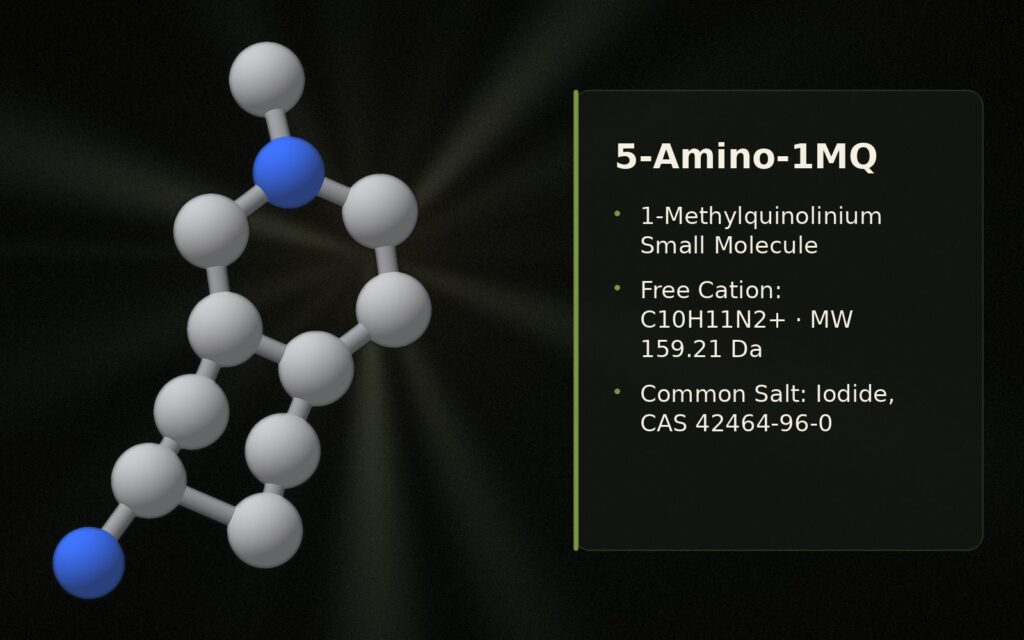
5-Amino-1MQ is a small-molecule research compound studied for its ability to inhibit an enzyme called nicotinamide N-methyltransferase (NNMT). It has drawn interest in laboratory settings because NNMT activity intersects with adipocyte (fat cell) metabolism, cellular NAD+ availability, and skeletal muscle stem cell function — three areas of active basic-science research.
The evidence base for 5-Amino-1MQ is still narrow. What exists comes from cultured cells and rodent models published by a small number of academic labs, most notably a group at the University of Texas Medical Branch (UTMB). No human clinical trials of 5-Amino-1MQ have been published, and no regulatory body has evaluated it for safety or effectiveness in people. Readers should treat every finding below as a laboratory result, not as evidence of a benefit in humans.
This guide summarizes the verifiable chemistry, mechanism, and preclinical data on 5-Amino-1MQ, and separates it clearly from the marketing claims that circulate around the compound online. It is written for laboratory researchers and other qualified professionals evaluating 5-Amino-1MQ as a research reagent — not as guidance for human use.
Featured definition: What is 5-Amino-1MQ?
5-Amino-1MQ (5-amino-1-methylquinolinium) is a small-molecule quinolinium derivative studied in laboratory research as a selective, cell-permeable inhibitor of nicotinamide N-methyltransferase (NNMT), an enzyme involved in cellular methylation and NAD+ metabolism. It is not a peptide, has not been approved by the U.S. Food and Drug Administration (FDA) for any use, and is not intended for human or animal consumption — it is sold and used exclusively as a research chemical.
What Is 5-Amino-1MQ? Chemical Identity and Derivation
5-Amino-1MQ is a small molecule, not a peptide — it contains no amino acid sequence and is not synthesized on a peptide synthesizer. Structurally, it is a quinolinium ring system with an amino (-NH2) substituent at the 5-position and a methyl group on the ring nitrogen, which is what gives the compound its “1-methylquinolinium” (1MQ) name.
Verified chemical identifiers for the compound:
- Chemical name: 5-amino-1-methylquinolin-1-ium (5-amino-1-methylquinolinium)
- Molecular formula (free cation): C₁₀H₁₁N₂⁺
- Molecular weight (free cation): approximately 159.21 g/mol
- Common laboratory salt form: 5-amino-1-methylquinolinium iodide (CAS 42464-96-0), molecular formula C₁₀H₁₁N₂·I, molecular weight approximately 286.11 g/mol
- Structure class: Quinolinium derivative (small molecule); a permanently charged (cationic) ring nitrogen is what gives the molecule its high membrane permeability, a property researchers have specifically noted when comparing it to earlier, less cell-permeable NNMT inhibitors
Because 5-Amino-1MQ carries a positive charge on the ring nitrogen, it is typically supplied and characterized as a salt — most commonly the iodide salt referenced above — rather than as a free base. Researchers sourcing the compound for laboratory use should confirm the exact salt form, purity (typically reported by HPLC), and certificate of analysis provided by the supplier, since molecular weight and dosing calculations in published studies are salt-form-specific.
5-Amino-1MQ was developed and characterized as a chemical probe for NNMT inhibition — it was not derived from a natural hormone, peptide, or endogenous signaling molecule, unlike many of the peptides more commonly discussed in longevity and metabolic research. It emerged from structure-activity work aimed at improving on earlier NNMT inhibitors that lacked adequate cell permeability for use in intact cells and animals.
How Is 5-Amino-1MQ Proposed to Work? Mechanism of Action
The proposed mechanism of 5-Amino-1MQ centers entirely on its activity as an NNMT inhibitor. Nicotinamide N-methyltransferase is an enzyme that transfers a methyl group from S-adenosylmethionine (SAM) onto nicotinamide, producing 1-methylnicotinamide (1-MNA) as a byproduct. This reaction sits at the intersection of two metabolic pathways researchers care about:
- The NAD+ salvage pathway — nicotinamide is a precursor for NAD+, a coenzyme central to cellular energy metabolism. When NNMT consumes nicotinamide, less is available for NAD+ regeneration.
- The methionine cycle / one-carbon metabolism — NNMT consumes SAM, the cell’s primary methyl donor, which is also used for other methylation reactions (including DNA and histone methylation).
In laboratory studies, NNMT expression has been found to be substantially elevated in certain tissues — most notably differentiated adipocytes (fat cells) and, separately, in some models of aged or senescent tissue. Researchers investigating 5-Amino-1MQ have hypothesized that inhibiting NNMT in these contexts could increase local NAD+ and SAM availability, which in turn has been associated in preclinical models with shifts in lipid metabolism and with changes in muscle stem cell activation.
It is important to state plainly what this mechanism does not establish: NNMT inhibition is a laboratory hypothesis about a metabolic pathway, observed in cultured cells and mice. It has not been demonstrated to produce a specific clinical outcome in humans, and the studies described below should be read as investigations of mechanism, not as evidence of a treatment effect.
Preclinical Research: What Cell and Animal Studies Have Found
All findings in this section come from published, peer-reviewed laboratory research conducted in cultured cells and in mice. None of these studies involved human subjects, and none should be read as evidence of what the compound does in the human body.
Adipocyte and Metabolic Research
The most-cited study of 5-Amino-1MQ in metabolic research is Neelakantan et al. (2018-2019), published in Biochemical Pharmacology by a research group at the University of Texas Medical Branch. Key reported findings:
- In cultured 3T3-L1 cells, NNMT expression was found to be roughly 37-fold higher in mature, differentiated adipocytes than in pre-adipocytes, suggesting a role for the enzyme specifically in fat cell biology.
- 5-Amino-1MQ reduced intracellular 1-methylnicotinamide (the direct product of NNMT activity) in a concentration-dependent manner, with a reported cellular EC50 of approximately 2.3 µM.
- At concentrations of 30–60 µM in culture, treated adipocytes showed a 50–70% reduction in lipogenesis (fat synthesis) compared to untreated controls, alongside increases in measured NAD+ and SAM levels.
- In diet-induced obese mice (male C57BL/6 mice maintained on a high-fat diet), the compound was administered subcutaneously at 20 mg/kg, three times daily (approximately 34 mg/kg/day, as reported in the study), for 11 days. This is a dose used in a specific mouse study — it is not a usage recommendation for humans or any other context.
- Over that 11-day period, treated mice lost an average of approximately 5.1% of baseline body weight, while control mice gained weight. Treated animals also showed roughly a 35% reduction in epididymal white adipose tissue mass, more than 30% smaller adipocyte size, and about a 30% reduction in plasma total cholesterol, with no measured change in food intake.
- The study authors noted the treatment window was short (11 days) and called for longer-duration studies and further pharmacokinetic optimization before drawing broader conclusions.
Aged Skeletal Muscle Regeneration Research
A separate line of research from the same laboratory group, published in Biochemical Pharmacology (Neelakantan et al., 2019), examined NNMT inhibition in the context of aging and muscle regeneration:
- Using 24-month-old mice (an aged-animal model) with an induced acute injury to the tibialis anterior muscle, researchers administered an NNMT inhibitor at low (5 mg/kg) and high (10 mg/kg) doses over one- and three-week post-injury periods. Again, these figures describe an aged-mouse injury model, not a human dosing protocol.
- Treated aged mice showed nearly double the myofiber cross-sectional area of controls during regeneration, and approximately 70% greater recovery of peak muscle torque.
- The researchers also reported increased muscle stem (satellite) cell proliferation and fusion, along with improved NAD+/NADH ratios in the regenerating tissue.
- The authors concluded that NNMT inhibition represents a “viable pharmacological approach” worth further study for age-related declines in muscle regenerative capacity — a preclinical, hypothesis-generating conclusion, not a therapeutic claim.
Beyond these two focused study lines, review literature on NNMT biology (e.g., recent PMC-indexed reviews on NNMT and metabolic syndrome, and on NNMT in aging-related conditions) discusses 5-Amino-1MQ primarily as a chemical tool used to probe NNMT’s role in these pathways, rather than as a therapeutic candidate with its own developed clinical program.
Human Evidence and Its Limitations
No published human clinical trials of 5-Amino-1MQ exist as of this writing. No pharmacokinetic, safety, dosing, or efficacy data in humans have been established in the peer-reviewed literature, and no such trials are listed as completed in public registries reviewed for this article.
This absence of human data is a significant limitation for anyone evaluating claims about the compound. Effects seen in cultured adipocytes and in mice — including species, strain, dose, and route-specific findings — frequently fail to translate to humans, or translate only partially and at different, unpredictable dose ranges. Human metabolism, NNMT tissue distribution, and pharmacokinetics for a compound like 5-Amino-1MQ have not been characterized. Any statement describing “expected” human effects, human dosing, or human safety margins for 5-Amino-1MQ goes beyond what the current research supports.
Evidence by Research Level
| Evidence Level | What It Shows | What It Cannot Prove |
|---|---|---|
| In vitro (cultured adipocytes, myoblasts) | NNMT is upregulated in differentiated fat cells; 5-Amino-1MQ inhibits NNMT activity and reduces measured lipogenesis at specific micromolar concentrations | Whether these cellular effects occur, or occur safely, in intact human tissue |
| In vivo — diet-induced obese mice | Short-term (11-day) subcutaneous dosing was associated with reduced body weight, fat mass, and cholesterol in one mouse strain | Long-term safety, effects in other species, or any outcome in humans |
| In vivo — aged mouse muscle-injury model | NNMT inhibition was associated with improved muscle regeneration metrics after acute injury in aged mice | Effects on human muscle aging, sarcopenia, or general “anti-aging” outcomes |
| Human clinical data | Not available | Cannot establish safety, dosing, or efficacy in humans; no claims of human benefit can be supported |
Common Claims vs. Evidence
5-Amino-1MQ is frequently marketed online as a “fat-loss compound” or “anti-aging peptide.” Neither framing is well supported by the current evidence, and the second is factually inaccurate about the molecule’s chemical class. The table below separates common marketing claims from what the cited research actually shows.
| Common Claim | What the Evidence Actually Shows |
|---|---|
| “5-Amino-1MQ is a peptide” | It is a small molecule (a quinolinium derivative), not a peptide — it contains no amino acid chain |
| “5-Amino-1MQ burns fat / causes weight loss” | Preclinical mouse data showed modest (~5%), short-term (11-day) body-weight and fat-mass reductions in one diet-induced obesity model; this has not been demonstrated in humans, and the finding does not establish a general “fat-burning” effect |
| “5-Amino-1MQ reverses aging” | A separate mouse study found improved muscle regeneration metrics after injury in aged animals; this is a specific, mechanism-focused finding in one tissue and one model, not evidence of a broad anti-aging effect |
| “5-Amino-1MQ is safe for long-term human use” | No human safety data exist; the longest published animal studies ran a few weeks, and long-term toxicology has not been established |
| “5-Amino-1MQ works like NNMT-targeting drugs already in clinical use” | No NNMT inhibitor, including 5-Amino-1MQ, has received FDA approval or completed late-stage human trials for any indication |
U.S. Regulatory Status
- FDA approval: 5-Amino-1MQ has not been approved by the FDA for any human or veterinary use, disease treatment, prevention, or dietary/supplement purpose. It has no FDA-recognized indication.
- 503A Bulks List: No record was found, in FDA’s published Bulks List materials or related guidance reviewed for this article, of 5-Amino-1MQ being nominated to or evaluated for the 503A Bulks List (the list governing substances traditional compounding pharmacies may use). Readers should not infer FDA acceptance or rejection from this absence — it simply has not been part of that public review process as far as could be verified.
- Warning letters naming this compound: No FDA warning letter specifically naming 5-Amino-1MQ or NNMT inhibitors was identified in the course of researching this article.
- Broader enforcement context: The FDA has, however, taken active enforcement action against sellers of other “research use only” compounds when those sellers made therapeutic claims inconsistent with RUO labeling. For example, FDA warning letters issued in December 2024 to peptide sellers cited them for marketing research-labeled GLP-1/GIP-class peptides (semaglutide, tirzepatide, retatrutide, cagrilintide, and mazdutide) with disease-treatment and weight-loss claims that established therapeutic intent for human use despite “research use only” disclaimers. This illustrates the agency’s active posture toward RUO-labeled products generally and underscores why research suppliers and researchers alike must keep marketing and labeling strictly within a laboratory-research context.
- Bottom line: 5-Amino-1MQ is not intended for human consumption, administration, or use of any kind outside a controlled laboratory research setting, and no U.S. regulatory body has evaluated it for human safety or efficacy.
Safety Considerations and Unknown Risks
Because no human trials exist, safety information is limited to what has been reported in cell and animal studies, plus general principles that apply to any uncharacterized small molecule:
- No established human safety profile. No maximum tolerated dose, no adverse-event data, and no drug-interaction data exist for humans.
- Short observation windows in animal studies. The published mouse studies ran on the order of 11 days to 3 weeks. Effects of longer-term or repeated NNMT inhibition — on the liver, kidney, methylation-dependent processes elsewhere in the body, or on other tissues where NNMT is expressed — have not been characterized.
- NNMT has roles beyond the tissues studied. NNMT is expressed in the liver and other organs and participates in broader methyl-group and NAD+ metabolism. Researchers studying NNMT inhibition generally note that systemic, sustained inhibition of a methyltransferase enzyme could plausibly affect other methylation-dependent processes; this has not been specifically tested for 5-Amino-1MQ in the available literature.
- Purity and formulation risks apply to any research chemical. Because 5-Amino-1MQ is not manufactured under pharmaceutical (GMP) standards for human use, sourced material intended for laboratory research may vary in purity, salt form, and stability between suppliers. Any research use should include appropriate analytical verification (e.g., HPLC/COA review) as part of standard laboratory practice.
- No data on interactions. Potential interactions with other compounds, medications, or physiological states have not been studied.
- Not for human or animal consumption. 5-Amino-1MQ is sold and should be used strictly as a laboratory research reagent, handled according to standard chemical safety practices (e.g., appropriate PPE, controlled storage conditions), and not administered to humans or animals outside of an approved research protocol.
Research Evaluation Checklist
For researchers or institutions evaluating 5-Amino-1MQ as a laboratory reagent, the following checklist can help frame a rigorous assessment:
- Confirm the research question. Is the study investigating NNMT biology, NAD+/methionine cycle metabolism, adipocyte function, or muscle stem cell regeneration specifically — the areas where published data exist?
- Verify the chemical identity and salt form. Confirm whether the material is the free cation or a specific salt (e.g., the iodide salt, CAS 42464-96-0), since molecular weight and reported concentrations in the literature are salt-form-specific.
- Review the certificate of analysis. Confirm purity (typically via HPLC) and identity confirmation (e.g., mass spectrometry) from the supplier before use in any experiment.
- Match your model to the literature. Note that most published in vivo data come from specific mouse strains, ages, and injury/diet models — findings may not generalize to other animal models without independent validation.
- Distinguish concentration/dose from any claim of effect. When citing prior work, use the exact in vitro concentration or in vivo dose reported (e.g., “20 mg/kg SC in DIO C57BL/6 mice”) rather than a generalized “effective dose.”
- Check for an appropriate institutional protocol. Any in vivo or in vitro work should proceed under an approved IACUC/IRB-equivalent protocol and institutional biosafety guidance, as applicable.
- Treat all findings as preliminary. With no human trials and a small number of published animal studies, current findings should be treated as hypothesis-generating rather than confirmatory.
People Also Ask About 5-Amino-1MQ
No. 5-Amino-1MQ is a small-molecule quinolinium derivative. It does not contain an amino acid sequence and is chemically distinct from peptides such as BPC-157 or Semax.
In laboratory studies, it acts as a selective, cell-permeable inhibitor of nicotinamide N-methyltransferase (NNMT), reducing the enzyme’s conversion of nicotinamide to 1-methylnicotinamide in cultured cells and animal tissue.
No published human clinical trials of 5-Amino-1MQ currently exist. All available data come from cell culture and mouse studies.
No. It has not been approved by the FDA for any human or animal use and is not intended for human consumption.
A mouse study found short-term reductions in body weight and fat mass in diet-induced obese mice given the compound by injection over 11 days. This preclinical finding has not been replicated in humans and should not be interpreted as a weight-loss claim.
This label appears to draw on a separate mouse study showing improved muscle regeneration in aged animals after injury. That is a narrow, mechanism-specific finding in one tissue type — it does not establish a general anti-aging effect, and no such claim is supported by current evidence.
Expert 5-Amino-1MQ Q&A
How does 5-Amino-1MQ’s mechanism differ from GLP-1 receptor agonists like semaglutide or tirzepatide?
They are unrelated mechanistically and chemically. GLP-1/GIP receptor agonists are peptide hormone mimetics that act on gut-brain signaling pathways and have completed extensive human clinical trials, leading to FDA approval for specific indications. 5-Amino-1MQ is a small molecule studied preclinically as an NNMT enzyme inhibitor with no completed human trials and no FDA approval. The two should not be discussed as comparable or interchangeable research subjects.
What is the significance of NNMT being elevated in adipocytes and aged tissue?
Researchers view elevated NNMT expression in these contexts as a potential marker of altered cellular methylation and NAD+ handling. It has led to the hypothesis, tested with NNMT inhibitors like 5-Amino-1MQ in preclinical models, that reducing NNMT activity could restore NAD+/SAM availability in these tissues. This remains a mechanistic hypothesis supported by early-stage animal data, not an established biological pathway with proven downstream benefit in humans.
Why hasn’t 5-Amino-1MQ progressed to human trials if the mouse data look promising?
Moving from a mouse pharmacology study to a human clinical trial requires extensive additional work — formal toxicology and safety pharmacology packages, pharmacokinetic characterization, manufacturing under regulatory-grade quality standards, and an investigational new drug (IND) application, among other steps. There is no public record of this process having been initiated for 5-Amino-1MQ, and the compound remains at an early, exploratory research stage.
What should a lab consider when designing an experiment with 5-Amino-1MQ?
Beyond standard reagent-quality checks (purity, identity confirmation, correct salt form), researchers should pay close attention to the specific concentrations and doses used in the published literature, since NNMT inhibition and any downstream metabolic effects appear to be concentration- and context-dependent in the available studies. Experiments should be designed to test a specific mechanistic hypothesis (e.g., NAD+/SAM changes, NNMT activity, lipogenesis markers) rather than to replicate a generalized “outcome.”
Are there other NNMT inhibitors researchers should be aware of alongside 5-Amino-1MQ?
Yes. The scientific literature on NNMT biology references multiple chemical tool compounds developed to probe this enzyme, including earlier, less cell-permeable inhibitors that preceded 5-Amino-1MQ’s development. Researchers comparing compounds should review potency (e.g., reported IC50/EC50 values), selectivity data, and cell-permeability characteristics reported for each specific molecule rather than treating “NNMT inhibitor” as a single interchangeable category.
Conclusion
5-Amino-1MQ is a small-molecule NNMT inhibitor with a genuine, if early-stage, body of preclinical research behind it — cell culture work establishing its potency and selectivity, a mouse study examining diet-induced obesity, and a separate mouse study examining aged skeletal muscle regeneration. Both animal studies came from short observation windows, used specific injected doses in specific mouse models, and were explicitly framed by their own authors as early findings warranting further study, not as demonstrated treatments.
No human trials of 5-Amino-1MQ have been published, it holds no FDA approval for any use, and no verified 503A Bulks List action or compound-specific FDA warning letter was identified in researching this guide. It is, and remains, a laboratory research chemical — not a human therapeutic, dietary supplement, or over-the-counter product.
Qualified researchers evaluating 5-Amino-1MQ for laboratory use are encouraged to review the primary literature cited in this guide directly and to consult Vericor Bioscience’s research product page for current specifications, purity documentation, and research-use-only terms.