
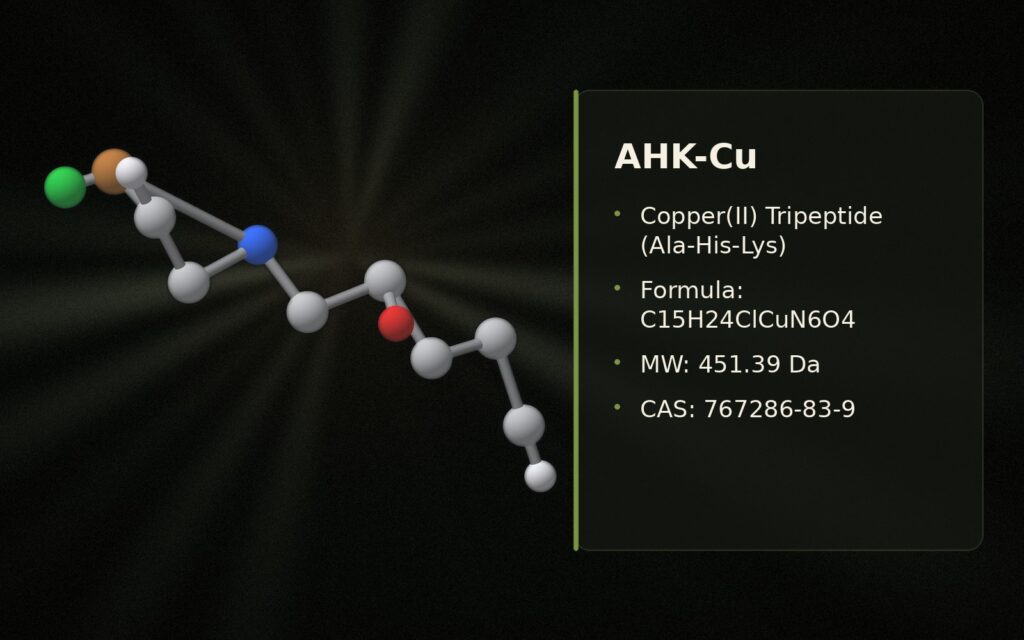
AHK-Cu is a copper-binding tripeptide that has drawn interest in dermatological and hair-follicle research as a laboratory tool for studying copper signaling in skin and scalp tissue. It is frequently discussed alongside its better-known relative, GHK-Cu, but the two are chemically distinct molecules with separate (and unequal) research records.
The evidence base for AHK-Cu specifically is narrow. A single peer-reviewed study using human hair follicle organ culture and isolated dermal papilla cells accounts for most of the direct experimental data on this exact peptide-copper complex. Much of what circulates online about AHK-Cu’s effects on collagen, elastin, and wound healing is extrapolated from research on GHK-Cu, a different tripeptide, and should not be read as evidence about AHK-Cu itself.
This article summarizes what has actually been published on AHK-Cu, what remains unstudied or unproven, and what its U.S. regulatory status is. It is written for laboratory researchers and is not a guide to human use. AHK-Cu is not approved by the FDA for any medical, therapeutic, or cosmetic use in humans, and nothing here should be read as a recommendation for human application.
Featured definition: What is AHK-Cu?
AHK-Cu (Copper Tripeptide-3) is a synthetic copper(II) complex of the tripeptide alanine-histidine-lysine (Ala-His-Lys), distinct from the more widely studied glycine-histidine-lysine copper complex, GHK-Cu. Its research record centers on a single published study showing effects on human hair follicle elongation and dermal papilla cell survival in ex vivo and in vitro models. It has not been evaluated in human clinical trials and is not FDA-approved for any use; it is sold strictly as a research-use-only laboratory reagent.
What Is AHK-Cu? Chemical Identity and Derivation
AHK-Cu is the copper(II) coordination complex of a three-amino-acid peptide: alanine, histidine, and lysine (hence “AHK”), chelated to a single copper ion. It is cataloged commercially under the CAS number 767286-83-9 and is also referred to in supplier and cosmetic-ingredient literature as “Copper Tripeptide-3” (some sources use “Copper Tripeptide-1,” an inconsistency in naming across vendors that researchers should be aware of when comparing product documentation).
Chemical suppliers commonly list the neutral chelate formula as C₁₅H₂₄CuN₆O₄, with a molecular weight of approximately 415.9 g/mol. PubChem’s database entry for this compound (CID 169450582) lists a closely related deprotonated anionic form of the same complex, C₁₅H₂₃CuN₆O₄⁻, reflecting how peptide-metal chelates can be represented at slightly different protonation states depending on the source. Researchers sourcing this compound should confirm the exact specification sheet (formula, salt form, and purity certificate) provided by their supplier rather than assuming a single universal formula, since batch documentation can vary.
Structurally Distinct From GHK-Cu
AHK-Cu is frequently confused with GHK-Cu (glycyl-L-histidyl-L-lysine copper complex, CAS 49557-75-7), a much older and more extensively studied copper tripeptide first isolated from human plasma in the 1970s. The two share a histidine-lysine copper-binding motif but differ in their first residue — alanine in AHK-Cu versus glycine in GHK-Cu — which changes the molecule’s size, charge distribution, and binding behavior. This is not a trivial distinction: the two peptides have separate research literatures, and findings from GHK-Cu studies do not automatically apply to AHK-Cu. Any research proposal or literature review should treat them as separate compounds rather than interchangeable “copper peptides.”
Proposed Mechanism of Action
Copper is an essential cofactor for several enzymes involved in connective-tissue remodeling and antioxidant defense, including lysyl oxidase (which cross-links collagen and elastin) and superoxide dismutase (an antioxidant enzyme). Free copper ions, however, are redox-active and can generate reactive oxygen species through Fenton-type chemistry, which is toxic to cells at sufficient concentration. The general hypothesis behind copper-tripeptide complexes like AHK-Cu is that chelating the copper ion within a small peptide may moderate this redox activity while still allowing regulated delivery of copper to cells that need it for these enzymatic processes.
For AHK-Cu specifically, the one published mechanistic study (discussed below) found that the complex increased the ratio of anti-apoptotic to pro-apoptotic proteins (Bcl-2/Bax) and reduced markers of programmed cell death (cleaved caspase-3, cleaved PARP) in cultured dermal papilla cells at the concentrations tested. This suggests a proposed anti-apoptotic, cell-survival-supporting mechanism in that specific cell type, rather than a demonstrated regenerative or collagen-synthesis mechanism. Broader claims that AHK-Cu directly stimulates collagen or elastin synthesis are extrapolated from the separate GHK-Cu literature and have not been independently confirmed for AHK-Cu in published research.
Preclinical Research: What Cell and Tissue Studies Show
Hair Follicle and Dermal Papilla Cell Research
The primary source of direct experimental data on AHK-Cu is a study by Pyo and colleagues published in the Archives of Pharmacal Research in 2007 (“The effect of tripeptide-copper complex on human hair growth in vitro,” Arch Pharm Res. 2007;30(7):834-9). This study used two research models:
- Ex vivo human hair follicle organ culture: Isolated human hair follicles were cultured with AHK-Cu at concentrations ranging from 10⁻¹² to 10⁻⁹ M. The researchers reported that AHK-Cu stimulated elongation of the cultured follicles compared to untreated controls.
- In vitro dermal papilla cell (DPC) culture: Human dermal papilla cells — specialized fibroblasts that regulate hair follicle cycling — were cultured with the same concentration range. AHK-Cu increased DPC proliferation, and at the highest concentration tested (10⁻⁹ M), it reduced the proportion of apoptotic (dying) DPCs, as measured by Annexin V-FITC/propidium iodide labeling and flow cytometry.
- Molecular findings: At 10⁻⁹ M, treated cells showed an elevated Bcl-2/Bax ratio (a marker associated with reduced apoptosis) and lower levels of cleaved caspase-3 and cleaved PARP, both markers of active cell death.
This is a legitimate, peer-reviewed, mechanistically detailed study — but it is a single publication, using ex vivo tissue and isolated cell culture, not a living animal or human subject. It has not, to our knowledge, been independently replicated by other research groups in the published literature.
What Has Not Been Directly Studied for AHK-Cu
Unlike GHK-Cu, which has decades of published research spanning wound-healing animal models, collagen synthesis assays, and some early human studies, AHK-Cu does not have a comparable body of independent research. We did not identify published in vivo animal studies (mouse or otherwise) specific to AHK-Cu, nor independent studies on AHK-Cu and collagen synthesis, elastin production, antimicrobial activity, or full-thickness wound closure. Marketing material that attributes these effects to AHK-Cu is generally drawing on the separate GHK-Cu literature rather than data generated with AHK-Cu itself. Researchers designing new studies should treat these as open questions rather than established findings.
Human Evidence and Its Limitations
We did not identify any published human clinical trials of AHK-Cu — no randomized controlled trials, open-label trials, or case series evaluating the compound’s effects, safety, or pharmacokinetics in human subjects. The Pyo et al. (2007) study used human-derived tissue (hair follicles and dermal papilla cells) in ex vivo and in vitro culture systems, which is a step closer to human biology than an animal model, but it is not equivalent to a clinical trial: it does not establish systemic safety, dosing, absorption, or outcomes in living human beings. No conclusions about human efficacy or safety can be drawn from a single tissue-culture study, and none should be inferred from it.
Evidence by Research Level
| Evidence Level | What It Shows | What It Cannot Prove |
|---|---|---|
| In vitro cell culture (dermal papilla cells) | AHK-Cu increased proliferation and reduced apoptosis markers in isolated human dermal papilla cells at nanomolar-to-picomolar concentrations in one study. | Cannot establish effects in intact tissue, a living organism, or a human being; cell-culture responses do not reliably predict in vivo outcomes. |
| Ex vivo human hair follicle organ culture | AHK-Cu was associated with follicle elongation in isolated, cultured human hair follicles. | Cannot establish systemic safety, dosing, delivery method, or outcomes in a living scalp with intact circulation, immune activity, and hormonal regulation. |
| In vivo animal studies | No AHK-Cu-specific published animal studies were identified in this review. | Cannot speak to species-specific metabolism, systemic toxicity, or whole-organism effects, because this evidence tier does not yet exist for this compound. |
| Human clinical trials | None identified. | Cannot establish human safety, efficacy, appropriate exposure levels, or long-term outcomes, because no such trials have been published. |
Common Claims vs. Evidence
| Common Marketing Claim | What the Evidence Actually Shows |
|---|---|
| “AHK-Cu regrows hair” | One ex vivo/in vitro study found AHK-Cu stimulated elongation of cultured human hair follicles and dermal papilla cell proliferation. This is a preclinical laboratory finding, not evidence that AHK-Cu regrows hair in a living person. |
| “AHK-Cu boosts collagen and elastin like GHK-Cu” | This claim borrows from the separate GHK-Cu literature. We did not identify a published study measuring AHK-Cu’s direct effect on collagen or elastin synthesis. |
| “AHK-Cu heals wounds” | No published wound-healing study (animal or human) specific to AHK-Cu was identified. Wound-healing claims for copper peptides generally originate from GHK-Cu research, not AHK-Cu research. |
| “Safe because it’s ‘natural’ copper and amino acids” | Copper is redox-active, and uncomplexed or excess copper can generate oxidative stress; safety of any specific complex, dose, and route in humans has not been established through clinical study for AHK-Cu. |
| “Equivalent to or better than GHK-Cu” | The two are structurally different molecules with separate, non-interchangeable research records; AHK-Cu’s published evidence base is far smaller than GHK-Cu’s. |
U.S. Regulatory Status
AHK-Cu is not approved by the U.S. Food and Drug Administration for any therapeutic, medical, or cosmetic use in humans. It has no FDA-approved indication, no New Drug Application, and no monograph status as an approved over-the-counter drug ingredient.
Unlike several injectable research peptides that have gone through FDA’s Pharmacy Compounding Advisory Committee (PCAC) review process for the 503A Bulks List — the mechanism by which compounded pharmacies can legally source certain bulk drug substances — we did not identify any record of AHK-Cu being nominated for, reviewed under, or acted upon within that 503A Bulks List process. This is consistent with AHK-Cu’s research and commercial history, which centers on topical cosmetic-ingredient formulation and laboratory research rather than compounded injectable use.
We also did not identify an FDA warning letter that names AHK-Cu specifically. This does not mean the compound is endorsed, cleared, or exempt from oversight — it means no such document surfaced in this research. FDA has, in recent years, issued broader warning letters and public communications targeting the unapproved-peptide marketplace generally, including “research use only” labeling used to market products for unsupervised human use, and has increased scrutiny of peptide compounding overall. Any research-use-only product, including AHK-Cu, sold or marketed for human self-administration, cosmetic application, or therapeutic use would fall outside its legitimate research-reagent status and outside the scope of any RUO labeling.
Vericor Bioscience sells AHK-Cu strictly as a research-use-only laboratory compound. It is not labeled, marketed, or intended for human use, self-administration, or incorporation into cosmetic products for sale to consumers.
Safety Considerations and Unknown Risks
Because no human clinical trials of AHK-Cu have been published, there is no established human safety profile, no defined safe exposure range, and no characterized adverse-event profile for this specific compound. Researchers should weigh the following known and open considerations:
- Copper’s redox chemistry. Free or loosely bound copper ions can participate in Fenton-type reactions that generate reactive oxygen species, which are cytotoxic at sufficient levels. The premise of peptide-chelated copper delivery is to moderate this activity, but the degree to which AHK-Cu achieves this compared to other copper complexes has not been independently quantified across a body of studies.
- Topical copper-peptide irritation reports. In the broader cosmetic-copper-peptide category (primarily involving GHK-Cu-containing products), user reports and some clinical literature describe irritation, dryness, or purging reactions with topical use. These reports are not specific to AHK-Cu and come largely from consumer cosmetic use rather than controlled research, but they illustrate that copper-peptide formulations are not risk-free irritant-wise.
- No pharmacokinetic data. Absorption, distribution, metabolism, and elimination of AHK-Cu in any living system (animal or human) have not been published, so systemic exposure risk from any route of administration is unknown.
- No established dosing. There is no validated concentration, frequency, or exposure duration for any research application beyond what was used in the single published cell/tissue study, and that data point should not be treated as a dosing recommendation for any purpose.
- Sourcing and purity variability. As with any peptide-metal complex sold across multiple suppliers, purity, salt form, and copper-to-peptide stoichiometry can vary by manufacturer and lot. Researchers should require a current certificate of analysis for any batch used in experimental work.
- Regulatory gap. The absence of FDA review or approval means there is no regulatory body that has evaluated AHK-Cu’s safety for any use; the compound exists in a research-only space precisely because that evaluation has not occurred.
Research Evaluation Checklist
- Confirm the exact chemical identity (CAS number, molecular formula, and salt form) matches your intended research specification, and request a current certificate of analysis from the supplier.
- Verify whether a claim you’ve encountered is supported by a published, peer-reviewed AHK-Cu study, or whether it has been extrapolated from GHK-Cu or generic “copper peptide” research.
- Identify which research tier (cell culture, ex vivo tissue, animal, human) any cited finding comes from, and do not extend conclusions beyond that tier.
- Check for independent replication — to date, the core hair-follicle/dermal-papilla finding rests on a single published study, which should factor into how much weight it is given.
- Confirm the compound’s current FDA status directly (FDA.gov, PCAC meeting materials, warning letter database) rather than relying on secondary summaries, since regulatory status and enforcement actions can change.
- Design experiments with appropriate institutional oversight (IACUC for animal work, IRB for any human-tissue work) and standard laboratory biosafety practices.
- Never source, label, or market this compound for human self-administration, cosmetic consumer use, or any therapeutic purpose — it is a laboratory research reagent only.
People Also Ask About AHK-Cu
No. AHK-Cu and GHK-Cu are different tripeptide-copper complexes — alanine-histidine-lysine versus glycine-histidine-lysine — with separate chemical identities and separate, non-interchangeable research literatures.
AHK-Cu is a copper(II) ion chelated to the tripeptide alanine-histidine-lysine. Its commonly cited molecular formula is C₁₅H₂₄CuN₆O₄, with a molecular weight of approximately 415.9 g/mol (CAS 767286-83-9).
No published human clinical trials of AHK-Cu were identified. The main published study used human-derived tissue (hair follicles and dermal papilla cells) in ex vivo and in vitro laboratory culture systems, not living human subjects.
No. AHK-Cu has no FDA-approved use, is not reviewed on the 503A Bulks List, and is not an approved cosmetic or drug ingredient. It is available only as a research-use-only laboratory compound.
A single laboratory study found that AHK-Cu stimulated elongation of isolated, cultured human hair follicles and increased proliferation of dermal papilla cells in vitro. This is preclinical laboratory evidence, not a demonstrated human outcome, and no clinical trial has tested hair regrowth in living subjects.
Because it has not undergone the clinical testing and regulatory review the FDA requires for a compound to be approved for human medical or cosmetic use. RUO labeling reflects the compound’s legitimate current status as a laboratory reagent, not a marketing workaround for unsupervised human use.
Expert AHK-Cu Q&A
How strong is the evidence that AHK-Cu affects hair follicle biology?
It is a single, methodologically detailed, peer-reviewed study — using both ex vivo human follicle organ culture and isolated dermal papilla cell assays with molecular apoptosis markers, which is a reasonably rigorous design. The limitation is not the study’s quality but its solitude: one publication does not constitute a validated finding until independent labs replicate it, and no in vivo or clinical follow-up has been published to our knowledge.
Why do so many marketing claims about AHK-Cu actually cite GHK-Cu research?
GHK-Cu has a much larger, older research base, so it is easier for commercial content to borrow its findings and apply them loosely to “copper peptides” as a category. Because AHK-Cu and GHK-Cu differ in their first amino acid residue and have distinct binding and cellular behavior, this substitution is not scientifically justified, and researchers should trace any claim back to a study that actually used AHK-Cu.
What would meaningfully strengthen AHK-Cu’s evidence base?
Independent replication of the 2007 hair-follicle findings, dose-response and mechanistic studies clarifying how the tripeptide modulates copper’s redox behavior, in vivo animal models assessing systemic exposure and tissue-level effects, and eventually controlled human studies — none of which have been published for this specific compound as of this writing.
Is there a meaningful difference between how AHK-Cu and free copper ions behave biologically?
The chelation hypothesis proposes that binding copper within the peptide structure moderates its redox reactivity relative to unbound copper ions, which are more directly associated with oxidative damage. This is a plausible mechanism supported by broader copper-chemistry and copper-peptide literature, but AHK-Cu-specific data quantifying this moderation (compared to free copper or to GHK-Cu) is limited.
What should a researcher do before designing a study with AHK-Cu?
Start with a current certificate of analysis to confirm identity and purity, review the single existing peer-reviewed study closely to understand its exact methods and concentration range, decide which evidence gap your study is meant to address (replication, mechanism, or a new research question), and secure appropriate institutional review before any cell, tissue, or animal work begins.
Conclusion
AHK-Cu is a chemically well-defined copper tripeptide with a narrow but legitimate research record centered on human hair follicle and dermal papilla cell biology. Its single published study is a useful starting point for further inquiry, not a settled finding — and much of the broader “copper peptide” narrative attached to it in commercial contexts actually belongs to the separate GHK-Cu literature. It is not FDA-approved, has not been tested in humans, and carries meaningful open questions about mechanism, dosing, and safety that only further controlled research can answer.
Qualified researchers evaluating AHK-Cu for laboratory use should review the compound’s current specifications, certificate of analysis, and intended research application on Vericor Bioscience’s research product page before use. All Vericor compounds are sold strictly for in vitro and laboratory research purposes and are not intended for human or animal administration.