
Cerebrolysin is one of the more unusual entries in the neuroscience research literature, and it is important to say so plainly before anything else: it is not a single, defined peptide. Compounds like BPC-157 or Semax are individual amino acid sequences with one molecular formula and one CAS number. Cerebrolysin is a complex mixture — a standardized preparation of low-molecular-weight peptide fragments and free amino acids derived from porcine (pig) brain tissue. That distinction shapes almost everything else that follows in this article, from how the material is characterized in a laboratory to how its research findings should be interpreted to how any research-use-only version of it should be evaluated before purchase.
This article summarizes what has actually been studied and reported about Cerebrolysin in the scientific and regulatory record — it is not a recommendation for use, and findings from clinical research conducted in other countries should not be read as translating into a safe or effective use case for a U.S. reader. Cerebrolysin has been evaluated as a prescription pharmaceutical in a number of countries outside the United States for conditions such as stroke recovery and vascular dementia. It has not been approved by the U.S. Food and Drug Administration for any indication, and it has not been evaluated by the FDA for safety or efficacy under U.S. regulatory standards. Nothing here is medical advice or an endorsement of self-administration. Material sold under the Cerebrolysin name for research purposes is intended strictly for non-clinical laboratory research by qualified personnel — not for human or animal consumption.
Featured Definition: What Is Cerebrolysin?
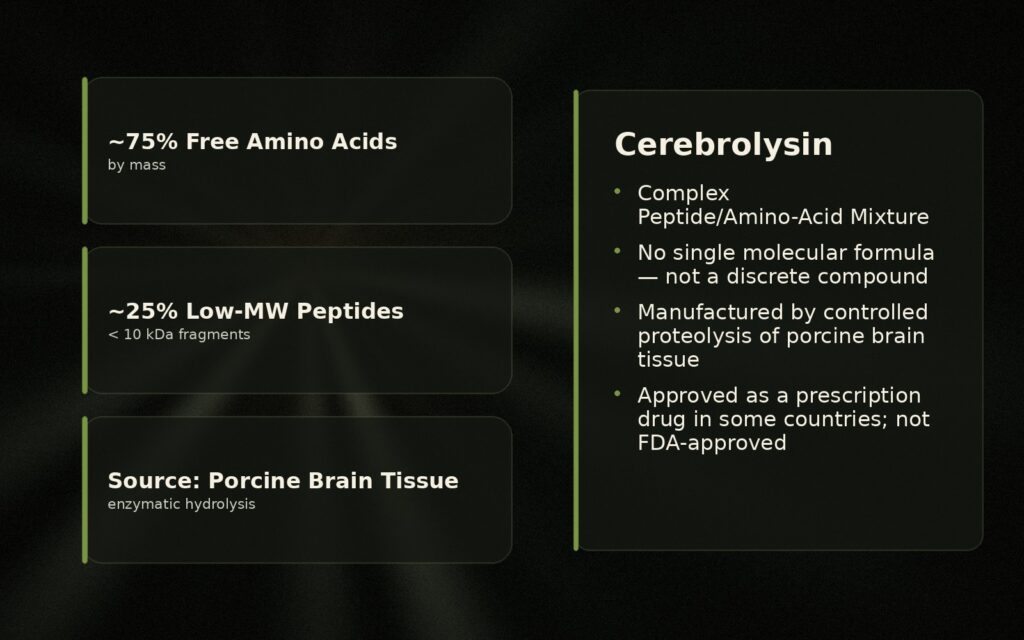
Cerebrolysin is a standardized preparation manufactured by enzymatic breakdown (proteolysis) of porcine brain tissue, yielding a mixture composed of roughly 25% low-molecular-weight peptides (under 10 kDa) and 75% free amino acids. It is studied in neuroscience research as a “neurotrophic-mimetic” agent — a substance proposed to mimic the signaling activity of natural brain growth factors — and is approved as a prescription drug in dozens of countries for neurological conditions, though not in the United States. Because it is a mixture rather than a single molecule, it does not have one defined molecular formula the way a discrete peptide does.
What Is Cerebrolysin? Composition and Sourcing {#composition}
Cerebrolysin was developed decades ago as a biological extract intended to concentrate the neurotrophic (nerve-growth-supporting) fraction of mammalian brain tissue. The manufacturing process — historically associated with originator manufacturer EVER Neuro Pharma, based in Austria — uses standardized enzymatic (proteolytic) digestion of porcine brain tissue to break large brain proteins into smaller fragments. The resulting preparation is reported to consist of approximately:
- ~25% low-molecular-weight peptides (generally under 10 kDa), representing many different short peptide fragments rather than one sequence, and
- ~75% free amino acids, the individual building blocks left over after proteolysis.
This is fundamentally different from how a single research peptide is defined. A discrete peptide has one amino acid sequence, one molecular weight, one molecular formula, and one CAS registry number, which allows a laboratory to verify identity and purity against a single reference standard. Cerebrolysin, by contrast, is a batch-characterized biological mixture — its identity is defined by manufacturing process controls, peptide-to-amino-acid ratio specifications, and analytical fingerprinting (such as chromatographic profiling), not by a single chemical structure.
That distinction is not academic. It has direct, practical implications for anyone evaluating research material sold under the Cerebrolysin name.
Why Cerebrolysin Has No Single Molecular Formula {#no-formula}
Because Cerebrolysin is a mixture of many different peptide species and free amino acids rather than one defined compound, it is not chemically accurate to describe it — as one might for BPC-157 or Semax — with a single molecular formula, a single exact mass, or a single “amino acid sequence.” Reputable pharmaceutical documentation for Cerebrolysin describes it in terms of composition ratios, manufacturing specifications, and biological/analytical characterization rather than a discrete structure.
This matters directly for research-use-only material sold under the Cerebrolysin name (or as a “Cerebrolysin-like” or “neuropeptide complex” product): because there is no single molecular fingerprint to test against, verifying that a given batch actually contains the expected peptide/amino-acid composition — and is free of contaminants — requires a different, more rigorous kind of documentation than a certificate of analysis for a single peptide. Any supplier of Cerebrolysin-type research material should be able to produce sourcing and compositional testing documentation specific to that batch. A generic purity claim (“99% pure”) is not a meaningful statement for a compound that is, by definition, a heterogeneous mixture — researchers should ask what, specifically, is being measured and against what reference.
Proposed Mechanisms Under Research {#mechanisms}
Researchers have proposed several overlapping mechanisms to explain Cerebrolysin’s biological activity in preclinical models, generally grouped under the umbrella of “neurotrophic-mimetic” or “neuroprotective” activity:
- Neurotrophic-factor-like signaling. Some peptide fragments in the mixture have been reported in cell and animal studies to activate signaling pathways associated with endogenous neurotrophic factors such as BDNF, NGF, and GDNF, which support neuron survival and growth.
- Anti-apoptotic and anti-inflammatory effects. Preclinical studies have examined whether Cerebrolysin reduces markers of programmed cell death and neuroinflammation following injury models such as induced ischemia.
- Synaptic plasticity and synaptogenesis. Animal studies have explored effects on dendritic branching and synapse formation, proposed as relevant to functional recovery after brain injury.
- Amyloid and tau pathology modulation. In rodent Alzheimer’s models, some studies report reduced amyloid-beta plaque and tau tangle markers, though translating this preclinical signal to human disease-modifying benefit remains unproven.
Because Cerebrolysin is a mixture, isolating which specific peptide fraction (if any) drives a given effect is scientifically difficult, and most published mechanistic work describes effects of the whole preparation rather than one active ingredient. This remains an area of ongoing preclinical research, not an established mechanism of action in humans.
Research Findings by Condition {#research-by-condition}
Unlike many single-molecule research peptides, Cerebrolysin has an unusually large human clinical trial literature, because it has been studied as a licensed pharmaceutical in multiple countries. That is a genuine point of interest for researchers — but the honest reading of that literature is mixed, not uniformly positive, and none of it establishes a treatment for a U.S. audience.
Ischemic Stroke Research
Cerebrolysin has been one of the more extensively studied agents in post-stroke recovery research, primarily through trials conducted in countries where it is an approved pharmaceutical. The evidence here is genuinely conflicting between reviews:
- A Cochrane systematic review (roughly six randomized controlled trials, about 1,500 participants, three of them large multicentre studies) found no clear benefit on mortality or functional outcome, and reported that Cerebrolysin more than doubled the rate of non-fatal serious adverse events in the three large multicentre trials. The reviewers concluded the potential benefit “is not supported by reliable evidence” and advised against routine use for acute ischemic stroke.
- More recent, larger pooled analyses tell a different story on safety. A 2021 meta-analysis of twelve trials (roughly 2,200 patients) reported no statistically significant difference in deaths, serious adverse events, or overall adverse events versus placebo — the opposite safety signal from the Cochrane analysis. A 2025 review pooling fourteen trials reported some positive signals on functional-recovery measures at higher doses and in more severe stroke, but again flagged trial heterogeneity and variable methodological quality.
Researchers should note that this is a genuinely unsettled evidence base, with different systematic reviews reaching different conclusions on both efficacy and safety depending on which trials are included and how adverse events are pooled — precisely the kind of inconsistency that warrants caution rather than confidence, in either direction.
Vascular Dementia Research
A Cochrane review of Cerebrolysin for vascular dementia (a small number of trials, with no new qualifying studies added since around 2013) reported a statistically detectable but modest improvement in cognition and global function versus placebo, with no significant difference in adverse effects between groups. The review rated the underlying evidence as “very low quality” due to high risk of bias and heterogeneity, and concluded any real benefit “may be too small to be clinically meaningful,” calling for larger, better-designed trials that do not appear to have since been completed.
Alzheimer’s-Type Dementia Research
Several randomized trials, mostly conducted in countries where Cerebrolysin is an approved pharmaceutical, have examined its effects in mild-to-moderate Alzheimer’s disease. Results have been mixed but include some positive signals: one trial reported dose-related improvements in global clinical function, cognition, activities-of-daily-living measures, and neuropsychiatric symptoms over roughly 24 weeks, with a favorable short-term safety profile. Other analyses describe the cognitive benefit as statistically real in some pooled data but modest in magnitude, and note that findings have not been consistently replicated across independent research groups or scaled to large, long-duration confirmatory trials.
Traumatic Brain Injury Research
Cerebrolysin has also been studied, to a lesser extent, in traumatic brain injury (TBI) recovery research, largely in countries where it holds an approved TBI indication. The clinical trial base here is comparatively thinner and more exploratory than the stroke and dementia literature, with most available evidence coming from smaller studies rather than large, high-quality randomized trials. Researchers examining Cerebrolysin in TBI models generally describe the evidence as preliminary and hypothesis-generating rather than established.
Evidence by Research Level {#evidence-table}
| Research Level | Context Studied | Summary of What Has Been Reported |
|---|---|---|
| Preclinical (cell/animal models) | General neuroprotection, Alzheimer’s models | Reported neurotrophic-factor-like signaling, reduced apoptosis markers, reduced amyloid-beta/tau pathology markers in rodent models |
| Human RCTs — Ischemic stroke | Post-stroke functional recovery | Conflicting results across reviews: a Cochrane analysis found no benefit and elevated serious adverse events in large trials; more recent, larger pooled analyses reported a favorable safety profile and some functional-outcome signals, especially at higher doses |
| Human RCTs — Vascular dementia | Cognitive and global function | Modest statistical improvement reported, but rated “very low quality” evidence by Cochrane reviewers due to bias and heterogeneity; no significant safety difference vs. placebo |
| Human RCTs — Alzheimer’s-type dementia | Cognition, function, behavior | Some dose-related positive findings in individual trials; effects described as modest and inconsistently replicated across the broader literature |
| Human RCTs — Traumatic brain injury | Neurological recovery after TBI | Limited number of studies; evidence described as preliminary/exploratory rather than established |
None of the above constitutes evidence of a safe or effective treatment for U.S. consumers. Clinical trial activity took place primarily in jurisdictions where Cerebrolysin holds pharmaceutical approval, under medical supervision and pharmaceutical-grade manufacturing — conditions that do not apply to research-use-only material.
Regulatory Status: Approved Elsewhere, Not in the United States {#regulatory}
Cerebrolysin occupies a genuinely unusual regulatory position compared to most compounds discussed in peptide research contexts: it is reported to hold prescription drug approval in a substantial number of countries, while remaining unapproved in the United States. Both facts are true, verifiable, and worth stating plainly — approval elsewhere is not the same thing as FDA approval, and does not change Cerebrolysin’s status for a U.S. researcher or consumer.
| Jurisdiction / Region | Reported Status |
|---|---|
| United States (FDA) | Not approved for any indication. Not listed among FDA-approved drug products. Cerebrolysin was explicitly named in a November 2021 FDA warning letter (issued to a compounding facility) as a substance that had not been nominated for, or included on, the Section 503A Bulks List — meaning it cannot lawfully be used by compounding pharmacies operating under that exemption. |
| Russia, Ukraine, and parts of Eastern Europe (e.g., Romania, Hungary, Poland, Bulgaria) | Reported as an approved prescription pharmaceutical for stroke, TBI, and dementia-related indications |
| China, South Korea, Vietnam, Mongolia | Reported as an approved pharmaceutical product |
| Austria, Germany, and other individual EU member states | Nationally authorized in some member states (the originator manufacturer is headquartered in Austria); not centrally approved EU-wide by the European Medicines Agency |
| Mexico, parts of Latin America, the Middle East, and Southeast Asia | Reported as approved in various individual markets |
| Overall | Reported to hold approval as a prescription drug in roughly 44 countries in total, according to manufacturer and literature sources |
For a U.S. researcher, the relevant takeaway is not that Cerebrolysin is “proven safe” because another country’s regulator has approved it. Different regulators apply different evidentiary standards, and approval in another jurisdiction says nothing about whether the FDA has reviewed the same evidence and reached the same conclusion — in this case, it has not. Any Cerebrolysin or Cerebrolysin-like material offered for sale in the United States as a research chemical is not the approved pharmaceutical product used in those other countries’ clinical settings, has not undergone FDA review, and is not intended for human or animal use.
Safety Considerations and Unknown Risks {#safety}
Safety data on Cerebrolysin is more extensive than for many research peptides, because of its history as a licensed pharmaceutical — but “more data” has not produced a consistent picture, and it does not extend to unregulated research material.
Reported adverse events in clinical trials. Commonly reported adverse events in the published trial literature include headache, dizziness, agitation, fever, and injection-site reactions, generally described as mild and transient. But systematic reviews disagree meaningfully on serious adverse event rates: the Cochrane stroke review reported more than double the rate of non-fatal serious adverse events in the Cerebrolysin arm across three large trials, while later, larger pooled analyses reported no significant difference from placebo. Researchers should treat this as an open, unresolved question rather than a settled “good safety profile.”
Composition-consistency risk — specific to a mixture product. Because Cerebrolysin is a biological mixture rather than a single defined molecule, batch-to-batch consistency in the peptide/amino-acid ratio is a documented concern in the pharmaceutical literature, and manufacturers of the approved drug product maintain validated process controls to manage it. Research-use-only material sourced outside that pharmaceutical manufacturing chain carries meaningfully higher batch-to-batch variability risk, because there is no single reference structure to test a sample against — only a compositional profile that depends entirely on the sourcing and manufacturing behind that specific batch.
Animal-tissue sourcing risk. As a product derived from porcine central nervous system tissue, Cerebrolysin sits in a category of animal-tissue-derived biologics that pharmaceutical regulators subject to specific sourcing, screening, and processing controls, including controls addressing transmissible pathogen risk associated with CNS tissue generally. This is a reason for heightened scrutiny, not diminished scrutiny, of any research-use-only material claiming to be porcine-brain-derived: researchers should expect documentation of tissue sourcing and processing controls, and treat its absence as a significant red flag.
Unknowns. Long-term safety data, data outside the specific trial populations studied, and independent confirmatory research on many reported findings remain limited. The absence of evidence of harm in a limited trial base is not evidence of safety, particularly for a mixture evaluated outside a pharmaceutical manufacturing and regulatory framework.
Research Evaluation Checklist {#checklist}
Researchers evaluating any Cerebrolysin or Cerebrolysin-like research material should consider working through the following before use in a laboratory setting:
- Confirm the product is labeled “for research use only” / “not for human or animal use.” Do not proceed if this labeling is absent or ambiguous.
- Request batch-specific compositional documentation, not a generic purity statement — since Cerebrolysin is a mixture, ask what peptide-to-amino-acid ratio and profile testing was performed, and against what method.
- Request third-party analytical testing (COA) for that specific lot, including any chromatographic or mass-spectrometry profiling used to characterize the mixture.
- Ask for tissue-sourcing documentation, including species verification and any animal-health screening applied upstream of manufacturing.
- Verify manufacturing and storage conditions, since a biological mixture can be more sensitive to degradation than a single stable peptide.
- Check for consistency across batches if ordering repeatedly — ask whether the supplier tests and documents batch-to-batch variability.
- Review the primary literature yourself rather than marketing summaries — note which findings come from Cochrane-level systematic reviews versus single small trials, and where reviews disagree.
- Confirm your institution’s biosafety and oversight protocols cover the intended non-clinical research use and appropriate handling of an animal-tissue-derived material.
- Do not use the material, or direct anyone else to use it, outside a qualified non-clinical research setting.
People Also Ask About Cerebrolysin
No. BPC-157 and Semax are each a single, defined peptide with one amino acid sequence and molecular formula. Cerebrolysin is a mixture of low-molecular-weight peptide fragments plus free amino acids, derived from porcine brain tissue, and is characterized by composition ratios rather than a single chemical structure.
Yes — it is reported to be approved as a prescription pharmaceutical in a substantial number of countries outside the United States, including Russia, China, and parts of Eastern Europe and Latin America, for indications such as stroke recovery, TBI, and vascular dementia. It has not been approved by the FDA in the United States, and approval elsewhere does not mean it has been evaluated under U.S. regulatory standards.
No. Material sold as a research chemical is not manufactured, tested, or regulated as the approved pharmaceutical product used under medical supervision abroad. It has not undergone FDA review and is not intended for human or animal use.
Because systematic reviews of the trial literature have reached different conclusions. A widely cited Cochrane review of stroke trials found an elevated rate of serious adverse events, while more recent, larger pooled analyses reported no significant safety difference from placebo. This is a genuinely unresolved point in the literature, not a settled conclusion.
Not in the way a single peptide does. As a mixture of many peptide fragments and free amino acids, its identity in regulatory documentation is expressed through composition specifications and process controls rather than one chemical formula.
Cerebrolysin has not been approved by the FDA for any use, and the FDA has specifically identified it as ineligible for use by compounding pharmacies under the Section 503A bulk drug substance exemption. Any research-use-only material should be sourced and used strictly in accordance with applicable law, purchased only by qualified researchers for laboratory use, and never used on humans or animals outside an authorized research protocol.
Expert Cerebrolysin Q&A
Why is it inaccurate to call Cerebrolysin “a peptide” the way researchers describe BPC-157?
BPC-157 is a single 15-amino-acid sequence with one defined structure. Cerebrolysin is a heterogeneous preparation of many peptide fragments plus free amino acids. Calling it “a peptide” in the singular sense misdescribes what is actually a complex biological mixture, and that distinction should inform how any sourcing claims about it are evaluated.
If Cerebrolysin is an approved drug in other countries, why doesn’t that carry weight for a U.S. researcher?
Regulatory approval reflects one agency’s review of a specific evidence package, tied to a tightly controlled pharmaceutical manufacturing process. The FDA has not conducted that review, and research-use-only material sold in the U.S. is not manufactured under the same controls as the approved pharmaceutical product evaluated abroad. Approval elsewhere is a real, relevant historical fact — not a substitute for FDA evaluation.
What is the single biggest sourcing risk specific to Cerebrolysin, versus a typical research peptide?
Compositional verification. With a single peptide, a lab can confirm identity and purity against one reference standard. With a mixture, there is no single structure to test against — only a compositional profile — which makes batch-specific analytical documentation considerably more important, and its absence considerably more concerning.
Why do different meta-analyses of the same compound reach opposite safety conclusions?
It usually comes down to which trials are included, how adverse events are pooled, and risk of bias and heterogeneity in the underlying studies — all flagged as concerns in reviews of Cerebrolysin’s stroke trials. When systematic reviews disagree this much, the responsible reading is that the question remains open.
What should a researcher do before working with any Cerebrolysin-labeled research material?
Treat it with at least the rigor applied to any biologic research material — arguably more, given its mixture composition and animal-tissue origin: confirm research-use-only labeling, request batch-specific compositional and sourcing documentation, consult institutional biosafety protocols, and review the primary clinical literature directly before drawing conclusions.
Conclusion {#conclusion}
Cerebrolysin is a scientifically interesting outlier in the research-peptide space precisely because it isn’t a peptide in the singular sense at all — it’s a manufactured mixture of porcine-brain-derived peptide fragments and free amino acids, studied for decades as a licensed pharmaceutical in a number of countries outside the United States. That history has produced a genuinely large clinical trial literature on conditions like stroke recovery, vascular dementia, and Alzheimer’s-type dementia — but reading that literature honestly means acknowledging that results are mixed, that major systematic reviews have reached conflicting conclusions on both efficacy and safety, and that even reviews reporting a positive signal typically describe the evidence quality as low or the effect size as modest.
None of that changes Cerebrolysin’s regulatory status in the United States: it is not FDA-approved for any indication, it has not been evaluated by the FDA for safety or efficacy, and the FDA has specifically excluded it from the substances compounding pharmacies may lawfully use. Because it is a mixture rather than a single defined compound, evaluating any research material sold under the Cerebrolysin name also requires a different kind of scrutiny than a single peptide does — batch composition, sourcing documentation, and manufacturing controls matter more, not less, when there is no single molecular structure to verify against.
Qualified researchers who want to evaluate Cerebrolysin research material for laboratory use — and who can confirm appropriate institutional protocols are in place — are encouraged to review the compositional and sourcing documentation on Vericor Bioscience’s Cerebrolysin research product page before making any purchasing decision. All Vericor research products are sold strictly for laboratory research use only and are not intended for human or animal consumption.