
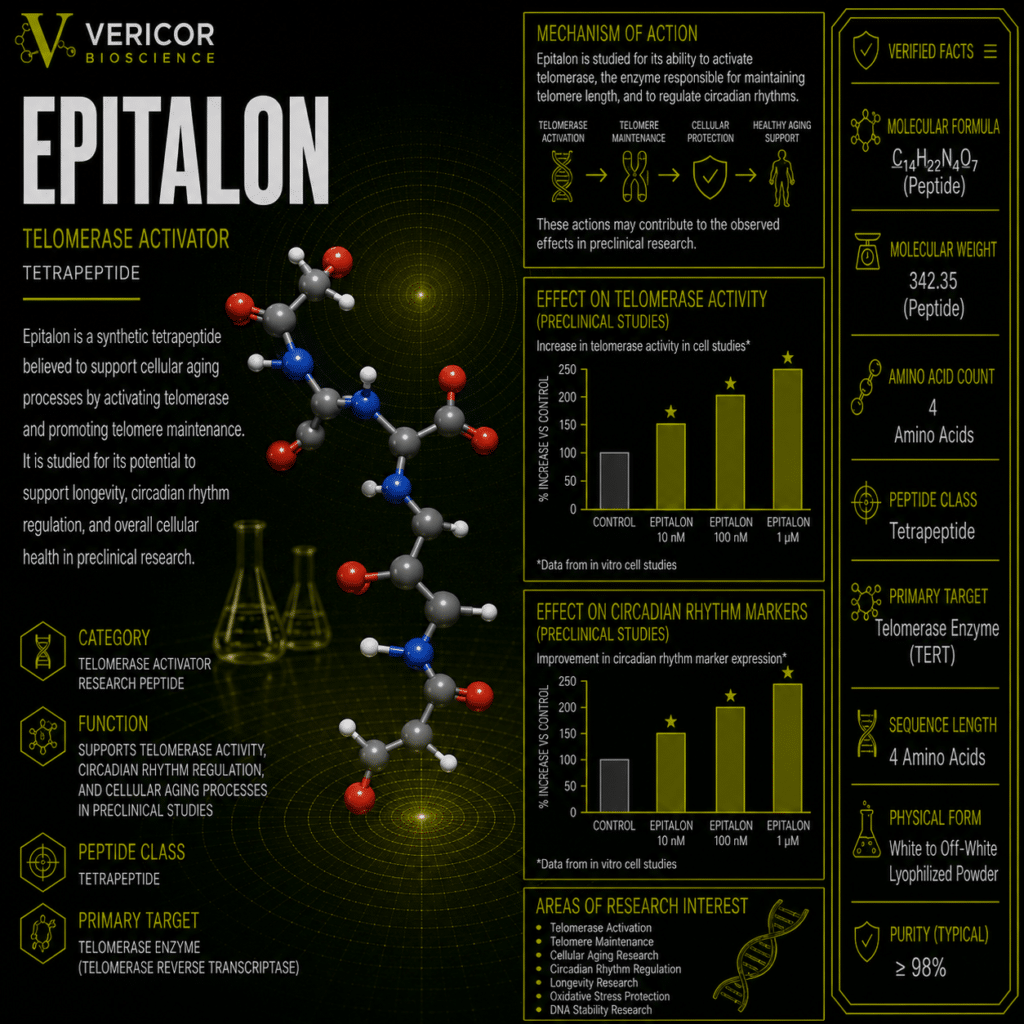
Epitalon is an experimental four-amino-acid peptide promoted online for longevity, telomere support, sleep, and age-related health concerns. Although laboratory and animal studies have produced findings that justify further investigation, Epitalon is not an FDA-approved anti-aging medication, sleep treatment, or life-extension therapy in the United States.
Interest in the peptide has grown because certain studies suggest that it may affect telomerase, telomeres, melatonin-related pathways, and cellular gene expression. However, these early findings are frequently presented online without their scientific limitations. From a research-review perspective, the critical issue is not whether Epitalon has biological activity. The more important question is whether that activity produces safe, meaningful, and repeatable health benefits in humans.
At present, strong human clinical evidence is limited. Therefore, claims that Epitalon reverses aging, lengthens human life, restores the pineal gland, repairs DNA, or prevents cancer should not be treated as established facts.
Featured definition: What is Epitalon?
Epitalon is a synthetic tetrapeptide composed of alanine, glutamic acid, aspartic acid, and glycine. It was developed from research involving pineal-gland peptide extracts. Laboratory studies have examined its effects on telomerase, gene expression, and cellular aging, but it is not an FDA-approved treatment and proven human benefits remain limited.
Table of Contents
- What Epitalon is
- Epitalon, Epithalon, and Epithalamin
- How Epitalon may work
- Epitalon and telomeres
- Epitalon and telomerase
- What laboratory studies show
- Findings from animal research
- Current human evidence
- Epitalon and healthy-aging claims
- Epitalon and sleep research
- Epitalon and melatonin
- Eye and retinal research
- Cancer-related questions
- U.S. FDA and compounding status
- Epitalon product categories compared
- Safety and unknown risks
- Research-evaluation checklist
- People Also Ask about Epitalon
- Expert Epitalon Q&A
- Conclusion
What Is Epitalon?
Epitalon is a synthetic tetrapeptide. A tetrapeptide is a molecule made from four amino acids joined by peptide bonds.
The Epitalon sequence is:
- Alanine
- Glutamic acid
- Aspartic acid
- Glycine
The sequence is often abbreviated as Ala-Glu-Asp-Gly or AEDG.
Amino acids are the building blocks of proteins and peptides. However, the fact that a product contains naturally occurring amino acids does not automatically make it safe or clinically effective.
The order of amino acids affects how a peptide behaves. In addition, its chemical form, purity, concentration, formulation, storage, and route of administration can influence its biological effects.
Epitalon was developed from research involving Epithalamin, a mixture of peptides obtained from animal pineal tissue. Scientists sought to identify short peptide sequences that might reproduce selected biological effects of the larger extract.
Therefore, Epitalon is synthetic. It is not simply a purified human hormone, vitamin, dietary protein, or standard nutritional supplement.
Epitalon, Epithalon, and Epithalamin
Several similar terms appear in articles, product listings, and scientific publications.
“Epitalon” and “Epithalon” are generally used as alternative spellings for the synthetic AEDG tetrapeptide. However, naming can vary across scientific databases and translations.
Epithalamin is different. It refers to a peptide preparation originally derived from the pineal glands of animals. It is a complex mixture rather than a single four-amino-acid peptide.
| Term | General meaning | Composition | Important distinction |
|---|---|---|---|
| Epitalon | Synthetic short peptide | Ala-Glu-Asp-Gly | Defined tetrapeptide sequence |
| Epithalon | Alternative spelling of Epitalon | Usually Ala-Glu-Asp-Gly | Often refers to the same synthetic peptide |
| Epithalamin | Pineal-derived peptide preparation | Mixture of peptides | Not chemically identical to Epitalon |
| Pineal peptide extract | Broad descriptive term | May contain several compounds | Composition may vary |
| Epitalon acetate | Salt-associated form | AEDG with acetate counterion | May differ in molecular-weight calculations and formulation |
Evidence involving Epithalamin should not automatically be presented as evidence for Epitalon. Likewise, results involving Epitalon free base may not fully establish the properties of an acetate product.
Accurate content should identify the exact substance studied.
Why Is Epitalon Associated With the Pineal Gland?
The pineal gland is a small endocrine structure in the brain. It is best known for producing melatonin, a hormone involved in sleep-wake timing and circadian rhythms.
Epitalon was developed within a line of research examining short peptides associated with pineal function and aging. This history explains why the peptide is often marketed for sleep, circadian rhythm, melatonin production, and longevity.
However, Epitalon is not melatonin. It also has not been proven to “restore” or “rejuvenate” the human pineal gland.
The pineal gland responds to signals from the body’s central biological clock. Light exposure, darkness, age, medications, shift work, travel, sleep schedules, and some medical conditions can affect melatonin patterns.
Consequently, a sleep problem cannot be assumed to result from an Epitalon deficiency. There is no recognized nutritional deficiency syndrome for this experimental peptide.
How Might Epitalon Work?
Researchers have proposed several possible Epitalon mechanisms.
These include effects on:
- Telomerase activity
- Telomere maintenance
- Gene transcription
- Chromatin structure
- Melatonin-related signaling
- Oxidative stress
- Cellular proliferation
- Inflammatory pathways
- Circadian biology
A proposed mechanism is not the same as a confirmed medical benefit.
For example, a peptide may alter gene expression in cultured cells without reaching those cells when administered to a person. It may also break down quickly, enter different tissues, or create effects that are too small to matter clinically.
To establish how Epitalon works in humans, researchers would need reliable data on:
- Absorption
- Distribution between tissues
- Metabolism
- Elimination
- Dose-response relationships
- Target engagement
- Short-term toxicity
- Long-term safety
- Drug interactions
- Clinically meaningful outcomes
This complete profile has not been established through a modern U.S. drug-approval program.
Epitalon and Telomeres
Telomeres are specialized structures at the ends of chromosomes. They contain repeated DNA sequences and protective proteins that help prevent chromosome ends from being mistaken for broken DNA.
Each time many human cells divide, their telomeres usually become shorter. Eventually, critically short telomeres can contribute to cellular senescence, genomic instability, or cell death.
Cellular senescence means a cell remains metabolically active but stops dividing normally. Senescent cells can also release signaling molecules that influence nearby tissue.
The National Institute on Aging describes telomere shortening as a feature associated with aging and several age-related conditions. However, telomere biology is complex, and longer is not always automatically better. Readers can explore the National Institute on Aging overview of telomere maintenance.
Telomere length differs according to:
- Cell type
- Age
- Genetics
- Inflammation
- Oxidative stress
- Smoking
- Some infections
- Chronic diseases
- Measurement method
- Sample-processing procedures
Therefore, one commercial telomere test does not provide a complete measure of biological age or predict an individual lifespan.
Epitalon and Telomerase
Telomerase is an enzyme that can add repeated DNA sequences to telomeres. It contains a reverse-transcriptase component and an RNA template.
Telomerase is active in certain stem cells, reproductive cells, immune cells, and other cell populations. In contrast, it has relatively low activity in many normal mature human tissues.
Many cancer cells activate telomerase to maintain their telomeres and continue dividing. According to the National Cancer Institute, cancer cells usually have more telomerase activity than most normal cells.
This creates an important scientific tension.
On one hand, maintaining telomeres may support the ability of selected normal cells to continue dividing. On the other hand, uncontrolled telomerase activity is associated with the ability of many cancer cells to replicate.
That does not prove that Epitalon causes cancer. It does mean that claims about activating telomerase should be evaluated carefully rather than presented as automatically beneficial.
Does Epitalon Lengthen Telomeres?
A 2025 laboratory study reported that Epitalon increased telomerase-related activity and telomere length in certain human cell lines under experimental conditions. The researchers examined normal fibroblast cells and breast-cancer cell lines rather than administering the peptide to people as a clinical anti-aging treatment.
The findings add to the biological case for further research. However, they do not show that Epitalon lengthens telomeres safely throughout the human body.
A cell-culture study cannot determine:
- How the peptide is absorbed
- What dose reaches human tissues
- Whether the effect occurs in living people
- How long any effect lasts
- Whether all cell types respond similarly
- Whether telomere changes improve health
- Whether the intervention affects cancer risk
- Whether repeated exposure is safe
Readers may examine the PubMed-indexed Epitalon telomere study for the study’s laboratory context and limitations.
Even if a future human trial found that Epitalon lengthened telomeres in one tissue, researchers would still need to show that the change improved physical function, reduced disease, increased healthy lifespan, or produced another meaningful outcome.
Telomere Length Is Not the Same as Lifespan
Telomeres are one part of aging biology. They do not function as a simple countdown clock that determines exactly how long a person will live.
Human aging also involves:
- DNA mutations
- Epigenetic changes
- Mitochondrial dysfunction
- Protein damage
- Altered nutrient signaling
- Stem-cell exhaustion
- Chronic inflammation
- Immune changes
- Cellular senescence
- Changes in communication between cells
A person may have relatively short telomeres without developing a particular age-related disease. Likewise, another person may have longer telomeres but still experience serious illness.
Moreover, different tissues can have different telomere lengths. A blood sample may not represent the brain, liver, lungs, muscles, or skin.
Therefore, claims that Epitalon can “reset biological age” based on telomere theory are not supported by current clinical evidence.
What Laboratory Epitalon Studies Show
Cell studies have explored how Epitalon may influence gene expression, telomerase, chromatin, cell growth, and inflammatory processes.
In laboratory research, scientists may expose cultured cells to a defined concentration of a peptide. They can then measure changes in:
- Messenger RNA
- Protein production
- Enzyme activity
- Cell division
- Cell survival
- Oxidative markers
- Inflammatory molecules
- Telomere length
These experiments are valuable because they can identify possible molecular targets.
However, laboratory conditions are highly controlled. The peptide is placed directly in contact with cells, often at concentrations that may not reflect realistic human exposure.
The human body presents additional barriers. A peptide may be degraded by digestive enzymes, blood enzymes, liver metabolism, or tissue proteases. It may also fail to cross cell membranes or reach the intended organ.
As a result, laboratory activity should be described as preclinical evidence.
What Animal Epitalon Research Shows
Animal studies have examined Epitalon in relation to aging, survival, melatonin, circadian patterns, retinal health, reproduction, stress, and tumor development.
Some mouse studies reported differences in survival outcomes after Epitalon administration. For example, one study using senescence-accelerated mice reported longer survival among selected groups, although the findings depended on the animal strain and the specific outcome evaluated.
Animal lifespan studies can help scientists develop hypotheses. Nevertheless, they do not prove that an intervention extends human life.
Important differences include:
- Lifespan
- Metabolic rate
- Immune function
- Tumor biology
- Dose relative to body size
- Housing conditions
- Genetics
- Diet
- Route of administration
- Causes of death
Furthermore, studies involving a specific inbred mouse strain may not represent the biological diversity of the U.S. population.
A valid human longevity claim would require long-term clinical evidence, not only observations in rodents.
What Human Evidence Exists for Epitalon?
Published reports have described Epitalon or related pineal peptide preparations in human subjects. Areas investigated have included retinal conditions, melatonin patterns, and age-related physiological changes.
However, much of this literature has significant limitations when judged by current clinical-research standards.
Possible limitations include:
- Small study populations
- Limited reporting of randomization
- Inadequate placebo control
- Unclear blinding
- Older research methods
- Incomplete adverse-event reporting
- Limited independent replication
- Combined reporting of different peptide preparations
- Publications that are difficult to evaluate in full
- Surrogate outcomes rather than health outcomes
Some studies also originated from a relatively small network of researchers. Independent replication is necessary because repeated findings from unrelated research groups generally provide stronger evidence.
At present, there is not a large body of modern, independently replicated, randomized U.S. clinical trials demonstrating that Epitalon extends lifespan, reverses aging, improves sleep disorders, or prevents disease.
Is Epitalon a Proven Anti-Aging Peptide?
No. Epitalon is not a proven anti-aging treatment.
The term “anti-aging” can refer to several very different goals:
- Improving appearance
- Reducing disease risk
- Preserving physical function
- Delaying frailty
- Improving cognitive health
- Extending lifespan
- Changing biological markers
- Supporting healthy behaviors
A treatment might change one laboratory measurement without improving any of these outcomes.
For Epitalon to qualify as an evidence-based longevity intervention, trials would need to evaluate meaningful endpoints, such as:
- Disability-free survival
- Cardiovascular events
- Cancer incidence
- Cognitive decline
- Frailty
- Physical function
- Hospitalization
- Quality of life
- Overall mortality
No robust clinical program has demonstrated these benefits.
Therefore, responsible content should say that Epitalon is being studied in aging-related biological pathways, not that it has been proven to reverse aging.
Can Epitalon Extend Human Lifespan?
There is no reliable clinical evidence showing that Epitalon extends human lifespan.
Human longevity studies are difficult because they require large groups, long follow-up periods, careful control of confounding variables, and comprehensive safety monitoring.
A human lifespan claim cannot be established through:
- Cell-culture experiments
- Changes in telomere length
- Mouse survival studies
- Testimonials
- Short-term biomarker changes
- Before-and-after photographs
- Self-reported energy or sleep improvements
Even a positive change in a biological-aging marker would not prove longer life. Researchers would need to show that the marker predicts meaningful outcomes and that modifying it changes those outcomes.
Epitalon and Sleep Research
Epitalon is sometimes promoted as a sleep peptide because of its historical connection with pineal-gland research.
The pineal gland produces melatonin at night in response to signals from the brain’s circadian clock. Melatonin helps communicate biological nighttime to the body.
Some earlier research examined whether Epitalon or Epithalamin influenced melatonin secretion patterns in older people and animals. These reports suggested possible effects on nighttime melatonin or circadian rhythms.
However, this does not establish Epitalon as a treatment for insomnia.
Insomnia can involve:
- Stress
- Anxiety
- Depression
- Pain
- Sleep apnea
- Restless legs syndrome
- Medication effects
- Menopause
- Shift work
- Alcohol use
- Irregular schedules
- Other medical conditions
A peptide that affects one melatonin-related measurement may not address the underlying cause.
Evidence-based insomnia care may include sleep-habit assessment, treatment of medical contributors, and cognitive behavioral therapy for insomnia. Prescription or nonprescription treatments should be selected with professional guidance.
Epitalon and Melatonin
Epitalon is not a form of melatonin and should not be discussed as though it directly replaces the hormone.
Melatonin is a specific chemical messenger. Epitalon is a four-amino-acid peptide.
A study involving older adults and monkeys reported changes in melatonin-related circadian measures after treatment with pineal peptide preparations. However, older studies involving Epitalon and Epithalamin should be interpreted carefully because the preparations, methods, and reporting may differ.
Future studies would need to establish:
- Whether Epitalon reliably changes melatonin in humans
- Which dose produces the effect
- Whether sleep duration improves
- Whether sleep quality improves
- Whether daytime function improves
- Whether the effect persists
- Whether repeated use is safe
- Whether it interacts with sleep medications
Until then, Epitalon should not be described as an FDA-approved sleep aid.
Epitalon and Retinal Research
Some older research examined Epitalon in retinal degeneration.
One publication included animal research involving inherited retinal degeneration and observations involving patients with degenerative retinal lesions. Although the authors reported positive findings, the available abstract does not provide enough detail to establish efficacy by modern clinical standards.
For a retinal treatment to become established, researchers would need well-designed trials measuring outcomes such as:
- Visual acuity
- Visual-field preservation
- Retinal imaging
- Electroretinography
- Disease progression
- Daily visual function
- Adverse effects
Epitalon is not an FDA-approved treatment for retinitis pigmentosa, macular degeneration, diabetic retinopathy, glaucoma, or another eye disease.
Anyone experiencing new flashes, floaters, a curtain-like visual shadow, sudden vision loss, or severe eye pain should seek urgent professional care rather than trying an experimental peptide.
Epitalon and Cancer Risk
The relationship between Epitalon, telomerase, and cancer is uncertain.
Many cancer cells use telomerase to maintain telomeres and continue dividing. Therefore, any intervention claimed to activate telomerase deserves careful long-term evaluation.
However, it would also be inaccurate to state that Epitalon has been proven to cause cancer.
Some animal studies did not report higher overall tumor incidence in treated groups. Nevertheless, absence of a signal in selected animal experiments does not establish long-term safety in diverse humans.
Important unanswered questions include:
- Does Epitalon activate telomerase in precancerous cells?
- Are effects different across tissue types?
- Does it influence tumor suppressor pathways?
- Can it alter the growth of an existing tumor?
- Does repeated exposure change cancer risk?
- Are effects dependent on dose or duration?
- How does it affect immune surveillance?
People with active cancer, a recent cancer diagnosis, unexplained masses, or high inherited cancer risk should discuss experimental peptide use with their oncology team.
A broad claim that telomerase activation is always beneficial ignores the complexity of cancer biology.
Is Epitalon FDA Approved?
Epitalon is not an FDA-approved medication for anti-aging, insomnia, telomere extension, retinal disease, immune support, or longevity.
In July 2026, the FDA’s Pharmacy Compounding Advisory Committee discussed Epitalon-related bulk drug substances, including Epitalon free base and Epitalon acetate, in connection with possible inclusion on the federal 503A Bulks List. The evaluated proposed use was insomnia.
This committee review did not mean that Epitalon became FDA approved.
The 503A Bulks List process concerns whether nominated bulk substances may qualify for use in certain compounded preparations under specific conditions. It is different from approving a finished drug after reviewing clinical trials, manufacturing, labeling, and safety data.
Readers can examine the FDA’s Epitalon compounding review materials for the current federal evaluation context.
An FDA substance record, chemical identifier, committee discussion, or orphan-drug designation also does not by itself mean a product has received marketing approval.
What Does Compounding Mean?
Pharmacy compounding is the preparation of a medication for a patient when an FDA-approved product does not meet a documented clinical need.
Compounded drugs are not FDA approved. Therefore, the FDA does not verify their safety, effectiveness, or manufacturing quality before marketing in the same way it evaluates approved commercial drugs.
Administrative questions about federal and state compounding requirements may involve:
- Whether the substance is eligible for compounding
- Whether a valid prescription is required
- The role of patient-specific need
- Applicable state pharmacy rules
- Facility registration
- Ingredient sourcing
- Labeling and recordkeeping
- Sterile-preparation standards
These are regulatory and administrative considerations, not personal legal advice. Businesses and healthcare organizations should obtain guidance from qualified regulatory professionals and licensed pharmacy counsel.
Epitalon Products Compared
| Product category | FDA approved? | Intended context | Main concern |
| FDA-approved Epitalon drug | No such approved U.S. drug | No approved indication | Established prescribing information is unavailable |
| Compounded Epitalon | No | Potential patient-specific preparation where legally permitted | Not reviewed like an FDA-approved medication |
| Research-grade Epitalon | No | Laboratory or analytical research | Not intended for human administration |
| “Research use only” vial | No | Nonclinical work | Should not be injected or consumed |
| Online peptide of unclear origin | Usually unclear | Marketing may be ambiguous | Identity, purity, sterility, and legality may be uncertain |
| Epithalamin preparation | Not equivalent | Historical pineal-peptide research | Not chemically identical to Epitalon |
The phrase “pharmaceutical grade” does not independently prove FDA approval. Likewise, “99% purity” does not prove sterility, correct potency, or clinical suitability.
Epitalon Free Base vs. Epitalon Acetate
Epitalon may be offered as a free-base form or acetate-associated form.
An acetate product contains acetate as a counterion. This can affect:
- Molecular-weight calculations
- Solubility
- pH
- Stability
- Analytical testing
- Formulation behavior
- Amount of peptide represented by a labeled mass
Therefore, equal milligram quantities of different forms may not represent exactly the same amount of peptide unless calculations account for the complete chemical form.
Researchers should confirm:
- Molecular formula
- Molecular weight
- Salt or counterion
- Water content
- Assay method
- Peptide content
- Purity definition
- Storage conditions
These factors matter for reproducible laboratory work.
Is Epitalon Safe?
Epitalon’s safety for routine or long-term human use has not been established through large, modern clinical trials.
Online sources sometimes describe it as safe because it consists of four amino acids. However, amino-acid composition alone cannot establish safety.
Biologically active peptides may affect:
- Enzymes
- Receptors
- Gene expression
- Cell proliferation
- Immune signaling
- Hormonal pathways
- Tissue growth
Potential risks depend on the route, dose, formulation, frequency, duration, and individual health status.
Possible concerns include:
- Allergic reactions
- Immune responses
- Headache
- Dizziness
- Sleep changes
- Fatigue
- Nausea
- Injection-site reactions
- Unknown hormonal effects
- Unknown drug interactions
- Effects on abnormal cell growth
- Product contamination
- Incorrect potency
The true frequency of these events is unknown because comprehensive adverse-event data are unavailable.
Risks of Injectable Epitalon Products
Injection adds risks beyond the activity of the peptide itself.
An injectable product must be appropriately assessed for:
- Sterility
- Bacterial endotoxins
- Particulate matter
- Identity
- Potency
- Purity
- pH
- Osmolality
- Residual solvents
- Stability
- Container integrity
A product can have high chemical purity and still be unsuitable for injection.
Potential complications include:
- Skin infection
- Abscess
- Tissue injury
- Severe inflammatory reaction
- Bloodstream infection
- Endotoxin reaction
- Allergic response
- Incorrect dosing
Research materials should never be treated as medicines or administered to humans.
Who Should Be Especially Cautious?
The lack of reliable human safety data creates additional concern for:
- Pregnant people
- Breastfeeding individuals
- Children and adolescents
- People trying to conceive
- People with active cancer
- Cancer survivors
- Organ-transplant recipients
- People using immunosuppressive drugs
- Individuals with autoimmune disease
- People with serious liver or kidney disease
- Patients preparing for surgery
- Anyone taking multiple medications
This is not a complete list. The absence of a known contraindication does not prove safety when the substance has not undergone adequate clinical testing.
Can Epitalon Interact With Medications?
Reliable Epitalon interaction studies are not available.
Potential interactions are difficult to predict because proposed biological effects involve melatonin-related rhythms, gene expression, immune pathways, and cell proliferation.
Extra caution may be appropriate with:
- Sleep medications
- Melatonin
- Sedating antihistamines
- Anticoagulants
- Immunosuppressants
- Cancer therapies
- Hormone treatments
- Anti-inflammatory drugs
- Medications with narrow therapeutic ranges
Patients should not stop or modify prescription treatment to use an experimental peptide.
“No reported interaction” often means the interaction has not been adequately studied. It does not necessarily mean that none exists.
How to Evaluate an Epitalon Research Claim
Use this numbered checklist before accepting a claim about Epitalon.
- Identify the experimental substance.
Confirm whether researchers studied Epitalon, Epitalon acetate, Epithalamin, or another pineal peptide. - Check the evidence level.
Determine whether the finding comes from cells, animals, an uncontrolled human report, or a randomized clinical trial. - Review the route.
Results from direct cell exposure cannot prove that oral, nasal, topical, or injectable use will produce the same effect. - Examine the outcome.
A telomerase change is not the same as better health, longer life, improved sleep, or reduced disease. - Check the comparison group.
Reliable clinical trials usually compare treatment with placebo or established care. - Review the study size.
Small studies may exaggerate effects and miss uncommon adverse events. - Look for independent replication.
Findings are stronger when unrelated research teams reproduce them. - Confirm FDA status.
Research, compounding consideration, and chemical registration do not equal drug approval. - Watch for guaranteed claims.
Terms such as “reverses aging,” “extends life,” and “repairs all DNA” are not supported. - Separate research from personal treatment.
Experimental findings should guide further studies, not self-administration.
Common Epitalon Marketing Red Flags
Be cautious when a seller:
- Claims Epitalon is FDA approved
- Promises a longer life
- Provides universal injection protocols
- Describes telomerase activation as risk-free
- Says the peptide cannot cause side effects
- Uses animal lifespan data as proof in humans
- Treats Epithalamin and Epitalon as identical
- Uses testimonials as clinical evidence
- Encourages replacing medical treatment
- Does not disclose intended research use
- Provides no verifiable lot testing
- Claims a purity result proves sterility
- Markets it as a cure for multiple unrelated diseases
Trustworthy scientific content explains uncertainty rather than hiding it.
Evidence Summary for Common Epitalon Claims
| Claim | Supporting rationale | Evidence level | Responsible conclusion |
| Extends telomeres | Cell research reports telomerase and telomere effects | Primarily laboratory evidence | Not proven throughout the human body |
| Reverses aging | Telomeres and gene regulation are related to aging | Preclinical and limited human research | No evidence of human age reversal |
| Extends lifespan | Selected animal survival findings | Animal research | Human lifespan extension is unproven |
| Improves sleep | Pineal and melatonin-related research | Limited older studies | Not an FDA-approved insomnia treatment |
| Improves retinal health | Animal and limited clinical observations | Incomplete human evidence | Not an approved retinal therapy |
| Prevents cancer | Some animal studies examined tumor incidence | Insufficient | Cancer prevention is not established |
| Repairs DNA | Proposed gene and telomere mechanisms | Laboratory theory | Broad DNA-repair claims are unsupported |
| Strengthens immunity | Some studies examined immune signaling | Preclinical evidence | Clinical immune benefits remain unproven |
People Also Ask About Epitalon
Epitalon is mainly used as an experimental research compound. Scientists have investigated telomerase, telomeres, gene expression, melatonin-related rhythms, aging biology, and retinal function, but it has no FDA-approved medical use.
No reliable human evidence shows that Epitalon reverses aging. Although laboratory findings involving telomerase have attracted interest, aging is a complex whole-body process that cannot be measured or reversed through one cell marker.
Epitalon is not an FDA-approved drug or dietary ingredient for treating disease. Its regulatory status depends on the product, intended use, marketing claims, and applicable compounding or research rules; organizations should obtain qualified regulatory guidance.
Certain laboratory studies have reported increased telomerase-related activity in cultured cells. However, researchers have not established that Epitalon safely increases telomerase across human tissues or improves clinical health outcomes.
No. Melatonin is a hormone involved in circadian timing, while Epitalon is a synthetic four-amino-acid peptide. Research has explored possible effects on melatonin-related patterns, but the substances are not interchangeable.
Expert Epitalon Q&A
1. Why does telomerase activation require careful safety research?
Telomerase may help selected normal cells maintain telomeres, but many cancer cells also use it to continue dividing. Therefore, researchers must evaluate effects on healthy, precancerous, and malignant cells before treating telomerase activation as beneficial.
2. Can a commercial telomere test prove that Epitalon works?
No. Telomere tests vary by sample, laboratory method, cell population, and biological variability. Even a measured change would not prove that Epitalon improved health or extended lifespan.
3. Why might Epitalon results differ between cell studies and people?
Cells in a dish are exposed directly to controlled concentrations. In a living body, the peptide may be degraded, metabolized, eliminated, or prevented from reaching the intended tissue.
4. Does an orphan-drug designation mean Epitalon is FDA approved?
No. Orphan designation may support development of a drug for a rare condition, but it is not marketing approval. A product must still demonstrate adequate safety, effectiveness, and manufacturing quality before approval.
5. What research is needed before Epitalon could become an accepted treatment?
Researchers need standardized manufacturing, pharmacokinetic studies, toxicology data, dose-ranging trials, randomized controlled studies, long-term safety monitoring, and independent replication. Trials must also measure meaningful clinical outcomes rather than relying only on biomarkers.
Epitalon and NAD+ in Longevity Research
Epitalon and NAD+ are both frequently referenced in longevity-focused research, despite working through unrelated mechanisms. Epitalon, a synthetic tetrapeptide, has been studied for its proposed influence on telomerase activity and pineal gland regulation in preclinical models. NAD+, a coenzyme required for cellular energy metabolism, has instead been researched for its role in sirtuin activation and age-related decline in mitochondrial function.
The two are sometimes grouped together in research discussions of cellular aging precisely because they approach the same broad question, why cells and tissues age, from different angles. Both remain in early-stage, preclinical investigation, and neither is FDA-approved or established as a treatment for aging in humans. Read more about NAD+’s studied mechanisms in our full NAD+ research guide.
Conclusion
Epitalon is a synthetic tetrapeptide made from alanine, glutamic acid, aspartic acid, and glycine. Laboratory and animal studies have explored its possible effects on telomerase, telomeres, gene expression, melatonin-related rhythms, retinal biology, and aging.
These findings make Epitalon a legitimate subject for continued scientific investigation. However, they do not establish it as an anti-aging medicine, sleep treatment, cancer-prevention product, or human life-extension therapy.
The strongest telomere-related evidence remains largely preclinical. In addition, human studies are limited, long-term safety has not been established, and important questions remain about absorption, dose, tissue exposure, interactions, abnormal cell growth, and product quality.
U.S. readers should also understand that FDA compounding discussions do not represent approval of Epitalon. Research-grade materials are not medications, and a purity certificate does not demonstrate that a product is sterile or suitable for administration.
Researchers and qualified professional buyers can review the available specifications on the Vericor Bioscience Epitalon research product page. Product information should be evaluated within its stated research context and should not replace diagnosis, medical treatment, or advice from a licensed healthcare professional.