
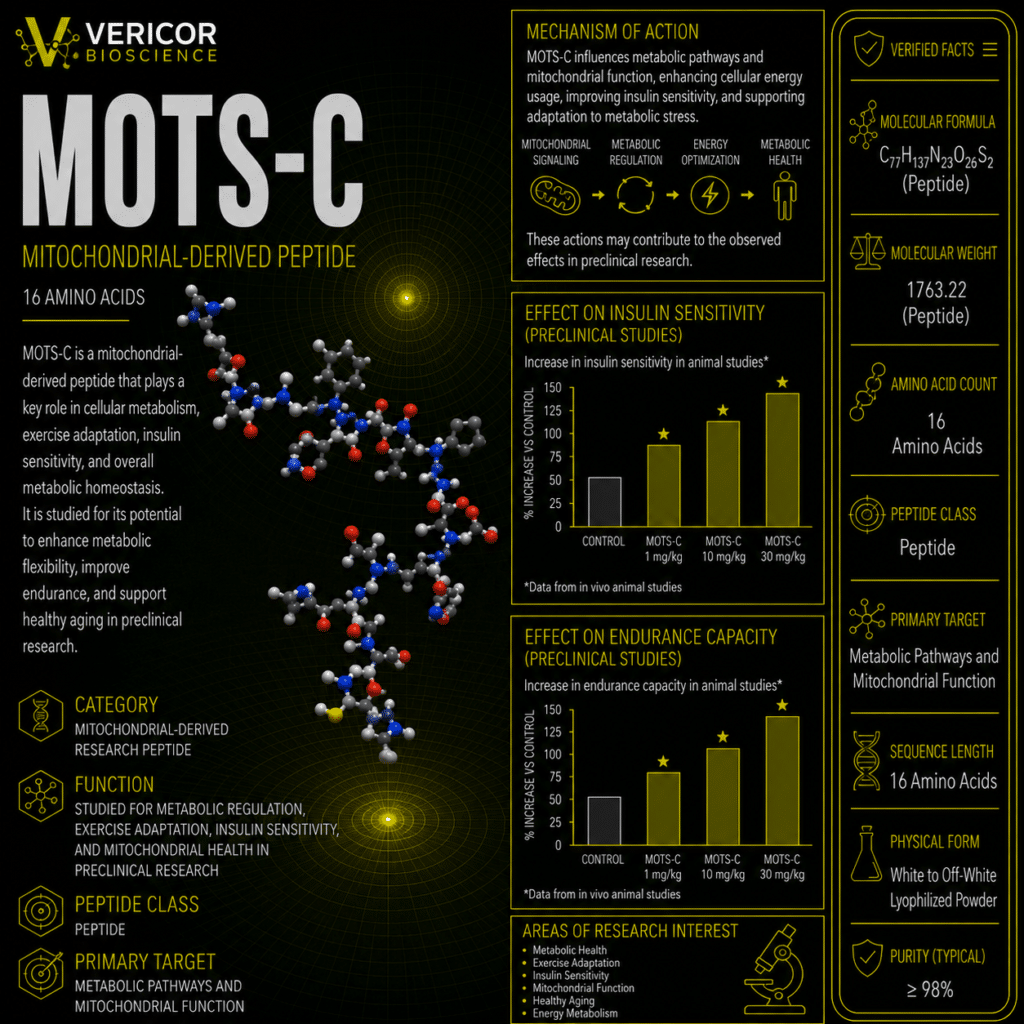
MOTS-C has attracted growing attention among researchers studying mitochondrial communication, metabolic health, exercise adaptation, insulin sensitivity, and healthy aging. However, online discussions often present laboratory findings as if they were proven human benefits. That is not accurate. Although early results are scientifically interesting, most evidence still comes from cell experiments, animal models, observational studies, and limited human research.
From a practical evidence-review standpoint, the most important step is separating what researchers have observed from what has been clinically proven. MOTS-C is an investigational mitochondrial-derived peptide. It is not currently an FDA-approved medication, supplement, weight-loss treatment, anti-aging therapy, or performance-enhancing drug.
This guide explains what MOTS-C is, how scientists believe it works, what research has found, what remains unknown, and what U.S. researchers should evaluate before working with it.
Featured Definition: What Is MOTS-C?
MOTS-C is a naturally occurring 16-amino-acid peptide encoded within mitochondrial DNA. Researchers are studying its possible role in metabolic signaling, cellular stress responses, insulin sensitivity, exercise adaptation, and energy regulation. However, its therapeutic benefits, appropriate dosage, long-term safety, and effectiveness in humans have not yet been established.
Table of Contents
- What MOTS-C Means
- Why Mitochondrial-Derived Peptides Matter
- How MOTS-C May Work
- Current MOTS-C Research
- Human Evidence and Clinical Trials
- MOTS-C and Metabolic Health
- Exercise, Aging, and Physical Performance
- Evidence Versus Marketing Claims
- Safety and Research Limitations
- U.S. Regulatory Status
- Research Quality Checklist
- People Also Ask
- Expert Q&A
- Conclusion
What Does MOTS-C Mean?
The name MOTS-C stands for mitochondrial open reading frame of the 12S ribosomal RNA type-c. It is a short peptide made from a sequence located within the mitochondrial genome.
Most people learn that mitochondria produce energy for cells. That description is correct, but incomplete. Mitochondria also participate in cellular signaling, inflammation, stress adaptation, programmed cell death, and metabolic regulation.
MOTS-C belongs to a group known as mitochondrial-derived peptides, or MDPs. These peptides appear to help mitochondria communicate with the rest of the cell. As a result, researchers are investigating whether they influence how cells respond to changes in nutrition, physical activity, aging, and metabolic stress.
MOTS-C contains 16 amino acids. Amino acids are the molecular building blocks used to form peptides and proteins. Because MOTS-C is relatively small, it is described as a peptide rather than a conventional protein.
Its discovery changed the traditional view that mitochondrial DNA mainly encodes components involved in energy production. Instead, the research suggests that mitochondrial DNA may also encode biologically active signaling molecules.
Why Mitochondrial-Derived Peptides Matter
Human cells constantly adjust to changing conditions. For example, cells respond when glucose availability falls, exercise increases energy demand, inflammation develops, or oxidative stress damages cellular components.
Mitochondria help coordinate these responses. Therefore, scientists are interested in molecules that allow mitochondria to communicate metabolic conditions to the cell nucleus.
The nucleus contains most of the body’s genetic material. However, mitochondria contain a small amount of their own DNA. MOTS-C is unusual because it originates from a mitochondrial DNA sequence but may influence genes inside the nucleus.
Under certain forms of metabolic stress, laboratory research suggests that MOTS-C can move into the nucleus. There, it may affect the expression of genes involved in:
- Cellular protection
- Glucose metabolism
- Antioxidant responses
- Inflammation
- Protein maintenance
- Energy balance
- Stress adaptation
This mitochondria-to-nucleus communication is sometimes called mitonuclear signaling. In simple terms, it describes how mitochondria send information that may change the behavior of the wider cell.
However, researchers are still determining how important this process is in living humans. A mechanism observed in cultured cells does not automatically produce a safe or useful medical treatment.
How May MOTS-C Work?
MOTS-C does not appear to function like a stimulant or hormone replacement product. Instead, researchers propose that it influences metabolic signaling pathways.
One pathway frequently discussed in MOTS-C research is AMP-activated protein kinase, commonly called AMPK.
AMPK and cellular energy sensing
AMPK acts as an energy sensor. It becomes more active when a cell detects that available energy is low. Once activated, AMPK can help the cell conserve energy and increase processes that produce usable fuel.
For example, AMPK signaling may:
- Increase glucose uptake in certain tissues
- Promote fatty-acid oxidation
- Reduce energy-intensive biosynthetic processes
- Support mitochondrial adaptation
- Influence insulin signaling
Early experiments indicate that MOTS-C may affect AMPK activity indirectly through changes in cellular metabolism. However, this does not prove that externally administered MOTS-C will safely improve metabolism in people.
Folate and purine metabolism
Research has also connected MOTS-C with pathways involving folate metabolism and purine synthesis. Purines are compounds needed to build DNA, RNA, and cellular energy molecules.
In laboratory models, MOTS-C appears to alter the availability of metabolic intermediates involved in these pathways. Those changes may increase levels of AICAR, a naturally occurring compound associated with AMPK activation.
This proposed chain of events is one reason MOTS-C is being investigated in metabolic research. Nevertheless, biological pathways are complex. A change that appears beneficial under one experimental condition may have different consequences in another tissue, disease state, or dose range.
Nuclear signaling during stress
Studies have reported that metabolic stress may cause MOTS-C to move from the cytoplasm into the nucleus. Once there, it may interact with transcription factors and influence stress-response genes.
This finding is scientifically important because it suggests that MOTS-C may act as more than a circulating metabolic signal. It may also participate directly in cellular adaptation.
Still, scientists have not fully established:
- Which tissues respond most strongly
- How long the response lasts
- Whether the mechanism changes with age
- Whether sex-related biological differences matter
- What concentration produces a meaningful effect
- Whether repeated external exposure changes normal signaling
These unanswered questions limit therapeutic conclusions.
What Does Current MOTS-C Research Show?
The first widely cited MOTS-C research described metabolic effects in cells and mice. In experimental models, the peptide was associated with changes in glucose utilization, insulin sensitivity, and resistance to diet-induced metabolic dysfunction.
The original study reported that MOTS-C influenced metabolic homeostasis and reduced certain features of obesity and insulin resistance in mice. Readers can review the peer-reviewed publication through the National Library of Medicine MOTS-C study. sults created several research questions:
- Does the body naturally change MOTS-C production during metabolic stress?
- Are circulating MOTS-C levels associated with diabetes or obesity?
- Can MOTS-C influence insulin signaling in humans?
- Does exercise increase naturally produced MOTS-C?
- Could the peptide affect age-related physical decline?
- Would externally administered MOTS-C reproduce natural signaling?
Researchers have begun addressing these questions, but the results remain incomplete.
A 2024 systematic review and meta-analysis examined circulating mitochondrial-derived peptide levels in metabolic conditions. It included 602 participants from six case-control studies and one cross-sectional study. The researchers found lower circulating MOTS-C levels among people with diabetes but higher levels in a subgroup of people with obesity.
Importantly, these findings were inconsistent across metabolic states. The authors also analyzed observational data rather than proving that MOTS-C caused or prevented disease. Therefore, circulating MOTS-C may be a marker of metabolic changes rather than a treatment target. C Evidence by Research Level
| Evidence level | What has been studied | What it may suggest | What it cannot prove |
|---|---|---|---|
| Cell studies | Metabolic pathways, AMPK signaling, stress responses and gene expression | Possible molecular mechanisms | Safety or effectiveness in a complete human body |
| Animal studies | Glucose control, insulin resistance, weight-related metabolism and physical capacity | Potential biological effects in living organisms | That people will experience the same results |
| Observational human studies | Natural MOTS-C levels and associations with health conditions | Possible relationships or biomarkers | That MOTS-C causes, prevents, or treats a condition |
| Small human experiments | Natural responses to exercise and metabolic stress | Evidence that MOTS-C participates in human biology | Long-term treatment effectiveness or safety |
| Controlled clinical trials | Investigational administration compared with placebo | Potential benefits, adverse effects and dose-response information | Final conclusions until trials are completed and replicated |
| FDA approval review | Manufacturing, quality, safety and effectiveness evidence | Whether benefits outweigh known risks for an intended use | Approval cannot be assumed from research availability |
The table highlights an important principle: evidence does not move directly from a mouse experiment to a reliable human treatment.
Human MOTS-C Research and Clinical Trials
Human research is beginning to develop, but it remains limited compared with the volume of online marketing.
Researchers have detected naturally occurring MOTS-C in human tissues and circulation. In addition, a 2021 study reported that exercise increased endogenous MOTS-C expression in human skeletal muscle and circulation. The same publication found improved physical performance in mouse models, including older mice.
However, the human portion did not demonstrate that injected or externally administered MOTS-C improves athletic performance, reverses aging, or treats metabolic disease. It showed that natural MOTS-C may respond to exercise.
As of August 2026, a Phase 2a study registered in the United States is evaluating investigational MOTS-C in adults with prediabetes and overweight or obesity. The randomized, double-blind, placebo-controlled study is designed to examine insulin sensitivity, metabolic markers, and safety over a 12-week treatment period.
The study reportedly began on February 2, 2026, and its estimated primary completion date is February 14, 2027. No study results had been posted at the time of this article. The trial record can be viewed through the official ClinicalTrials.gov MOTS-C study page. al represents meaningful progress because controlled human data are needed. Nevertheless, registration does not mean the treatment has been proven safe or effective. ClinicalTrials.gov also explains that the U.S. government does not review or approve the safety and scientific validity of every study merely because it appears in the database.
MOTS-C and Metabolic Health
Metabolic health describes how effectively the body regulates glucose, insulin, lipids, blood pressure, and energy storage.
Interest in MOTS-C is largely connected to its proposed effects on:
- Insulin sensitivity
- Glucose uptake
- Energy sensing
- Skeletal-muscle metabolism
- Fatty-acid utilization
- Cellular stress resistance
Insulin sensitivity
Insulin helps move glucose from the bloodstream into cells. When tissues respond poorly to insulin, the pancreas may need to release more of it to maintain normal glucose levels. This condition is called insulin resistance.
Animal studies suggest that MOTS-C may influence glucose utilization and insulin sensitivity. However, researchers do not yet know whether investigational administration produces a clinically meaningful improvement in people.
Furthermore, insulin resistance has many contributing factors, including genetics, sleep, physical activity, body composition, medications, nutrition, hormones, and medical conditions. Therefore, it would be misleading to describe one experimental peptide as a complete metabolic solution.
Weight-management claims
MOTS-C is sometimes promoted online as a weight-loss compound. That claim goes beyond the current evidence.
Animal studies involving diet-induced obesity may help scientists understand metabolic pathways, but they do not establish predictable fat loss in humans. Human weight also reflects appetite, energy intake, activity, sleep, medication use, health conditions, and socioeconomic factors.
No completed large-scale clinical evidence currently establishes MOTS-C as a safe and effective weight-loss medication. In contrast, FDA-approved weight-management medications must undergo structured studies that assess dosing, benefits, side effects, contraindications, and manufacturing consistency.
Diabetes-related research
Lower circulating MOTS-C levels have been observed in some populations with diabetes. However, an association does not show whether reduced MOTS-C contributes to diabetes or occurs because of the disease.
It is also possible that factors such as age, medication, body composition, kidney function, activity level, or laboratory methodology influence measured peptide levels.
Therefore, MOTS-C testing is not an established replacement for standard clinical measurements such as:
- Fasting blood glucose
- Hemoglobin A1c
- Oral glucose tolerance testing
- Clinician-directed insulin measurements
- Lipid testing
- Blood pressure
- Waist circumference
Patients should use validated medical screening and care rather than relying on experimental peptide measurements.
MOTS-C, Exercise, and Physical Performance
Exercise places controlled stress on muscles. During physical activity, cells use more energy, generate metabolic by-products, and activate adaptation pathways.
The observation that exercise increases natural MOTS-C levels supports the idea that the peptide may participate in exercise-related signaling. Researchers are especially interested in whether it helps skeletal muscle adapt to metabolic demand.
In mice, MOTS-C administration has been associated with increased physical capacity and improved metabolic responses. The effects were reported in young, middle-aged, and older animals.
Still, three distinctions matter:
- A mouse performance outcome is not a human athletic result.
- Naturally increased MOTS-C during exercise is not equivalent to administering a manufactured peptide.
- Improved laboratory performance does not establish long-term safety.
Athletes also need to consider anti-doping rules. The 2026 World Anti-Doping Agency Prohibited List includes a broad category covering pharmacological substances that lack approval from a governmental health authority for human therapeutic use. That category applies both in and out of competition. Athletes should obtain guidance from their sport’s qualified anti-doping personnel before exposure to any investigational compound. C and Healthy-Aging Research
Aging is associated with changes in mitochondrial function, muscle quality, glucose regulation, inflammation, and cellular repair.
Because MOTS-C is connected to mitochondrial signaling, researchers are studying whether it participates in age-related adaptation. Animal findings related to physical capacity and metabolic homeostasis have created interest in possible healthy-aging applications.
However, “associated with aging biology” does not mean “proven to slow aging.”
Human aging is a long-term, multidimensional process. A credible anti-aging intervention would need evidence demonstrating meaningful improvements in health outcomes, not simply changes in a biomarker or metabolic pathway.
Researchers would need to evaluate questions such as:
- Does the intervention preserve mobility?
- Does it reduce disease risk?
- Does it improve quality of life?
- Do benefits persist after treatment?
- Does long-term exposure produce immune reactions?
- Are certain populations more vulnerable to adverse effects?
- Does it interact with medications or medical conditions?
Current MOTS-C evidence does not answer these questions sufficiently.
MOTS-C Evidence Versus Common Marketing Claims
| Common claim | Current evidence-based interpretation |
|---|---|
| “MOTS-C burns fat” | Animal metabolic findings do not prove predictable human fat loss. |
| “MOTS-C reverses insulin resistance” | This is being investigated, but completed clinical evidence is insufficient. |
| “MOTS-C increases energy” | Cellular energy signaling is not the same as a proven improvement in perceived energy. |
| “MOTS-C improves endurance” | Animal performance results and natural exercise responses do not establish a human performance treatment. |
| “MOTS-C is an anti-aging peptide” | Researchers are studying aging-related mechanisms, but anti-aging effectiveness has not been established. |
| “MOTS-C is natural, so it is safe” | A naturally occurring peptide and an externally administered manufactured substance are not automatically equivalent. |
| “Research-grade purity guarantees safety” | Analytical purity alone does not establish sterility, identity, stability, biological activity, or human safety. |
Responsible scientific communication should use terms such as “investigated,” “associated with,” “proposed,” and “observed in animal models.” It should avoid words such as “proven,” “guaranteed,” “cures,” or “reverses” unless high-quality clinical evidence supports them.
Known and Unknown MOTS-C Safety Issues
The long-term safety profile of externally administered MOTS-C has not been established.
This means researchers cannot reliably define all possible adverse effects, contraindications, interactions, or delayed immune responses.
Potential research concerns
Important areas of uncertainty include:
- Immune reactions to the peptide or peptide aggregates
- Contamination during manufacturing or handling
- Endotoxin exposure
- Incorrect peptide identity
- Degradation during storage
- Variation between manufacturing batches
- Unintended metabolic effects
- Injection-related infection or tissue injury
- Drug interactions
- Effects during pregnancy or breastfeeding
- Effects in people with cancer, liver disease, kidney disease, or endocrine disorders
These are not confirmed outcomes for every MOTS-C material. Instead, they are unresolved risks that require controlled research.
Why peptide quality involves more than purity
A product may be labeled with a high percentage purity, yet the percentage alone does not establish that the material is appropriate for human administration.
Researchers may need documentation addressing:
- Identity testing
- Peptide sequence confirmation
- Molecular mass
- Chromatographic purity
- Residual solvents
- Water content
- Peptide content
- Counterion content
- Endotoxin levels
- Bioburden
- Sterility, when relevant to the research design
- Container compatibility
- Storage stability
A certificate of analysis should also be traceable to a specific lot. Generic or undated documents provide less useful information because they may not represent the material supplied.
U.S. Regulatory Status of MOTS-C
MOTS-C is not an FDA-approved drug for treating obesity, diabetes, aging, fatigue, reduced exercise performance, or any other medical condition.
In July 2026, FDA briefing materials evaluated MOTS-C-related bulk drug substances in the context of pharmacy compounding. The agency noted inconsistent identification of the proposed substance and highlighted gaps involving physical and chemical characterization, quality attributes, impurities, aggregates, endotoxins, microbial bioburden, stability, and possible immunogenicity.
The materials also stated that the nomination had been withdrawn, although the FDA continued evaluating the substances at its discretion. The agency could not rule out immunogenicity concerns associated with peptide-related impurities and aggregates. Readers can examine the detailed FDA MOTS-C briefing document. oval is not a simple registration process. For a drug to receive approval for a specific use, a sponsor generally must provide evidence addressing:
- Product identity and manufacturing controls
- Preclinical toxicology
- Human pharmacology
- Dose selection
- Clinical effectiveness
- Short- and long-term safety
- Adverse-event monitoring
- Labeling and intended use
- Inspection and quality compliance
A substance being discussed in scientific literature or sold for laboratory research does not mean it has met these standards.
Research use versus medical use
“Research use only” generally means a material is intended for controlled laboratory investigation rather than diagnosis, treatment, prevention, or direct human consumption.
However, placing a research disclaimer on a page does not by itself determine regulatory compliance. Actual marketing claims, instructions, customer communications, intended use, and distribution practices may also matter.
Administrative or compliance decisions should be reviewed by qualified regulatory counsel, compliance professionals, institutional review boards, or licensed clinical investigators where applicable. This article provides general information, not legal or regulatory advice.
Seven-Point MOTS-C Research Evaluation Checklist
Before selecting MOTS-C for a legitimate research project, use the following checklist.
- Define the research purpose State the hypothesis, biological model, endpoints, and limitations. Avoid beginning with a desired commercial claim and then searching for evidence to support it.
- Confirm the exact material identity Determine whether the material is MOTS-C free base, an acetate form, or another specified form. Different forms should not automatically be treated as interchangeable.
- Request lot-specific analytical documentation Review whether the certificate of analysis identifies the batch, testing date, methods, specifications, and results. Sequence or mass confirmation can be especially important for peptide identity.
- Evaluate manufacturing controls Ask how the material was synthesized, purified, packaged, transported, and stored. Additionally, determine whether relevant testing was conducted independently or only by the supplier.
- Match quality requirements to the study Cell-culture, analytical, animal, and clinical research have different requirements. A material that is suitable for one experimental use may be inappropriate for another.
- Establish storage and handling procedures Peptides may be affected by temperature, moisture, light, repeated freeze-thaw cycles, contamination, and adsorption to containers. Follow validated study procedures rather than informal online instructions.
- Document interpretation limits Clearly state whether findings come from cells, animals, observational human data, or controlled trials. Do not translate experimental outcomes into medical promises.
How to Read a MOTS-C Study Critically
Research headlines rarely explain the complete study design. Therefore, readers should evaluate several details.
Identify the model
Was the research conducted in isolated cells, mice, healthy adults, older adults, or people with a specific condition? Results from one model may not apply to another.
Check how MOTS-C was measured or administered
A study measuring natural MOTS-C levels is different from one administering a synthesized peptide. Likewise, route, timing, formulation, and duration can affect results.
Examine the comparison group
Controlled trials generally provide stronger evidence than uncontrolled observations. A placebo or appropriate control group helps researchers determine whether changes are truly related to the intervention.
Review the sample size
Small studies can identify signals but often produce uncertain estimates. They may also miss uncommon adverse effects.
Look for clinically meaningful outcomes
A change in a laboratory marker may be scientifically interesting without improving health, function, symptoms, or disease risk.
Check funding and conflicts of interest
Industry involvement does not automatically invalidate research. Nevertheless, funding sources, intellectual-property interests, and commercial relationships should be disclosed and considered.
Look for replication
One positive result should not be treated as final. Confidence increases when independent research teams reproduce findings using strong methods.
People Also Ask About MOTS-C
No. MOTS-C is not currently an FDA-approved medication for weight loss, diabetes, aging, energy, or athletic performance. It remains an investigational peptide, and important questions about manufacturing consistency, dosage, effectiveness, and long-term safety remain unresolved.
MOTS-C appears to participate in mitochondrial and metabolic signaling. Laboratory research suggests possible effects on AMPK-related pathways, glucose metabolism, cellular stress responses, and skeletal-muscle adaptation, but these proposed mechanisms have not yet produced established therapeutic uses.
There is not enough completed human clinical evidence to describe MOTS-C as a safe or effective weight-loss treatment. Findings from mice with diet-related metabolic dysfunction cannot be used to predict a specific amount of human weight loss.
Yes. MOTS-C is a mitochondrial-derived peptide that occurs naturally in humans. However, a naturally produced peptide and an externally manufactured research material may differ in concentration, exposure pattern, purity, formulation, and biological effect.
Competitive athletes should be cautious because non-approved pharmacological substances may fall under anti-doping prohibitions. An athlete should consult qualified anti-doping officials or their sport’s medical and compliance staff rather than relying on a seller’s interpretation.
Expert MOTS-C Q&A
1. Can a blood MOTS-C level diagnose insulin resistance?
No validated clinical standard currently establishes circulating MOTS-C as a routine diagnostic test for insulin resistance. Research has found associations between MOTS-C levels and certain metabolic conditions, but results have varied, and standard clinical tests remain more established.
2. Does exercise eliminate the need to study external MOTS-C administration?
No. Exercise-related increases in natural MOTS-C help researchers understand physiology, but they do not reveal whether manufactured MOTS-C is effective or safe. Natural production may occur at specific concentrations, locations, and times that external administration does not reproduce.
3. Why can MOTS-C results differ between studies?
Differences may reflect participant age, sex, health status, body composition, medication use, physical activity, sampling time, assay methods, peptide stability, or small sample sizes. In addition, obesity and diabetes may influence MOTS-C biology in different ways.
4. What would establish a clinically useful MOTS-C dose?
Researchers would need pharmacokinetic, pharmacodynamic, dose-ranging, safety, and efficacy studies. A clinically useful dose must produce meaningful benefits while maintaining an acceptable safety profile in a clearly defined patient population.
5. What is the biggest misconception about MOTS-C?
The biggest misconception is that promising metabolic research already proves therapeutic benefit. In reality, MOTS-C is an emerging research subject. Mechanistic findings and animal outcomes are useful for generating hypotheses, but they are not substitutes for completed, replicated human trials.
MOTS-C and SS-31: Two Approaches to Mitochondrial Research
MOTS-C and SS-31 are both mitochondria-focused research peptides, but they represent genuinely different approaches to mitochondrial biology. MOTS-C is a mitochondrial-DNA-encoded microprotein studied primarily for its proposed role in AMPK activation and metabolic/exercise-adaptation signaling — it is thought to act as a retrograde signal from mitochondria to the nucleus during metabolic stress. SS-31 (elamipretide), by contrast, is a cell-permeable tetrapeptide studied for its proposed interaction with cardiolipin on the inner mitochondrial membrane, where it is thought to help stabilize electron transport chain structure and reduce oxidative byproduct formation.
Because these two proposed mechanisms sit at different points in mitochondrial function — one upstream in nuclear signaling, one structural at the membrane level — researchers sometimes discuss them together when reviewing the broader mitochondrial-research-peptide landscape, rather than as interchangeable or competing compounds. As with all research materials in Vericor’s RUO catalog, neither is FDA-approved for human use, and any comparison here is intended strictly for laboratory research context, not treatment guidance.
Conclusion
MOTS-C is a scientifically interesting mitochondrial-derived peptide with proposed roles in metabolic signaling, cellular stress adaptation, glucose regulation, exercise responses, and muscle homeostasis.
The strongest evidence currently supports MOTS-C as a research subject—not as an established therapy.
Cell and animal studies have identified plausible mechanisms and potentially useful biological effects. Observational human studies also suggest that natural MOTS-C levels may vary with metabolic health. Moreover, a Phase 2a clinical trial is now evaluating investigational MOTS-C in adults with prediabetes and overweight or obesity.
Nevertheless, the central questions remain unanswered. Researchers do not yet have completed large-scale evidence establishing therapeutic effectiveness, standardized dosing, long-term safety, or broad clinical usefulness. FDA materials have also identified unresolved concerns involving characterization, impurities, stability, manufacturing controls, and immunogenicity.
Therefore, responsible MOTS-C content should avoid promises about fat loss, diabetes reversal, increased endurance, or anti-aging results. Instead, it should explain the evidence level, distinguish laboratory findings from clinical proof, and clearly identify the peptide’s investigational status.
Qualified researchers evaluating materials for controlled laboratory work can review the MOTS-C research product specifications from Vericor Bioscience. The material should be assessed according to the project’s analytical requirements, institutional procedures, and applicable U.S. research standards, and it should not be represented as an FDA-approved treatment.