
This article is provided strictly for laboratory research use only (RUO). Thymosin Alpha-1, as offered by Vericor Bioscience, is not for human use, is not a drug, and is not the same product as Zadaxin, the branded thymosin alpha-1 pharmaceutical approved for prescription use in a number of countries outside the United States. Thymosin Alpha-1 has never received FDA approval for any indication in the United States, and nothing below should be read as dosing guidance, treatment information, or an endorsement of any use outside a controlled research setting by qualified personnel.
Thymosin Alpha-1 occupies an unusual position in the peptide research space: the identical molecule is marketed as an approved prescription drug (Zadaxin) in dozens of countries, yet it holds no FDA approval of any kind in the United States. That split status makes precise, careful communication essential. This guide summarizes the peer-reviewed and regulatory literature on thymosin alpha-1’s chemistry and mechanism, and it draws an explicit, non-negotiable line between the foreign-approved pharmaceutical product and Vericor’s unapproved research-grade compound, which is sold exclusively to qualified researchers and institutions for in vitro and preclinical investigational use.
Featured definition: Thymosin Alpha-1 (Tα1) is a synthetic 28-amino-acid peptide corresponding to a naturally occurring fragment of prothymosin alpha, studied in the literature as an immune-modulating agent affecting T-cell and dendritic-cell function. It is the active ingredient in Zadaxin, a drug approved in a number of countries outside the U.S.; Vericor’s thymosin alpha-1 is a separate, unapproved research chemical, not that drug product, and is not FDA-approved in the United States.
What Is Thymosin Alpha-1?
Thymosin Alpha-1 (Tα1) is a 28-amino-acid peptide that corresponds to the N-terminal fragment of prothymosin alpha, a small acidic protein first isolated from calf thymus tissue and later shown to be widely expressed across mammalian tissues. Biochemical work has established that Tα1 is generated intracellularly from prothymosin alpha through cleavage by a lysosomal asparaginyl endopeptidase, alongside a related fragment, thymosin alpha-11 (Sarandeses et al., J Biol Chem, 2003 — PubMed 12554742). This places Tα1 in the broader “thymosin” family of peptides originally characterized during efforts to isolate thymic factors involved in immune development, a family that also includes thymosin beta-4 and the unrelated synthetic peptide thymulin.
In the pharmaceutical and clinical literature, the synthetic version of this peptide is known by the International Nonproprietary Name thymalfasin and is manufactured and marketed under the brand name Zadaxin by SciClone Pharmaceuticals (now part of GC Pharma’s SciClone business) for use as a prescription drug in numerous countries outside the United States. Vericor does not sell Zadaxin, does not manufacture a drug product, and does not make any therapeutic claim about its research compound. This article discusses thymosin alpha-1 as a molecule of ongoing scientific and immunological interest — the chemical identity, the mechanistic literature, and the regulatory history that any researcher sourcing this peptide should understand — not as a product recommendation for any use in humans or animals.
Chemical Identity & Structure
Verified chemical identifiers for thymosin alpha-1 (thymalfasin), cross-referenced against PubChem and independent chemical-supplier reference data:
| Property | Value |
|---|---|
| Common name | Thymosin Alpha-1 (Tα1) |
| INN / generic name | Thymalfasin |
| Peptide class | 28-residue fragment of prothymosin alpha |
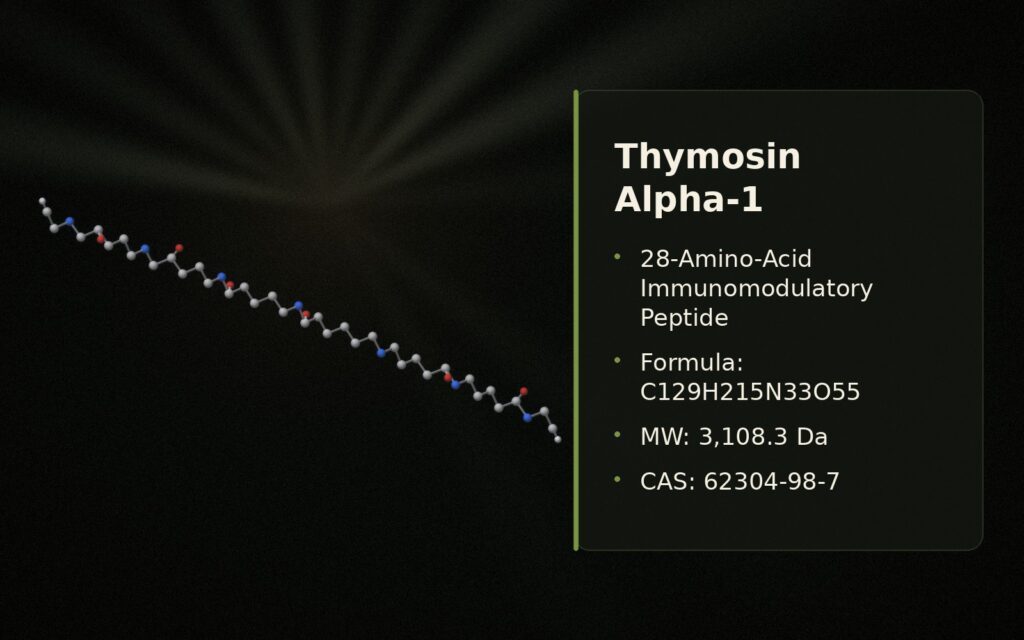
| CAS number | 62304-98-7 |
| Molecular formula | C₁₂₉H₂₁₅N₃₃O₅₅ |
| Molecular weight | ≈3,108.3 g/mol |
| PubChem CID | 16130571 |
| Structure type | 28-residue linear peptide, N-terminal acetylated |
Amino acid sequence: Thymosin alpha-1 consists of 28 amino acid residues with an acetylated N-terminus and a free carboxylic acid C-terminus:
Ac-Ser-Asp-Ala-Ala-Val-Asp-Thr-Ser-Ser-Glu-Ile-Thr-Thr-Lys-Asp-Leu-Lys-Glu-Lys-Lys-Glu-Val-Val-Glu-Glu-Ala-Glu-Asn-OH
The peptide is notably acidic, carrying a substantial excess of glutamate and aspartate residues relative to basic residues, with the exception of a lysine-rich stretch near the C-terminus (the “LKEKK” motif, residues 16–20) that has been specifically studied for its role in electrostatic interactions with hyaluronic acid and other polyanionic biomolecules (Fanales-Belasio et al.; Sarpietro et al., Molecules, 2017). N-terminal acetylation is a defining structural feature of the natural and synthetic peptide alike and is required for the sequence to match the biologically characterized native fragment. As with any 28-residue synthetic peptide, batch purity, correct acetylation, and absence of truncated, deamidated, or oxidized variants are material to any research result and should be confirmed by certificate of analysis (HPLC and mass spectrometry) for each lot used in a study.
Proposed Mechanism of Action
The mechanistic literature on thymosin alpha-1 describes it as an immune-modulating peptide that acts primarily on cells of the innate and adaptive immune system, rather than on a single defined receptor in the way a classical hormone-receptor pair operates. Reported and proposed elements of this activity, as described in pharmacological and immunological literature, include:
- Toll-like receptor (TLR) engagement: Studies in murine dendritic cells report that Tα1 can upregulate expression of certain Toll-like receptors, including TLR9, and act partly through MyD88-dependent signaling pathways typically engaged downstream of TLR activation (Romani et al.; Sarpietro et al., Molecules, 2017).
- Dendritic cell maturation: Tα1 has been reported to promote maturation of dendritic cells, a step associated with enhanced antigen presentation to T cells.
- T-cell modulation and IL-2 signaling: Published work describes Tα1 as inducing T-cell maturation markers and interleukin-2 (IL-2) expression, consistent with its long-standing characterization (dating to early thymic-factor research) as an agent influencing T-lymphocyte differentiation and function.
- Intracellular signaling cascade: Mechanistic proposals describe activation of a protein kinase C (PKC)–TRAF6–IκB kinase pathway downstream of these surface events, converging on activation of nuclear factor-κB (NF-κB) and initiation of cytokine gene transcription.
- Reported modulation of cytokine balance: Across the published literature, Tα1 exposure has been associated with shifts in cytokine profiles (including interferon and interleukin signaling), which is the basis for its long-standing characterization in the literature as an immune “modulator” rather than a simple stimulant or suppressant.
It is important to state plainly that this mechanistic picture is drawn from a mix of in vitro, animal, and human clinical-trial literature developed primarily around the pharmaceutical product Zadaxin, and it should be read as a summary of what has been proposed and studied in the scientific record — not as a settled, fully elucidated pharmacology, and not as a description of effects that Vericor asserts for its own unevaluated research material. Several of the specific molecular steps above (particular receptor targets, the precise weighting of TLR-dependent versus TLR-independent effects) remain active areas of investigation rather than fully closed questions.
Thymosin Alpha-1 vs. Zadaxin: A Global Regulatory Distinction
This section exists because the distinction matters, both scientifically and legally, and it must not be glossed over.
Zadaxin (thymalfasin) is an approved prescription drug in a substantial number of countries outside the United States. SciClone Pharmaceuticals has developed and marketed Zadaxin for several decades, with regulatory approvals reported across dozens of countries in Asia (including China, where SciClone has historically generated the bulk of its Zadaxin revenue), as well as in parts of Latin America, Eastern Europe, and elsewhere. Approved or studied indications for Zadaxin in these markets have included chronic hepatitis B, chronic hepatitis C (historically, often in combination with interferon-based regimens that have since been largely superseded by newer antiviral therapies), and use as an immune adjunct alongside chemotherapy in certain cancers. Zadaxin has also received Orphan Drug Designation from the FDA for malignant melanoma — a designation that confers certain development incentives but is explicitly not the same thing as marketing approval, and does not mean the drug is approved for sale or use in the United States.
Thymosin alpha-1 has never received FDA marketing approval for any indication in the United States. SciClone pursued U.S. clinical development for thymosin alpha-1 in multiple contexts over the years, including studies in the sepsis/critical-care space; despite this development history and extensive international clinical experience with Zadaxin, no thymosin alpha-1 product has completed the FDA approval process or been granted a New Drug Application approval for sale in the U.S. market. Researchers should treat any claim that thymosin alpha-1 is “FDA-approved” — even indirectly, by reference to its foreign approval status — as inaccurate. Foreign regulatory approval of Zadaxin under other nations’ drug laws has no bearing on the FDA status, legality of therapeutic use, or approval status of thymosin alpha-1 in the United States.
Vericor’s thymosin alpha-1 is a separate, unapproved research chemical. It is:
- Not manufactured, reviewed, or approved by the FDA, or by any foreign regulatory authority, as a drug product.
- Not tested, inspected, or verified equivalent to Zadaxin’s active pharmaceutical ingredient formulation, excipients, sterility, or manufacturing controls.
- Not sold for, or intended for, human or animal administration of any kind.
- Not a substitute for Zadaxin, and not interchangeable with it in any clinical, therapeutic, or personal-use context, regardless of what regulatory status Zadaxin holds in any country.
- Intended strictly for in vitro, analytical, and preclinical laboratory research conducted by qualified personnel at institutions or companies capable of handling investigational compounds appropriately.
Put simply: Zadaxin is a regulated medicine, approved and sold under medical supervision in a defined set of countries that does not include the United States. Vericor’s thymosin alpha-1 is a laboratory reagent for scientists studying peptide immunology, receptor pharmacology, or related basic and preclinical research questions — available only for that purpose, in the U.S. or anywhere else. The two should never be conflated, compared as equivalent options, or discussed as though a purchaser could choose between them for the same purpose, and Zadaxin’s foreign approval history should never be cited as evidence that thymosin alpha-1 is legal for human use in the United States or that Vericor’s research compound carries any of that approval status.
Research Findings
The published literature on thymosin alpha-1 spans several decades and includes preclinical immunology studies, international clinical trials supporting Zadaxin’s foreign approvals, and more recent randomized controlled trials in critical-care settings. The summary below is organized by evidence type; all findings described are attributed to their original source population and study design and should not be extrapolated to general research use, other populations, or Vericor’s unevaluated research compound without independent replication.
Evidence by Research Level
| Evidence Level | Description | Example Focus in Thymosin Alpha-1 Literature |
|---|---|---|
| Randomized controlled trials (RCTs) | Multicenter clinical trials, including recent phase 3 programs | TESTS trial (2025): phase 3, multicenter, double-blind, placebo-controlled trial of thymosin α1 in sepsis, reporting 28-day and 90-day mortality hazard ratios close to 1.0, indicating no significant mortality benefit over placebo in the studied population (Wu et al., corrected analysis, BMJ-family journal, PMC12123687) |
| Earlier controlled trials | Smaller or single-blind randomized trials | ETASS trial: a multicenter, single-blind, randomized, controlled trial reporting improved outcomes with thymosin α1 as adjunctive therapy in severe sepsis, run prior to the larger TESTS program |
| Regulatory/clinical development history | U.S.-focused development programs referenced in industry and regulatory literature | SciClone’s U.S. clinical development of thymosin alpha-1 in sepsis and other indications, which did not result in FDA marketing approval |
| Mechanistic/preclinical studies | Cell- and animal-based immunology research | TLR9 upregulation and MyD88-dependent signaling in murine dendritic cells; T-cell maturation marker and IL-2 induction studies |
| Foreign clinical development supporting Zadaxin approvals | Trials conducted to support non-U.S. regulatory filings | Hepatitis B/C combination-therapy studies and cancer-adjunct studies conducted largely outside the U.S., underlying Zadaxin’s approvals in other countries |
Key points documented in the clinical and mechanistic record for thymosin alpha-1:
- The most recent and rigorously reported large randomized trial identified in the current literature, the 2025 TESTS phase-3 trial in sepsis, found 28-day and 90-day mortality hazard ratios statistically consistent with no treatment effect (reported hazard ratios of approximately 0.97 and 0.95, respectively, after a published correction to the original dataset). This is a meaningfully more cautious result than some earlier, smaller trials (such as ETASS) had suggested, and it illustrates why single studies — especially smaller or earlier-generation ones — should not be treated as settled evidence of clinical benefit.
- Systematic reviews and meta-analyses of thymosin alpha-1 in sepsis have historically noted substantial heterogeneity across trials in dosing, population, and outcome definitions, and have called for larger, well-controlled confirmatory trials — a call the 2025 TESTS trial was designed to answer, with a null mortality result.
- SciClone’s earlier U.S.-focused clinical development efforts for thymosin alpha-1, including work in sepsis and other critical-care indications, did not culminate in FDA approval, despite the compound’s extensive international clinical and regulatory record under the Zadaxin brand.
- Preclinical mechanistic work continues to describe thymosin alpha-1’s effects on TLR expression, dendritic-cell maturation, and T-cell/cytokine signaling, and it remains an active subject of immunology research independent of its clinical-trial track record in any single indication.
No claims in this article should be read as describing effects of, or supporting any use for, Vericor’s unapproved research compound. All efficacy and outcome data above pertain to specific clinical trial populations and the international clinical development program associated with the Zadaxin drug product, and are cited strictly as regulatory and scientific background. They have no bearing on, and should not be extrapolated to, Vericor’s research-grade material, which has not been independently evaluated by Vericor for these or any other effects.
U.S. Regulatory Status
To state this precisely: Thymosin alpha-1 (thymalfasin) has never received FDA marketing approval for any indication in the United States. Zadaxin’s approvals in other countries — for chronic hepatitis B, chronic hepatitis C, or as an immune adjunct in certain cancers — are decisions made under those countries’ own regulatory frameworks and have no legal or scientific bearing on U.S. drug status. Orphan Drug Designation granted by the FDA for a specific proposed indication (such as malignant melanoma) is a development-incentive designation, not marketing approval, and does not authorize sale or clinical use of the drug in the U.S. As of the most recent available information, thymosin alpha-1 also does not appear on the FDA’s published lists of bulk drug substances eligible for use in outsourcing-facility (503B) compounding, and researchers should independently confirm current 503A/503B list status directly with FDA.gov before drawing any conclusions about compounding eligibility, since these lists are updated periodically.
Vericor’s thymosin alpha-1 is not an FDA-approved drug product and is not represented as one. It has not been evaluated by the FDA, or any other regulatory authority, for safety, efficacy, identity, purity, or any other quality attribute as a pharmaceutical. It is sold strictly as a research chemical, for laboratory research use only, and is not labeled, marketed, or intended for use in humans or animals, for diagnosis, treatment, cure, mitigation, or prevention of any disease, or as a dietary supplement, cosmetic, or food additive. Purchasers are responsible for ensuring their use complies with all applicable institutional, state, and federal regulations governing research chemicals and controlled research materials.
This is a fast-moving regulatory area, and formulations, labeling, approval status, and compounding-list status can change; researchers should always confirm current information directly from FDA.gov and SciClone’s own published materials rather than relying solely on third-party summaries, including this one.
Safety Profile & Unknown Risks
Because Vericor’s thymosin alpha-1 is sold strictly for laboratory research use and has not been evaluated by any regulatory body as a pharmaceutical, its safety profile as a research chemical is, by definition, not established for human or animal exposure. Important context:
- Even in the clinical-trial literature surrounding the foreign-approved drug Zadaxin, published data (including the 2025 TESTS phase 3 sepsis trial) illustrate that clinical benefit and risk-benefit tradeoffs for thymosin alpha-1 are not uniformly established across indications — a large, rigorous trial found no significant mortality benefit in the critically ill sepsis population studied, underscoring that even extensively used foreign pharmaceutical products carry open scientific questions.
- Those clinical-trial safety and tolerability data apply to a pharmaceutical-grade product manufactured, tested, and dosed under medical supervision in specific countries — conditions that do not apply to an unapproved research compound handled outside a clinical setting in the United States.
- No safety, purity, sterility, or stability claims are made by Vericor about its research compound beyond what is stated on the applicable certificate of analysis.
- Handling should follow standard laboratory biosafety and peptide-handling practices (appropriate PPE, controlled storage conditions, institutional biosafety and chemical-safety protocols) as determined by the receiving institution’s own safety officers — this article does not substitute for institution-specific safety review.
- This compound must not be administered to humans or animals outside of properly authorized, IRB/IACUC-approved research protocols conducted by qualified investigators.
Research Evaluation Checklist
For laboratories evaluating a thymosin alpha-1 research compound for a study, consider verifying the following before use:
- Certificate of Analysis (CoA): Confirm lot-specific HPLC purity and mass spectrometry identity confirmation matching the expected molecular formula and mass (C₁₂₉H₂₁₅N₃₃O₅₅, ≈3,108.3 g/mol).
- Sequence verification: Confirm the full 28-residue sequence and correct N-terminal acetylation, since truncated, deamidated, or non-acetylated variants are known synthesis impurities in peptides of this length.
- Storage and stability documentation: Confirm recommended storage temperature, lyophilization status, and reconstitution guidance appropriate for a 28-mer acidic peptide.
- Supplier transparency: Confirm the supplier clearly labels the product as RUO and does not market it for human or animal use, or as a substitute for or equivalent to Zadaxin.
- No conflation with the foreign-approved drug: Confirm marketing and product literature never imply that Zadaxin’s foreign approvals extend any legitimacy to the research product’s U.S. legal status.
- Institutional approval: Confirm your research protocol has appropriate institutional review (IACUC for animal studies, biosafety committee review as applicable) before beginning work.
- Regulatory awareness: Confirm your intended use and jurisdiction comply with applicable research-chemical and controlled-substance regulations, and independently verify current FDA compounding-list status if relevant to your institution.
People Also Ask About Thymosin Alpha-1
No. Thymosin alpha-1 (thymalfasin) has never received FDA marketing approval for any indication in the United States. The same molecule is approved and sold as a prescription drug under the brand name Zadaxin in a number of other countries, but that foreign approval status does not extend to, or imply, FDA approval or U.S. legal status for human use.
Thymosin alpha-1 (thymalfasin) is the peptide’s chemical/generic identity. Zadaxin is the specific branded pharmaceutical product manufactured and marketed by SciClone Pharmaceuticals, approved as a prescription drug in a number of countries outside the U.S. A thymosin alpha-1 research compound sold by a supplier such as Vericor is a separate, unapproved research chemical — not the same product, not manufactured to pharmaceutical standards, and not interchangeable with Zadaxin for any purpose.
Yes — as Zadaxin, thymosin alpha-1 has been approved as a prescription drug in a substantial number of countries outside the United States, historically for indications including chronic hepatitis B, chronic hepatitis C, and as an immune adjunct in certain cancers. It has never been approved by the FDA for any indication in the United States.
In the scientific literature, thymosin alpha-1 is studied primarily as an immune-modulating peptide, with research focused on its effects on dendritic cell maturation, T-cell function, Toll-like receptor signaling, and cytokine regulation, as well as in clinical trials (largely outside the U.S.) exploring adjunctive use in infectious disease, oncology, and critical-care settings. Vericor’s research compound is intended for this type of laboratory investigation only, not for human or animal administration.
No. Vericor sells thymosin alpha-1 strictly for laboratory research use by qualified personnel. It is not sold, labeled, or intended for human or animal use, and it is not a legal or appropriate substitute for Zadaxin, which is a foreign prescription drug requiring medical supervision and is not itself available as an FDA-approved product in the United States.
The most recent and largest randomized trial identified in the literature, the 2025 TESTS phase 3 trial, found 28-day and 90-day mortality hazard ratios close to 1.0 — statistically consistent with no significant mortality benefit from thymosin alpha-1 over placebo in the sepsis population studied. This followed earlier, smaller trials that had reported more favorable results, illustrating the value of large confirmatory trials in this research area.
Expert Thymosin Alpha-1 Q&A
How is thymosin alpha-1 biosynthesized, and how does that relate to prothymosin alpha?
Thymosin alpha-1 is generated intracellularly as a proteolytic fragment of prothymosin alpha, cleaved by a lysosomal asparaginyl endopeptidase alongside a related fragment, thymosin alpha-11 (Sarandeses et al., J Biol Chem, 2003). This biosynthetic relationship is why Tα1 is classified as a fragment peptide rather than a full-length independent gene product.
What receptor or signaling targets have been proposed for thymosin alpha-1’s immune effects?
Unlike a peptide with a single well-defined receptor, Tα1’s reported activity spans multiple innate-immune signaling nodes, most notably upregulation of certain Toll-like receptors (including TLR9) in dendritic cells, with downstream MyD88-dependent signaling and a proposed PKC–TRAF6–IκB kinase–NF-κB cascade driving cytokine gene transcription. This multi-node mechanism is still being refined in the literature rather than fully settled.
What does the 2025 TESTS trial change about how researchers should interpret earlier positive sepsis trials of thymosin alpha-1?
The TESTS trial is a larger, more rigorously controlled phase 3 program than most earlier work (such as the single-blind ETASS trial), and its corrected mortality hazard ratios (approximately 0.97 at 28 days and 0.95 at 90 days) are statistically consistent with no treatment effect. This is a useful illustration of why smaller or earlier-generation trials showing benefit should be weighed cautiously until replicated in larger, blinded, placebo-controlled designs — a general principle in evaluating any peptide’s clinical literature, not specific to thymosin alpha-1 alone.
Does Zadaxin’s approval in other countries or its FDA Orphan Drug Designation mean thymosin alpha-1 is legal for human use in the U.S.?
No. Foreign marketing approval is granted under another country’s regulatory framework and has no legal effect in the United States. FDA Orphan Drug Designation is a development-incentive status tied to a specific proposed indication and explicitly does not constitute marketing approval. Neither status changes the fact that no thymosin alpha-1 product has been approved by the FDA for sale or clinical use in the U.S., and neither status applies in any way to Vericor’s unapproved research compound.
What analytical methods are typically used to confirm the identity of a synthesized thymosin alpha-1 research peptide?
Standard approaches described in peptide-characterization literature include reversed-phase HPLC for purity assessment and mass spectrometry (e.g., MALDI-TOF or ESI-MS) to confirm the expected molecular mass (~3,108.3 g/mol) and detect deamidation, truncation, or incomplete-acetylation impurities common in synthetic peptides of this length.
Conclusion
Thymosin alpha-1 is scientifically significant as a well-characterized immune-modulating fragment of prothymosin alpha, and it is one of the more regulatorily distinctive peptides in this space: the identical molecule is an approved, prescription-only pharmaceutical (Zadaxin) in a substantial number of countries, yet it has never received FDA marketing approval for any indication in the United States. That foreign approval history belongs to a distinct, regulated pharmaceutical product manufactured by SciClone Pharmaceuticals under medical supervision in specific jurisdictions. It does not extend to, validate, or apply to Vericor’s thymosin alpha-1 research compound, which is sold strictly for laboratory research use only — not for human use, not FDA-approved in the United States, and not a substitute for or equivalent to the foreign drug product Zadaxin. Researchers interested in studying thymosin alpha-1’s immunological pharmacology or peptide chemistry in an appropriate laboratory setting can review current lot documentation and specifications on Vericor’s thymosin alpha-1 research product page.