
VIP — Vasoactive Intestinal Peptide — occupies an unusual position in the peptide research catalog: unlike most synthetic research peptides, it is a naturally occurring hormone that the human body already produces and uses continuously, in the gut, the brain, and the immune system. That “endogenous” status has generated a large, legitimate body of basic-science literature spanning five decades, but it has also made VIP a target of unproven alternative-medicine marketing, most notably around so-called “mold illness” protocols. This article separates the two.
Everything below is written strictly for laboratory, academic, and other qualified research audiences evaluating VIP as a subject of ongoing scientific inquiry. Nothing in this article constitutes, or should be read as, guidance for human dosing, self-administration, nasal-spray use, injection, or any consumer health application. VIP is not FDA-approved for any indication and is not a treatment for any disease or condition.
Featured definition: VIP (Vasoactive Intestinal Peptide) is a naturally occurring 28-amino-acid neuropeptide hormone belonging to the secretin/glucagon peptide superfamily, produced endogenously throughout the gastrointestinal tract, central nervous system, and immune cells, where it signals through VPAC1/VPAC2 receptors to influence smooth muscle tone, vasodilation, circadian rhythm, and immune regulation.
What Is VIP?
Vasoactive Intestinal Peptide was first isolated from porcine intestine in 1970 by Sami Said and Viktor Mutt, who identified it as a smooth-muscle-relaxing, vasodilating factor extracted from gut tissue — hence the name. Structurally, VIP belongs to the secretin/glucagon peptide superfamily, a group of structurally related gut-brain signaling hormones that also includes secretin, glucagon, glucagon-like peptides (GLP-1, GLP-2), growth hormone-releasing hormone (GHRH), and pituitary adenylate cyclase-activating polypeptide (PACAP) — VIP’s closest structural relative, with which it shares receptor overlap.
A critical distinction that separates VIP from most entries in a research-peptide catalog: VIP is not primarily a synthetic laboratory tool. It is an endogenous hormone the human body makes and uses constantly. The VIP gene (located on chromosome 6q25 in humans) encodes a larger precursor protein, prepro-VIP, which is enzymatically processed into mature VIP and a related peptide called PHM-27 (PHI in other species). VIP-producing neurons and cells are distributed widely:
- Gastrointestinal tract: VIP is released from enteric neurons throughout the gut, where it is one of the principal mediators of smooth muscle relaxation, intestinal secretion, and blood flow regulation in the digestive system.
- Central and peripheral nervous system: VIP acts as a neurotransmitter and neuromodulator, notably within the suprachiasmatic nucleus (SCN) of the hypothalamus — the brain’s master circadian clock — where it functions as a key synchronizing signal between individual clock neurons.
- Immune cells: VIP is produced by and acts on T cells, macrophages, and other immune cells, where it has been studied extensively as an endogenous anti-inflammatory and immunomodulatory signal.
- Cardiovascular and respiratory systems: VIP contributes to vasodilation, bronchodilation, and modulation of cardiac contractility.
Because VIP is a physiological signaling molecule the body already relies on, the research literature around it is substantially larger and more mechanistically grounded than for most synthetic “biohacker” peptides — this is genuine basic endocrinology and neuroscience, not primarily a wellness-marketing construct. That legitimacy, however, applies to VIP as a subject of laboratory and preclinical research. It does not extend to unapproved human therapeutic claims, discussed further below.
Chemical Identity & Structure
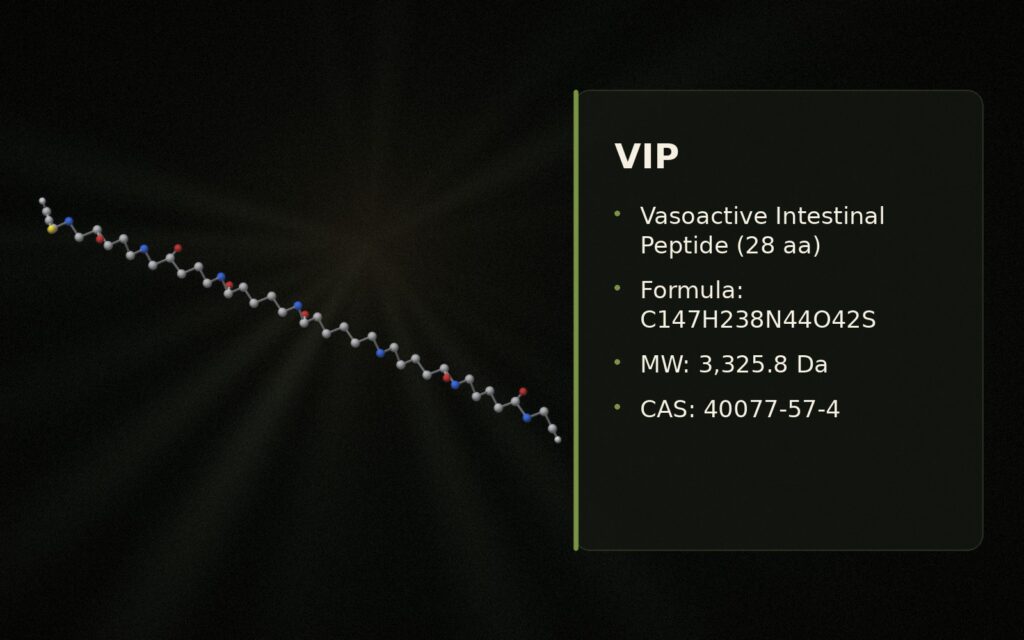
VIP is a linear, C-terminally amidated 28-amino-acid peptide. Reported physicochemical parameters (human/porcine/rat VIP share an identical sequence and are commonly supplied together by peptide reference suppliers) are summarized below:
| Property | Value |
|---|---|
| Common name | Vasoactive Intestinal Peptide (VIP) |
| Sequence | His-Ser-Asp-Ala-Val-Phe-Thr-Asp-Asn-Tyr-Thr-Arg-Leu-Arg-Lys-Gln-Met-Ala-Val-Lys-Lys-Tyr-Leu-Asn-Ser-Ile-Leu-Asn-NH₂ (HSDAVFTDNYTRLRKQMAVKKYLNSILN-NH₂) |
| Peptide length | 28 amino acids |
| Molecular formula | C₁₄₇H₂₃₈N₄₄O₄₂S |
| Molecular weight | ≈3,325.8 g/mol (reported ~3,325.7–3,325.9 across reference sources) |
| CAS number | 40077-57-4 |
| Peptide superfamily | Secretin/glucagon superfamily |
| Precursor gene | VIP (chromosome 6q25, human); prepro-VIP is co-processed into VIP and PHM-27 |
Researchers should note that molecular formula and mass figures for VIP vary slightly across databases and suppliers depending on whether the C-terminal amide, counter-ion form, or a truncated fragment (e.g., VIP 1-11 or VIP 6-28, used as receptor-fragment tools) is being described. The values above correspond to the full-length, C-terminally amidated native sequence and should be confirmed against a current Certificate of Analysis (CoA) for any specific lot obtained for research.
Proposed Mechanism of Action
VIP signals primarily through two class B (secretin-family) G protein-coupled receptors: VPAC1 and VPAC2, both of which VIP shares with PACAP (a related peptide with even higher receptor affinity at both subtypes). A third receptor, PAC1, binds PACAP preferentially and VIP with much lower affinity, and is generally considered a PACAP-selective receptor rather than a primary VIP target.
Receptor engagement is reasonably well characterized at the biochemical level, though translating that signaling into confirmed physiological and therapeutic outcomes in every tissue remains an active area of research:
- cAMP/PKA pathway: VPAC1 and VPAC2 are coupled to Gα stimulatory G proteins; ligand binding activates adenylate cyclase, raising intracellular cAMP and activating protein kinase A (PKA), which in turn phosphorylates downstream transcription factors such as CREB. This pathway underlies much of VIP’s smooth-muscle-relaxant and secretory effects.
- Circadian signaling: In the SCN, VPAC2 signaling has been identified in animal studies as necessary for normal synchronization of clock-gene oscillations between neurons; VPAC2-knockout mice display disrupted circadian behavioral rhythms, a widely cited finding in the chronobiology literature.
- Immunomodulatory signaling: In immune cells, VIP-VPAC signaling has been studied for effects on cytokine production (generally shifting cytokine profiles toward an anti-inflammatory pattern in various in vitro and animal models) and on T-cell differentiation and macrophage activation state.
- Neuroprotective signaling hypotheses: Preclinical work has proposed that VIP-VPAC signaling can support glial cell function and reduce neuronal apoptotic signaling in certain injury models, though — as with the other pathways above — this remains an active preclinical research area rather than a confirmed clinical mechanism.
Researchers should treat each of these as receptor-level and preclinical mechanistic findings, not as validated clinical mechanisms of therapeutic benefit in humans. VIP’s genuinely broad physiological distribution is precisely what makes rigorous, tissue-specific mechanistic study — and appropriately cautious interpretation of any single finding — important.
Research Findings
The VIP literature is large relative to most research peptides, reflecting its status as an endogenous signaling molecule studied since the 1970s. The summary below is organized by research level; readers should read cited study types (in vitro, animal, human) as boundaries on what can be concluded, not as interchangeable evidence for a single claim.
Smooth muscle and vasodilation: Foundational pharmacology studies (dating to VIP’s initial isolation and characterization) established VIP as a potent relaxant of vascular, gastrointestinal, tracheal, and gallbladder smooth muscle in isolated-tissue and animal preparations, along with measurable systemic vasodilatory and blood-pressure-lowering effects in animal models. This remains among the most robustly replicated areas of VIP pharmacology.
Circadian biology: Animal studies — most influentially in VPAC2-receptor-knockout mice — have demonstrated that VIP/VPAC2 signaling in the SCN is important for maintaining synchronized circadian gene expression across clock neurons and for normal circadian behavioral rhythms. This body of work is frequently cited in the chronobiology literature as a clear example of a neuropeptide with a defined role in mammalian clock synchronization, though it is basic-science circadian biology, not a validated intervention for human sleep or jet-lag disorders.
Immune modulation: A substantial in vitro and animal literature has examined VIP’s role as a self-produced immunomodulator, generally reporting anti-inflammatory shifts in cytokine profiles and effects on T-cell and macrophage activity in models of colitis, sepsis, and autoimmune inflammation. Some of this preclinical work has explored VIP or VIP-receptor-targeted compounds as a conceptual basis for future anti-inflammatory drug development — a line of pharmaceutical-industry research distinct from, and considerably more rigorous than, informal human “protocol” use discussed below.
Neuroprotection: A smaller preclinical literature has examined VIP’s effects in models of neuronal stress, ischemia, and neurodegeneration, generally reporting reduced markers of apoptosis or improved cell survival in vitro and in some animal models. This remains an early-stage, mechanistic research area.
Respiratory and pulmonary research: Because of its bronchodilatory and vascular effects, VIP and VIP-receptor agonists have been studied in preclinical and limited early-phase human pharmacology contexts related to pulmonary hypertension and asthma, generally as a basis for exploring VPAC-receptor-targeted drug candidates rather than establishing VIP itself as a therapeutic agent.
Alternative-medicine context (CIRS / “mold illness”): Outside the peer-reviewed basic-science literature, VIP has been promoted within functional- and alternative-medicine circles — most prominently through a protocol associated with physician Ritchie Shoemaker — as a treatment for “Chronic Inflammatory Response Syndrome” (CIRS), a diagnosis attributed to exposure to water-damaged buildings and mold biotoxins. This use is administered as a compounded intranasal spray in that community. It is important for researchers to understand this context accurately: CIRS is not a diagnosis recognized by the FDA or by major U.S. medical specialty societies, and the supporting evidence for VIP in this application consists primarily of small, open-label, non-randomized case series from a single research and clinical network (the largest frequently cited being a 2013 open-label study of roughly 20 patients), rather than independently replicated, peer-reviewed, placebo-controlled clinical trials. Advocacy sources cite large patient totals (frequently “10,000+”), but these figures represent practice-community and advocacy claims rather than data from a published multicenter registry or controlled trial. This article notes the CIRS/mold-illness context because it materially affects how VIP is discussed and sourced online — not because the evidence supports it as an effective or established treatment. Nothing in this article should be read as endorsing, recommending, or validating VIP for CIRS, mold-related illness, or any other human condition.
Evidence by Research Level
| Research Level | What’s Been Studied | Strength of Evidence |
|---|---|---|
| In vitro / isolated tissue | Smooth muscle relaxation, vasodilation, receptor binding pharmacology | Strong, well-replicated foundational pharmacology |
| Animal (circadian biology) | SCN clock-neuron synchronization via VPAC2 (e.g., VPAC2-knockout models) | Strong preclinical evidence for a defined chronobiological role |
| Animal / in vitro (immune) | Cytokine modulation, T-cell/macrophage activity in inflammation models | Moderate; consistent direction of effect, mechanism-focused |
| Animal / in vitro (neuroprotection) | Apoptosis markers, cell survival in injury models | Early-stage, preclinical only |
| Early human pharmacology (respiratory/vascular) | VPAC-receptor-targeted compounds in pulmonary hypertension, asthma research contexts | Limited, exploratory; basis for drug-development research, not an approved use |
| Human, alternative-medicine literature (CIRS/mold) | Small open-label case series, advocacy-network publications | Weak; non-randomized, unreplicated in independent peer-reviewed trials; not FDA-recognized |
Across every level, the same pattern holds: VIP’s foundational pharmacology and basic circadian/immune biology are genuinely well-supported by decades of peer-reviewed work, while claims of human therapeutic benefit for any specific condition — including CIRS — remain unsupported by rigorous, independently replicated clinical evidence.
U.S. Regulatory Status
VIP is not approved by the FDA as a drug for any indication and is not an ingredient in any FDA-approved prescription or over-the-counter product. It has no FDA-recognized therapeutic use, no Generally Recognized as Safe (GRAS) designation, and no approved consumer or dietary-supplement pathway.
VIP has also been directly and specifically evaluated by FDA in the pharmacy-compounding context. FDA’s own briefing materials for the Section 503A Bulks List — the list of bulk drug substances that compounding pharmacies may lawfully use absent an FDA-approved equivalent — included VIP among substances reviewed, and FDA’s determination was not to include VIP on that list, a position reflected in agency rulemaking materials from 2016 and again in 2019. Notably, FDA’s own review documentation specifically referenced VIP’s use for “Chronic Inflammatory Response Syndrome,” while making clear that this use is not FDA-approved. This is a meaningful, source-documented regulatory fact: the specific alternative-medicine application discussed above has been reviewed, by name, by the FDA — and FDA did not extend compounding-list status to VIP.
One further point of accurate distinction: unlike most synthetic research peptides sold under Research Use Only terms, VIP is a naturally occurring, endogenous human hormone. That biological fact does not change its regulatory status — it remains unapproved as a drug and outside the 503A compounding framework — but it is a genuine chemical and biological distinction worth noting accurately rather than treating VIP as identical, in origin, to a synthetic analog peptide.
For research suppliers and laboratories, the practical implication is straightforward: VIP should be sourced, handled, and represented strictly as a laboratory research compound for non-clinical, Research Use Only (RUO) applications, obtained and used under appropriate institutional review and biosafety protocols, and never marketed, sold, or represented as a human drug, supplement, nasal spray, or treatment for any condition. Vericor Bioscience supplies VIP, where available, exclusively under RUO terms consistent with this status.
Safety Profile & Unknown Risks
Because VIP has not been the subject of modern, adequately powered clinical safety trials for any indication, and because this article addresses laboratory research use rather than human administration, researchers should be aware of the following:
- No established human dosing framework exists for any research or clinical purpose. Reported administration parameters in the alternative-medicine literature (e.g., intranasal dosing schedules) come from uncontrolled, non-FDA-recognized protocols and should not be treated as validated pharmacological reference points.
- Endogenous hormone status complicates safety extrapolation. Because VIP is a hormone the body produces and regulates continuously, exogenous administration in any context (research animal models included) raises questions about feedback regulation, receptor desensitization, and systemic effects across multiple organ systems that are not fully characterized in the literature.
- Broad receptor distribution means broad potential off-target effects. VPAC1/VPAC2 receptors are expressed across the gut, cardiovascular system, lungs, immune cells, and CNS; any experimental administration model should account for this systemic distribution rather than assuming tissue-localized effects.
- Purity and characterization vary significantly by manufacturing source. As with other peptides in the compounding and research-supply markets, researchers should request and review a current Certificate of Analysis (CoA) before use in any experimental protocol.
- No FDA-reviewed safety dataset supports any human therapeutic use, including the CIRS/mold-illness context discussed above; researchers should not treat advocacy-network safety claims as equivalent to FDA-reviewed pharmacovigilance data.
Nothing in this article provides, or should be construed as, dosing guidance, administration instructions, or safety assurance for human use. VIP handling should occur exclusively within qualified laboratory settings, in compliance with institutional biosafety, chemical-handling, and animal-research protocols as applicable.
Research Evaluation Checklist
Researchers evaluating VIP as a subject, or evaluating claims made about it, may find it useful to work through the following:
- Confirm the evidence tier behind any specific claim. Distinguish foundational pharmacology (smooth muscle, circadian, immune) from unproven human application claims (e.g., CIRS/mold protocols).
- Separate “endogenous” from “clinically validated.” VIP being a naturally occurring hormone with genuine physiological roles does not, by itself, establish it as a safe or effective exogenous intervention for any human condition.
- Check whether a cited study is in vitro, animal, or human, and whether human data, where it exists, comes from a randomized, controlled, peer-reviewed trial or an uncontrolled case series.
- Verify regulatory framing accurately. VIP is not FDA-approved as a drug and was specifically evaluated and not included on the FDA’s Section 503A Bulks List, with FDA materials explicitly referencing its CIRS-related use as unapproved.
- Request a current Certificate of Analysis from any research supplier to confirm sequence identity, purity, and lot-specific characterization before use.
- Be skeptical of large, uncited patient totals in advocacy or marketing literature; treat such figures as unverified claims rather than published clinical data.
- Confirm institutional compliance — IRB/IACUC approval, biosafety protocols, and applicable research-use-only regulations — before any procurement or experimental use.
People Also Ask About VIP
Not entirely. Most catalog research peptides are synthetic compounds without a natural physiological role at typical research concentrations. VIP is different: it is a hormone the human body produces and uses continuously in the gut, brain, and immune system. That endogenous status gives VIP a larger basic-science literature but does not change its regulatory status as an unapproved drug substance outside clinical or consumer use.
There is no FDA-recognized diagnosis of “Chronic Inflammatory Response Syndrome,” and no independently replicated, peer-reviewed, placebo-controlled clinical trial has established VIP as an effective treatment for it. The supporting literature for this use consists of small, open-label case series from a single clinical/research network. FDA’s own compounding-review materials specifically identify this use as unapproved.
VIP is a 28-amino-acid, C-terminally amidated peptide with the sequence HSDAVFTDNYTRLRKQMAVKKYLNSILN-NH₂, molecular formula C₁₄₇H₂₃₈N₄₄O₄₂S, and a molecular weight of approximately 3,325.8 g/mol (CAS 40077-57-4).
No. VIP is not approved by the FDA for any indication and is not an ingredient in any FDA-approved drug product. It was also specifically reviewed for, and not included on, the FDA’s Section 503A Bulks List for pharmacy compounding.
VIP signals primarily through VPAC1 and VPAC2, class B G protein-coupled receptors that activate adenylate cyclase/cAMP/PKA signaling. It shares these receptors with PACAP, a structurally related peptide with higher affinity at both subtypes.
Because VIP/VPAC2 signaling in the suprachiasmatic nucleus (the brain’s master circadian clock) has been shown in animal studies to be important for synchronizing molecular clock activity across individual neurons, making VIP a well-established subject in basic chronobiology research.
Expert VIP Q&A
What’s the single most important distinction a researcher should understand about VIP before reading further into the literature?
That VIP is an endogenous hormone, not a synthetic research analog — and that this distinction cuts both ways. It means VIP’s basic physiological roles (smooth muscle, vasodilation, circadian signaling, immune modulation) rest on a genuinely large and credible peer-reviewed literature. It does not mean VIP is validated as a safe or effective exogenous therapeutic for any human condition, and researchers should not let the “it’s natural” framing substitute for clinical evidence.
How should researchers weigh the CIRS/mold-illness literature against the basic-science literature on VIP?
As categorically different evidence tiers. The basic-science literature (receptor pharmacology, circadian biology, immune signaling) is peer-reviewed, mechanistically grounded, and broadly replicated across independent labs. The CIRS-related literature is comparatively small, comes largely from a single clinical/research network, uses open-label rather than blinded designs, and has not been independently replicated in peer-reviewed, controlled trials. FDA’s own compounding-review documentation treats this application as unapproved.
Why does FDA’s 503A Bulks List determination on VIP matter for researchers?
Because it is a direct, source-documented regulatory fact rather than an inference. FDA reviewed VIP by name for inclusion on the list governing lawful compounding substances, referenced its CIRS-related use in that review, and did not include VIP on the list — in rulemaking materials from 2016 and again in 2019. Researchers citing VIP’s regulatory status should reference this specific determination rather than a general “not FDA-approved” statement alone.
Are there confirmed differences between VIP and PACAP that matter for interpreting the literature?
Yes. VIP and PACAP are structurally related members of the same peptide family and share the VPAC1/VPAC2 receptors, but PACAP additionally binds a third receptor, PAC1, with much higher affinity, and PACAP generally shows higher potency at all three receptors than VIP. Studies using nonselective agonists or older pharmacological tools sometimes attribute effects to “VIP-like signaling” that may be substantially PACAP-mediated; careful researchers should check which ligand and receptor subtype a given study actually used.
What would most improve the strength of VIP’s human evidence base going forward?
Independently conducted, adequately powered, randomized, placebo-controlled trials — particularly for any proposed anti-inflammatory or neuroprotective application — published in peer-reviewed journals with pre-registered protocols. The existing basic-science and receptor-pharmacology literature is a solid foundation; what is largely missing, especially in alternative-medicine contexts like CIRS, is rigorous, independently replicated human clinical data.
Conclusion
VIP occupies a genuinely distinct place among research peptides: a naturally occurring, endogenous 28-amino-acid hormone with a large, credible peer-reviewed literature spanning smooth muscle physiology, vasodilation, circadian biology, and immune signaling. That legitimate scientific foundation, however, does not extend to unproven human therapeutic applications that have circulated in alternative-medicine circles — most notably CIRS/”mold illness” protocols, which FDA’s own compounding-review materials explicitly reference while declining to include VIP on the Section 503A Bulks List. VIP is not FDA-approved for any indication, is not a treatment for any disease or condition, and should be treated strictly as a subject of laboratory and preclinical research, sourced and handled under Research Use Only terms.
Qualified researchers and institutions interested in VIP for laboratory, non-clinical research purposes can review current specifications, documentation, and Research Use Only terms on Vericor Bioscience’s VIP research product page.